
Disclaimer: This has been reported after the availability of the order of the Court and not on media reports, so as to give an accurate report to our readers.
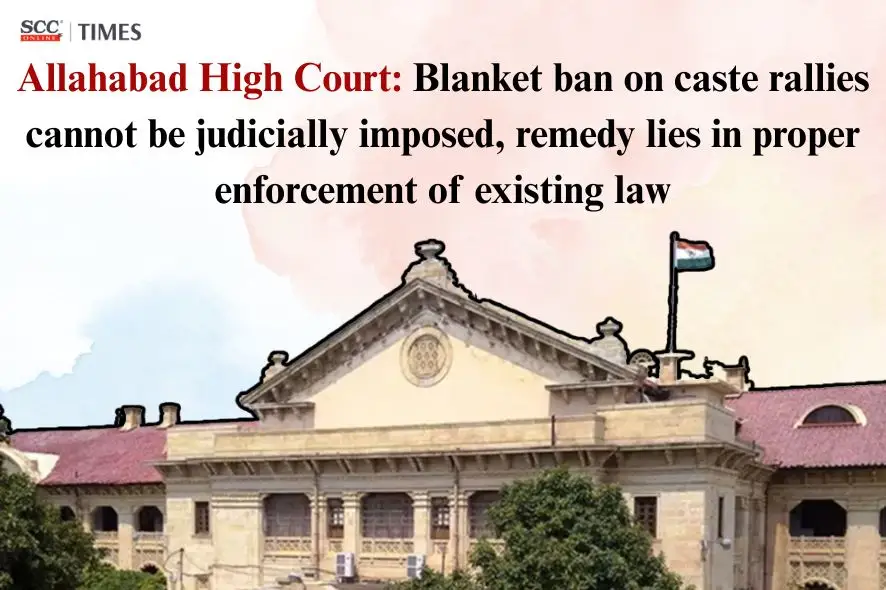
Allahabad High Court: In a Public Interest Litigation filed by the petitioner seeking directions to ban caste-based rallies, the Division Bench of Rajan Roy and Abdhesh Kumar Chaudhary, JJ., held that the existing constitutional and statutory framework already provides mechanisms to regulate such conduct during elections and otherwise. The Court declined to issue the sweeping mandamus sought and disposed of the petition, observing that further reforms fall within the legislative domain.
Background
The Public Interest Litigation was instituted by the petitioner seeking the Court’s regulatory intervention against caste-based political mobilisation. The grievance raised was that political parties frequently organise caste-centric rallies, such as the Brahmin Maha Sabha Rally, Yadav Rally, Chhatriya Rally, Kayastha Rally, and Vaish Sammelan, to consolidate electoral support along caste and religious lines. The petitioner contended that these practices undermine constitutional values of equality, fraternity and free and fair elections.
On this premise, the petitioner sought directions to the Election Commission of India(“ECI”) and other authorities to prohibit caste-based rallies, restrain candidates or parties from contesting elections if they divide voters on caste or religious lines, and cancel the registration of political parties found indulging in such activities.
Per contra, the respondents, including the ECI, submitted that adequate statutory and regulatory mechanisms already exist to address such concerns. It was contended that during the election period, the Model Code of Conduct (“MCC”) expressly prohibits appeals to caste or communal sentiments and authorises the ECI to take disciplinary and regulatory action.
Analysis
1. Whether the Court can issue a mandamus directing the ECI to impose a blanket ban on caste-based political rallies organised by political parties?
At the outset, the Court examined the scope of the powers vested in the ECI under Article 324 of the Constitution in conjunction with the Representation of the People Act, 1951 (“RPA”). The Court noted that the ECI’s regulatory authority becomes operational upon notification of elections and continues until their conclusion. During this period, the MCC expressly prohibits any appeal to caste or communal sentiment that aggravates the existing differences between communities or creates mutual hatred. The Court observed that, under paragraph no. 16-A of the Election Symbols (Reservation and Allotment) order, 1968, violations of the MCC might attract suspension or withdrawal of recognition, upon satisfaction of the ECI.
The Court further observed that the RPA itself treats appeals to caste or religion for securing votes as a “corrupt practice” under Section 123(3). Such allegations may be adjudicated in election petitions and, upon proof, may result in disqualification under Section 8-A or declaration of the election as void under Section 100 of the RPA. Consequently, the Act provides a proper legal mechanism to address electoral misconduct of this nature, and the issue is not unregulated in law.
Regarding the period when elections are not notified, the Court took note of a Government Order dated 21-09-2025 issued by the State prohibiting politically motivated caste-based rallies. The Court also noted another Government Order issued by the State for the implementation of the aforementioned one, and held that it was the duty of the State to periodically review, assess and take action to ensure effective implementation within the confines of Constitution and prevailing law.
Thus, the Court held that preventive measures addressing the concerns highlighted by the petitioner exist for both the election and non-election period. The Bench emphasised that the difficulty lies in the will to effectively enforce them, which falls within the domain of the Government concerned and the ECI, and not the judiciary. In light of this, the Court stated that the authority concerned may consider the recommendations proposed by the petitioner and the Amicus Curiae.
2. Whether individuals or political parties can be prohibited or disqualified from contesting elections on the ground that they attempted to create caste or religion-based divisions?
Addressing the petitioners’ prayer, the Court noted that no such disqualification presently exists in the RPA, except Section 8-A which entailed disqualification if a person or political party was found guilty of corrupt practice as per the RPA. The Court held that this issue also fell within the domain of the legislature and thus, the petitioner would have to approach the Legislature.
3. Whether the Election Commission possesses the power to cancel the registration or deregister the political parties for organising caste or religion-based rallies?
In this regard, he Court relied upon the decision of the Supreme Court in Indian National Congress v. Institute of Social Welfare, (2002) 5 SCC 685, wherein it was held that the ECI, while exercising powers under Section 29-A of the RPA, acts in a quasi-judicial capacity and does not possess the power to deregister political parties. Such power exists only in limited exceptions, such as attainment of registration by fraud or forgery, or amending the nomenclature of its association.
The Court also added that the recognition of a recognized political party could be suspended or withdrawn as per paragraph no. 16-A mentioned hereinabove.
Therefore, the Court held that the third relief seeking cancellation of party registration by the ECI was also legally untenable and the petitioner could pursue it with the Legislature.
However, the Court expresssed hope and trust that the authorities concerned would implement the existing provisions effectively. It also stated that a permanent solution to the problem of caste and communal divisions in society was the inculcation of proper values in the family and educational system of a child, in tandem with the social fabric of India and imbibing the spirit of Article 51-A(e) of the Constitution.
“Inculcation of right values at the appropriate stages of life, which the family system and the education system can do, will go a long way in curbing these parochial loyalties and encouraging a feeling of fraternity and mutual trust.”
The Court remarked that undoubtedly, formulation and effective implementation of the statutes play a pivotal role in curbing such narrow outlook, however, everything can’t be controlled and regulated by these statutes and laws.
“It is at all pyramidical levels that we need to work individually, as also through the society, and, where required, through the executive and the legislature concerned, to achieve our shared goal of nation building, as envisaged by our Constitution.”
Accordingly, the petition was disposed of
[Moti Lal Yadav v. Election Commission of India, 2026 SCC OnLine All 156, order dated 19-01-2026]
Advocates who appeared in this case:
For the petitioner: Petitioner in person and Advocate Rajat Rajan Singh
For the respondents: Anupriya Srivastava, Kaushlendra Yadav, Senior Advocate O.P. Srivastava, Additional Chief Standing Counsel Isha Mittal
Buy Constitution of India HERE