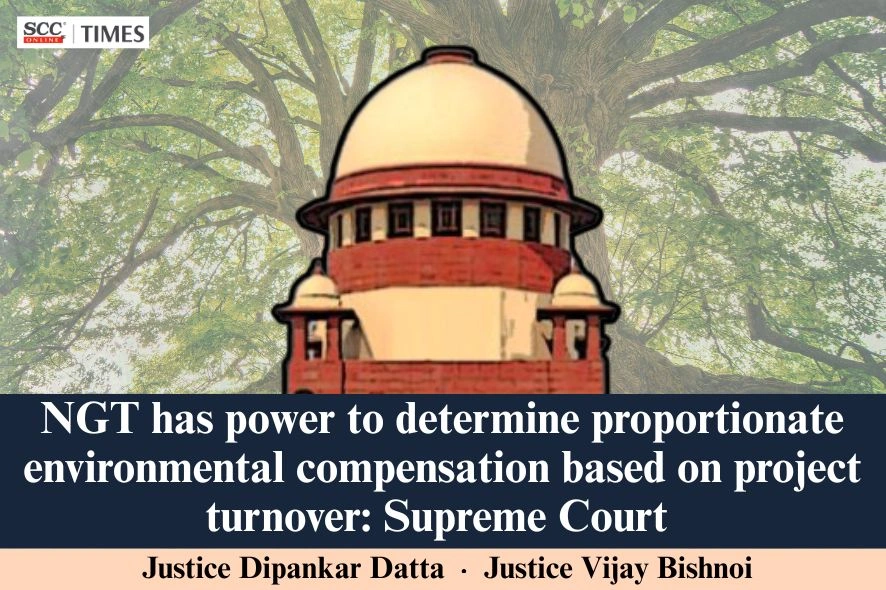
Supreme Court: In appeals arising out of two separate orders passed by the National Green Tribunal (NGT), regarding alleged violations of environmental laws by two real estate developers, appellants and imposing of compensation on them, a Division Bench of Dipankar Datta* and Vijay Bishnoi, JJ., held that there was no ground to interfere with the computation of environmental compensation imposed by the NGT in either appeal. The Court held that —
-
The NGT is not divested of authority to determine environmental compensation merely because no rigid statutory formula exists.
-
The NGT has statutory authority to employ project turnover as a relevant yardstick for the determination of environmental compensation.
-
Project cost or turnover may be used as a relevant factor, provided the compensation is rational, proportionate and reasoned.
-
The compensation imposed on both Rhythm County (Rs. 5 crores) and Key Stone Properties (Rs. 4,47,42,188/-) was neither arbitrary nor disproportionate.
Brief Facts
The appellant-M/s. Rhythm County undertook a residential and commercial project titled “Rhythm County” at Autade Handewadi, Pune. Environmental Clearance was granted on 27-11-2017 under the Environmental Impact Assessment Notification, 2006 for a built-up area of 1,45,682.28 sq. metres and construction commenced in 2018. Subsequently, the Maharashtra Pollution Control Board (MPCB) issued a show-cause notice alleging that construction had been carried out without valid statutory consents under the Water and Air Acts. By order dated 06-07-2020, Consent to Establish was refused and a stop-work direction was issued. A local resident filed an application before the NGT alleging that the project was being executed without valid clearances and in violation of environmental safeguards. A Joint Committee reported deviations from the sanctioned plan, including construction of a clubhouse not covered by the original Environmental Clearance and continuation of construction despite the stop-work direction.
Similarly, the appellant in second writ petition, M/s. Key Stone Properties, undertook a residential housing project at Survey No. 16/3, Punawale, Pune. Construction activity commenced prior to obtaining prior Environmental Clearance. Thereafter, under the notification dated 14-03-2017 providing for regularisation of violation cases, the project proponent applied for post-facto Environmental Clearance, which was granted on 24-012020 subject to conditions, including preparation and implementation of a remediation plan and a natural and community resource augmentation plan. The cost of remediation was assessed at Rs. 1.76 crores and a bank guarantee of the said amount was furnished. Consent to Establish was granted on 17-08-2020 and Consent to Operate on 01-02-2022. In the meantime, a local resident filed an application before the NGT alleging that the project was being carried out in violation of environmental norms. A Joint Committee found that the project had been executed for long periods without Consent to Establish and Consent to Operate, that construction had continued despite a closure notice, and that possession had been handed over without requisite statutory permissions.
Proceedings before the NGT
On consideration of the Joint Committee reports, the NGT held that both project proponents had violated environmental norms. In the case of M/s. Rhythm County, compensation was enhanced from Rs. 2.39 crores (as suggested by the Joint Committee) to Rs. 5 crores, relying on Goel Ganga Developers India (P) Ltd. v. Union of India, (2018) 18 SCC 257. In the case of M/s. Key Stone Properties, environmental compensation was quantified at Rs. 4,47,42,188/-. Aggrieved by the imposition and quantification of compensation, both project proponents filed appeals before the Supreme Court.
Moot Points
-
Whether, in the absence of a legislatively prescribed framework for quantification of environmental compensation, the NGT could enhance compensation on the basis of project cost or turnover?
-
Whether the NGT, in exercise of its powers under Sections 15, 17 and 20 of the National Green Tribunal Act, 2010 (NGT Act), is competent in law to adopt project cost or turnover as a relevant yardstick for computation of environmental compensation?
Court’s Analysis
The Court emphasised that the powers conferred upon the NGT are “by legislative design, wide, flexible, and principle-oriented”. The Court noted that Section 15 of the NGT Act empowers the Tribunal to grant “relief and compensation” and “restitution of the environment”. The Court underscored that Parliament had consciously employed language of “considerable amplitude”, particularly the expression “as the Tribunal may think fit”, thereby reposing discretion in the Tribunal to mould relief commensurate with the nature and gravity of environmental harm. This discretion, however, is not unguided, as Section 20 mandates application of the principles of sustainable development, precautionary principle and polluter pays principle.
The Court rejected the contention that in the absence of a fixed statutory formula, compensation could not be imposed and stated that environmental compensation jurisprudence does not admit of a uniform or straitjacket formula “the statutory scheme vests the NGT with the discretion to mould the relief guided by the ‘polluter pays’ principle, having due regard to the scale of the offending activity and the capacity of the violator.”
Addressing the challenge to the use of project cost or turnover as a metric, the Court observed that scale of operations bears a direct nexus to environmental footprint. The Court noted that “bigger operations signify a bigger footprint” and that where a project proponent profits from scale, it is logical that it bears proportionate responsibility for environmental costs. The Court described the contention that turnover or project cost can never be a relevant factor as “fallacious”.
Relying on Goel Ganga Developers (Supra), the Court reiterated that this Court has, in cases of flagrant environmental violations, treated 5% of project cost as a general guiding benchmark, though not as an inflexible ceiling. The Court held that project cost can be a relevant yardstick. The Court stated that in Rhythm County’s case, the compensation of Rs. 5 crores was “barely 1.49% of the project cost” and could not be characterised as excessive. The Court held that such compensation could “neither be characterised as arbitrary nor disproportionate, much less unreasonable”.
“The NGT cannot be held to be divested of its statutory authority to employ project turnover as a relevant yardstick for the determination of environmental compensation.”
With respect to Key Stone Properties, the Court found that the NGT had distinguished between violations already regularised and “separate statutory infractions relating to prolonged construction without CTE, continuation of activities despite closure directions and occupation without CTO”. The Court upheld the use of the CPCB methodology and observed that the framework is “facilitative and indicative, and not as a rigid or exhaustive code”.
The Court rejected the argument that the NGT abdicated its adjudicatory role and noted that the record demonstrated that the NGT was “alive to the limited role of expert bodies” and had independently applied its mind to both liability and quantum. The Court held that acceptance of expert inputs does not amount to surrender of judicial function.
Ultimately, the Court held that environmental compensation must be rational, proportionate and reasoned. While turnover or project cost cannot be used as a blunt instrument, they remain relevant and permissible factors where the factual matrix so warrants. The Court held that the determinations made by the NGT, in both cases, fell within the “permissible zone of judicially recognised discretion”.
“The NGT cannot be held to be divested of its statutory authority to employ project turnover as a relevant yardstick for the determination of environmental compensation.”
Court’s Decision
The Supreme dismissed the appeal on not finding ground to interfere with the impugned computation of environmental compensation. The Court extended the time to pay the compensation by three months and directed the parties to bear their own costs.
[M/s. Rhythm County v. Satish Sanjay Hegde, 2026 SCC OnLine SC 126, Decided on 30-01-2026]
*Judgment by Justice Dipankar Datta