
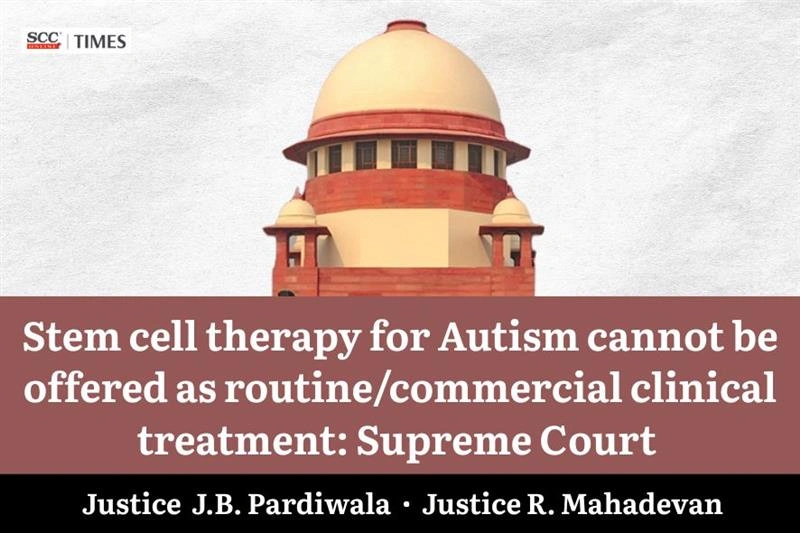
Supreme Court: In a Public Interest Litigation (PIL) raising serious concerns regarding the rampant promotion, prescription and administration of stem cell “therapy” for Autism Spectrum Disorder (ASD) by clinics across the country, the Division Bench of J.B. Pardiwala* and R. Mahadevan,* JJ., held that Stem cell therapy for treatment of Autism cannot be demanded by a patient as a matter of right. The Court further held that —
-
Stem cells administered for ASD, though falling within the definition of “drugs”, cannot be offered as a clinical service merely on that basis.
-
Administration of an intervention, lacking credible scientific evidence or not recommended by authoritative bodies, violates the standard of care owed by medical practitioners.
-
Stem cell therapy for Autism cannot be offered as a routine or commercial clinical treatment.
-
Patient consent does not legitimise an unproven treatment in the absence of adequate information.
-
Therapeutic use of stem cells in ASD is permissible only within approved and monitored clinical trials.
The Court directed the Secretary, Ministry of Health and Family Welfare, in consultation with AIIMS and the National Medical Commission, to evolve a mechanism so that patients already undergoing therapy could be re-routed to approved clinical trial institutions, while discontinuation should not be abrupt.
Factual Matrix
The instant matter pertains to rampant promotion, prescription and administration of stem cell “therapy” for ASD by clinics across the country. The petitioners contended that although stem cell therapy was still at an experimental stage, it was being touted as a “treatment” or “cure” for ASD in flagrant violation of the existing legal framework and guidelines.
It was alleged that parents and caregivers, unaware of scientific and legal intricacies, placed implicit faith in such clinics in the hope of a miraculous cure and were subjected to cost-intensive procedures without safety nets available in regulated clinical trials.
Reference was made to parliamentary material showing that 59 entities were engaged in offering stem cell therapy, though the number of treated patients was not centrally maintained.
During pendency of the present case, significant regulatory developments took place, including recommendations dated 06-12-2022 by the Ethics & Medical Registration Board (EMRB) of the National Medical Commission (NMC); dissolution of the National Apex Committee for Stem Cell Research & Therapy (NAC-SCRT) and interim orders of the Delhi High Court in Dalip Kaur v. Union of India permitting continuation of ongoing treatment on patient-autonomy grounds.
Moot Points
-
Whether doctors/clinics/hospitals/institutions are legally permitted to offer stem cell ‘therapy’ as a routine healthcare service?
-
Whether the Drugs Act, 1940 and the NDCT Rules, 2019 provide a framework for the regulation of research in stem cell therapies which are used for the treatment of ASD?
Court’s Analysis
Maintainability of present PIL
The Court rejected the allegation that the petition was motivated by commercial rivalry. The Court observed that even if there existed “underlying commercial competition amongst the service providers of various modes of treatment, it does not discredit the petition’s main concern”, namely, the confusion surrounding the regulatory framework governing stem cell therapies.
On a perusal of the pleadings and materials, the Court found that the petition raised “an issue of public importance” touching the rights of a vulnerable population. The Court found the petitioners to be bona fide and held that “no personal grievance is sought to be addressed through the present petition” and therefore, the PIL is held maintainable.
Nature of Stem Cell ‘Therapies’ in ASD
At the outset, the Court noted that there is no statutory definition of the term “therapy” under the Drugs Act, 1940 or the Rules framed thereunder and therefore turned to the scientific and ethical guidance documents issued by the ICMR and the Department of Health Research.
Relying on Chapter 5 of the Evidence Based Status of Stem Cell Therapy for Human Diseases, 2021, the Court recorded that the so-called therapies involved administration of various types of stem cells—embryonic, cord blood, bone marrow—derived, autologous mononuclear cells—through multiple routes including intravenous, intrathecal and spinal methods. The Court asserted that this diversity “clearly underscores that therapeutic use of stem cells in ASD is undertaken in the form of administering stem cells”, and is not a uniform or settled clinical practice.
The Court made it clear that classification as a ‘drug’ is not determinative of permissibility. Even if certain stem cells fall outside the definition of a “new drug”, that alone does not justify their administration as a clinical service.
Standard of Care and Medical Ethics
The Court reiterated that “every medical practitioner owes to his patient a duty to exercise a reasonable degree of care, skill, and knowledge expected of a prudent medical practitioner in the same field.” This standard, drawn from Indian Medical Association v. V.P. Shantha, Jacob Mathew v. State of Punjab, (2005) 6 SCC 1 and reaffirmed in M.A. Biviji v. Sunita, (2024) 2 SCC 242 requires conformity with the principle that a doctor’s conduct must conform to a “practice acceptable to the medical profession of that day” when “judged in the light of the knowledge available at the time of the incident”.
The Court emphasised that a line of treatment must be “sound and relevant medical practice” and “not a discarded or obsolete category in any circumstance.”
Accordingly, if an intervention is characterised by scientific or regulatory authorities as unproven, experimental or lacking justification, it cannot be defended as an exercise of reasonable care. The Court held that stem cell therapy for ASD squarely fell within this category.
“If a treatment is characterised by the relevant scientific community or regulatory authorities as unproven, experimental, obsolete, or lacking justification, such a treatment cannot be defended as an exercise of due care and reasonable judgment by a medical practitioner.”
Scientific and Regulatory Position
The Court placed decisive reliance on expert and regulatory material, particularly, EMRB (NMC) Recommendations dated 06-12- 2022; ICMR’s Evidence Based Status of Stem Cell Therapy for Human Diseases, 2021 and National Guidelines for Stem Cell Research, 2017.
The EMRB expert committee had found that “there is as yet insufficient and inadequate scientific evidence on efficacy of the SCT in ASD. Therefore, SCT cannot be recommended as a treatment for ASD” and concluded that “Stem cell therapy is not recommended as a treatment for Autism Spectrum Disorder (ASD) in clinical practice… use of stem cell in ASD, its promotion and advertisement will be considered as professional misconduct.”
The Court noted that these recommendations were approved by the National Medical Commission and thus constituted authoritative guidance on professional conduct. The Court further relied upon the ICMR’s finding that “critical review of the studies reported so far do not support the use of stem cell therapy over and above the behavioural and supportive therapies for ASD.”
From above-discussed scientific and regulatory position, the Court concluded that therapeutic use of stem cells in ASD does not meet the threshold of a practice acceptable to the medical profession.
Distinction between ‘Drug’ and ‘Therapy’
The Court rejected the argument that autologous stem cell therapy escapes regulation merely because it is a “procedure” and not a “drug.” The Court asserted that “though autologous stem cells… may not meet the criteria of being a ‘new drug’ under the NDCT Rules, 2019, yet they fall under the broader definition of ‘drugs’ in the Drugs Act, 1940.” Therefore, the Court held that statutory protections under biomedical research regulation must apply.
Consent and Patient Autonomy
The Court firmly rejected the argument that patient autonomy under Article 21 justified stem cell therapy and held that autonomy cannot validate an unproven intervention.
“A treatment cannot be demanded by a patient as a matter of right.”
Referring to Samira Kohli v. Prabha Manchandra, (2008) 2 SCC 1, the Court underlined that adequate information is the bedrock of valid consent. The Court observed that since stem cell therapy for ASD does not fulfil the essentials of “adequate information,” consent is vitiated by “therapeutic misconception.” It held that “such choice does not amount to a valid consent to undergo the treatment due to the lack of ‘adequate information’ to form its basis.”
Thus, the Court held that the voluntary participation cannot legitimise what is professionally impermissible.
Permissibility Only in Clinical Trial Setting
Synthesising these strands, the Court held that “Stem cell ‘therapies’ for ASD cannot be offered by medical practitioners as a clinical service, outside an approved and monitored clinical trial/research setting.”
The Court clarified that although autologous stem cells may not qualify as “new drugs” under the NDCT Rules, 2019 but “all stem cells fall within the purview of ‘drugs’ as ‘substances’ under Section 3(b)(i) of the Drugs Act, 1940.”
Accordingly, Chapter IV of the NDCT Rules, 2019 (Biomedical and Health Research) provides the appropriate regulatory pathway, ensuring safeguards such as ethics approval, monitoring, and compensation.
Court’s Suggestions
The Court expressed serious concern over executive inaction and observed that “it is unfortunate that the Union has let the matter worsen without any suitable and timely intervention.” The Court stated that the absence of clear regulatory enforcement had led parents to seek “an unproven method of treatment… incurring huge financial cost.”
Accordingly, the Court suggested —
-
Consolidation and clarification of the legal position at the earliest;
-
Creation of a dedicated regulatory authority for stem cell research and therapies across the country;
-
Revival or reconstitution of an apex oversight body (such as NAC-SCRT) for coherent supervision.
-
Enactment of a comprehensive legislative framework clarifying approval procedures, monitoring mechanisms, compensation regimes and penalties for violations.
-
Research participants should not be charged for experimental therapies and must receive compensation in case of injury or death.
-
Non-compliance of the statutory mandate must attract consequences viz. professional misconduct under Regulation 7.22 of the IMC Regulations, 2002 as well as action under Sections 32 and Section 40 respectively, of the Clinical Establishments (Registration and Regulation) Act, 2010, which provide for the cancellation of registration and penalty.
Court’s Decision
Recognising the predicament of patients already undergoing therapy, the Court directed the Ministry of Health and Family Welfare, in consultation with AIIMS and the NMC, to devise a solution enabling continuity until patients can be re-routed to approved clinical trial institutions, while reiterating that commercial continuation was impermissible.
[Yash Charitable Trust v. Union of India, 2026 SCC OnLine SC 131, Decided on 30-01-2026]
*Judgment by Justice J.B. Pardiwala and Justice R. Mahadevan