



Introduction
Daughters’ property rights under Hindu law have undergone a transformative shift with the Hindu Succession (Amendment) Act, 2005. For decades, daughters were excluded from coparcenary rights in ancestral property, a position rooted in patriarchal interpretations of Mitakshara law. The constitutional values such as equality and dignity guaranteed by Articles 14, 15, and 21 of the Constitution were eroded by this imbalance. Acknowledging this, the Hindu Succession (Amendment) Act, 2005 (‘2005 Amendment’), made a unique modification by amending Section 6 of the Succession Act to give daughters the status of a coparcener by birth, just as the sons. However, the change did not resolve legal disputes on its own as the Courts struggled with issues of retrospective versus prospective effect and interpretations of the amended text, until the Supreme Court’s historic ruling in Vineeta Sharma v. Rakesh Sharma, (2020) 9 SCC 1, which strongly supported the amendment’s gender-neutral goal.
What is Ancestral Property
According to Hindu law, property that is passed down from four successive generations of the male lineage and that remains undivided over the course of several generations is referred to as ancestral property. In Maktul v. Manbhari, 1958 SCC OnLine SC 155, the Court defined ancestral property as regards sons to mean property inherited from a direct male lineal ancestor and as regards collaterals the property inherited from a common ancestor. Under the Mitakshara school of law, the allocation of ancestral property is based on the rule of survivorship. Whenever a coparcener died in the joint family property or coparcenary property, his interest got merged with that of the surviving coparceners.1
Ancestral property does not include self-acquired property, property received by gift or will, or property inherited from maternal ancestors. Furthermore, the share that each member receives when ancestral property is divided, loses its ancestral character and becomes their self-acquired property.2
Read Also: Ancestral Property: Key Supreme Court Rulings You Should Know
Daughters’ Property Rights -Position before Hindu Succession (Amendment) Act, 2005
Before the 2005 Amendment in the Succession Act, there was a clear distinction between coparcenary property and self-acquired property. A father, his sons, grandsons, and great-grandsons comprised a group of coparceners in a Hindu Undivided Family (‘HUF’) administered by the Mitakshara school, but notably, they were all male. A daughter was not eligible to be a coparcener, rather she had the same status as a ‘member’ who was born without any inherent rights to ancestral property.3 The doctrine of survivorship caused the ancestral property to pass automatically to male heirs upon the father’s death. For this reason, daughters were not eligible to be the HUF’s Karta; could not seek partition; and were not regarded as members of the coparcenary in the economic sense.
This legal restriction was founded on the outdated notion that once a daughter was married off, she became a member of her husband’s family and lost her tie to her parents’ property. In reality, this approach continued women’s financial dependence while promoting traditional and unequal gender roles, disregarding the constitutional guarantee of gender equality.
Earlier, the devolution used to take place by survivorship as provided under the old Section 6 of the Succession Act4. Upon the death of a male coparcener, his undivided interest passed on to the surviving male coparceners unless the proviso to Section 6 applied. As per the proviso, if the deceased coparcener left behind certain Class-I female heirs, his interest would not devolve upon the surviving coparcener by survivorship but upon his heirs by intestate succession as per Section 8 of the Succession Act. However, this would not mean that the daughter had a birthright in the coparcenary property.5
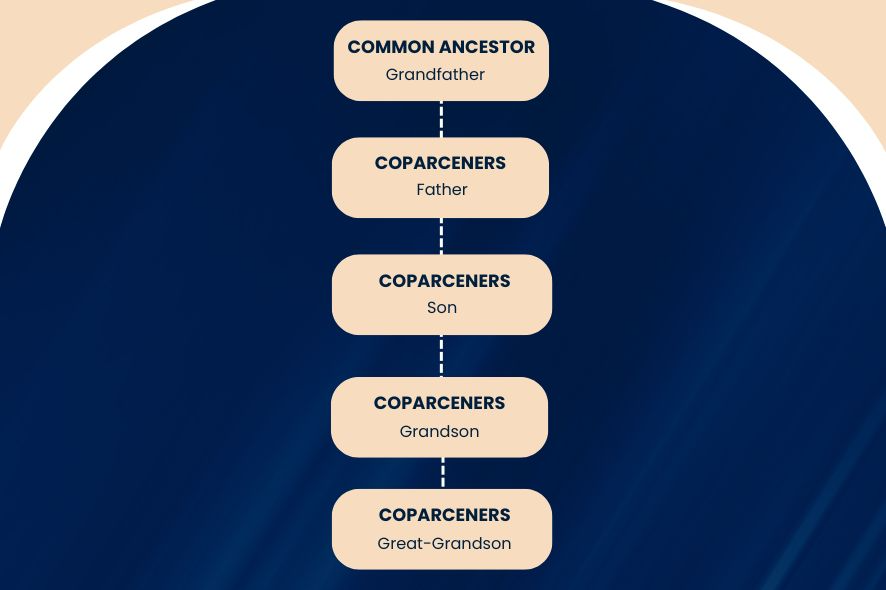
Fig. Coparceners before the Amendment
Issues under the Old Law -Why a change was needed
By not giving daughters the birthright in ancestral property, the law delayed, if not eliminated, women’s claims, leaving them exposed to familial pressures, abandonment, and exclusion. Such exclusion put women at disadvantage when compared to their male siblings in a society where property forms the foundation of social and economic security. Therefore, the amendment was required in the Succession Act in order to:
- Eliminate discrimination based on gender in Hindu succession laws and grant daughters equal ownership rights over ancestral property.
- Align Hindu personal law with the equality and non-discrimination principles set forth in Articles 14 and 15 of the Constitution.
- Acknowledge daughters as coparceners by birth.
- Guarantee women’s financial stability and economic empowerment and to reflect evolving societal realities in which women make equal contributions to the family.
-
Stop the exclusion of daughters on the grounds that marriage sever their connection from their birth family.
2005 Amendment – What changed for Daughters’ Property Rights
The 174th Law Commission Report6 extensively discussed the gender disparity present in the old Act and remarked that “the retention of the Mitakshara coparcenary without including females in it meant that females cannot inherit ancestral property as males do. If a joint family gets divided, each male coparcener takes his share and females get nothing. Only when one of the coparceners dies, a female gets a share of his share as an heir to the deceased. Thus, the law by excluding the daughters from participating in coparcenary ownership (merely by reason of their sex) not only contributed to an inequity against females but has led to oppression and negation of their right to equality and appears to be a mockery of the fundamental rights guaranteed by the Constitution”.
A significant change was thus made to Section 6 of the Succession Act by the Hindu Succession (Amendment) Act, 2005 which provided that “the daughter of a coparcener shall by birth become a coparcener in her own right in the same manner as the son”. This text was drafted to put daughters on an equal footing with sons and overcome gender bias in coparcenary rights. Daughters, married or unmarried, could now claim a share in the ancestral property. The 2005 Amendment gave the daughters the same rights in the ancestral property as the sons enjoyed and they were also subjected to the same liabilities.
Section 6(5) provided a savings clause stating that — “Nothing contained in this section shall apply to a partition, which has been effected before the 20th day of December 2004”. Meaning thereby, that nothing contained in Section 6 would affect or invalidate any disposition, alienation, partition or will made before 20-12-2004. The amendment also defined other legal heirs like the surviving child of the predeceased son or a predeceased daughter, child of predeceased child of the predeceased son or a predeceased daughter.
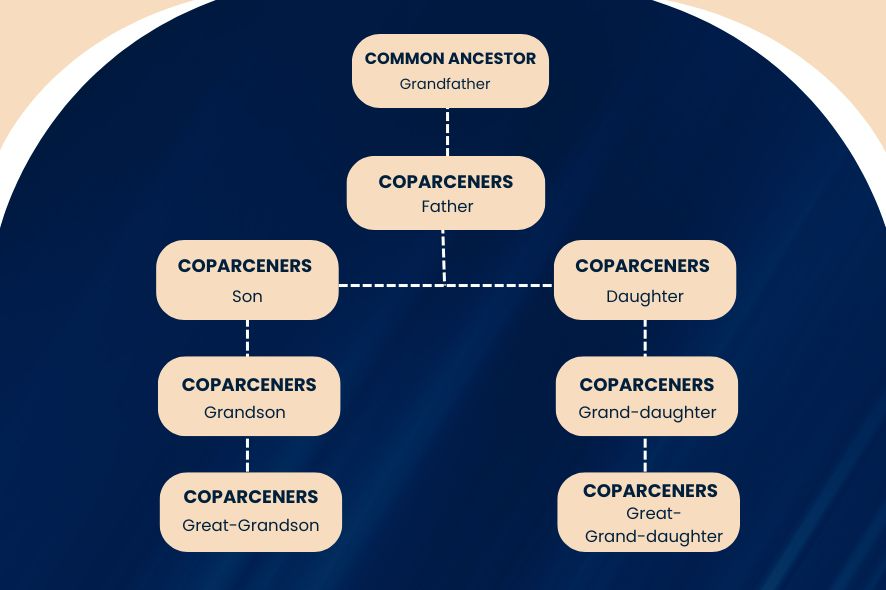
Fig. Coparceners after the 2005 Amendment
Daughters’ Property Rights after 2005 Amendment
The change effected by the 2005 Amendment has been a step towards attaining gender equality because giving daughters the status of coparceners brought about cultural and financial enhancement in the position of the women. If the daughter ever faced a problem in their matrimonial home, she now had the option of coming back to her own home, where she had a share in her father’s property as a matter of right.
The Amendment had the following impact7:
- Daughters can claim coparcenary rights whether they are born before or after the date of Amendment, even though the rights are effective from 9-9-2005.
- Daughter has right to joint possession and she can use the property.
- Daughters can also be a Karta or Manager of the HUF if they are the senior-most coparcener, which was earlier limited to male members.
- Daughters can demand partition and alienate her share. Her claim is tested like the other partition claims, i.e., proving title, establishing the nature of property, evidence of any concluded partition and stage of any pending suits.
- Only partition made by execution of a deed or by a Court’s decree are recognised.
- With effect from 9-9-2005, Section 4(2) of the 2005 Amendment which dealt with the Succession Act’s non-applicability to statutes pertaining to preventing the fragmentation of agricultural holdings; fixing ceilings; or devolution of tenancy rights with regard to such holdings, has been omitted.
-
Sections 23 and 24 of the Succession Act which talked about restriction on seeking partition of dwelling house and disability of widows to succeed if they remarried, respectively, are deleted.
Landmark Supreme Court Judgments on Daughters’ Property Rights
Preliminary decree can be modified to grant daughter her rightful share – Ganduri Koteshwaramma v. Chakiri Yanadi, (2011) 9 SCC 788
A preliminary decree was passed by the Court in relation to a Hindu Joint Family. The suit was still pending, when the 2005 amendment came into force giving the daughters the status of a coparcener. The daughters, who were left out from the partition, sought their recognition as coparceners and claimed their share in the subject property. The Supreme Court held that:
“The new Section 6 provides for parity of rights in the coparcenary property among male and female members of a joint Hindu family on and from September 9, 2005.”
The substantive rights accorded to the daughters, making her a coparcener by birth, were recognised by the Court, and she was subjected to the same rights and liabilities as that of a son. Further, the Court opined that “the right accrued to a daughter in the property of a joint Hindu family governed by Mitakshara law, by virtue of the 2005 Amendment Act, is absolute, except” where a disposition or alienation, including a partition, or a testamentary disposition had taken place before 20-12-2004.
The Court noted that the partition was not effected before 20-12-2004 and it was not even done by means of a registered partition deed or by the Court’s decree. The Court clarified that a preliminary decree determines the rights and interests of the parties, but the suit continues until the final decree is passed. It was further observed that:
“If after passing of the preliminary decree and before the final decree is passed, supervening circumstances occur necessitating change in shares, there is no impediment for the court to amend the preliminary decree or pass another preliminary decree.”
Accordingly, the Supreme Court restored the Trial Court’s order which has held that the daughters were entitled for re-allotment of shares in the coparcenary property and ordered the Trial Court to proceed for the preparation of final decree. It established that a preliminary decree does not reflect a final partition.
Both father and daughter need to be alive on 9-9-2005 – Prakash v. Phulavati, (2016) 2 SCC 36
The dispute arose when the daughter sought partition claiming coparcenary rights under the 2005 Amendment, even though her father had died in 1988 before the amendment came into force. The main issue was whether the 2005 Amendment would have retrospective effect.
The Supreme Court held that the 2005 amendment is prospective, conferring coparcenary rights only if both the daughter and her father were alive on the date of commencement of the amendment, i.e., 09-09-2005. A concept of ‘living coparcener’ was propounded in this case, which meant that since the father was not alive when the amendment was enforced, the daughter could not claim rights.
The Court observed that:
“An amendment of a substantive provision is always prospective unless either expressly or by necessary intendment it is retrospective. In the present case, there is neither any express provision for giving retrospective effect to the amended provision nor a necessary intendment to that effect.”
Daughters whether born before or after 1956 can assert their rights – Danamma v. Amar, (2018) 3 SCC 343
The case arose from a partition suit filed by the grandson. The grandfather had died in 2001 leaving behind his widow, two sons, and two daughters as his legal heirs. Both, the Trial Court and the High Court held that the daughters did not have a share in the property as they were born before the Succession Act and were therefore not coparceners. It was even argued that they relinquished their share as they were married. The main issue in this case was whether the daughters could be denied a share in the property on the ground that they were not coparceners as they were born prior to the Succession Act’s enactment.
The Supreme Court while reversing the findings held that:
“This amendment now confers upon the daughter of the coparcener as well the status of coparcener in her own right in the same manner as the son and gives same rights and liabilities in the coparcener properties as she would have had if she had been a son.”
The Court clarified that a daughter would hold property to which she is entitled as a coparcenary property which would be construed as property being capable of being disposed of by her either by a will or any other testamentary disposition.
The Court remarked that:
“These changes have been sought to be made on the touchstone of equality, thus seeking to remove the perceived disability and prejudice to which a daughter was subjected.”
The Court went a step further from Prakash (supra) and observed that the 2005 Amendment granted coparcenary status to daughters and such right was not extinguished by a father’s subsequent death. But it did not answer the question whether the father needed to be alive when the amendment came into force.8
DEFINING VERDICT on Daughters’ Property Rights – Vineeta Sharma v. Rakesh Sharma, (2020) 9 SCC 1
In 2020, the Supreme Court reconsidered both Prakash (supra) and Danamma (supra) and noted the divergence of opinion with respect to the aspect of living daughter of a living coparcener. Regarding Prakash (supra), the Court clarified that:
“It is not necessary to form coparcenary or to become a coparcener that a predecessor coparcener should be alive; relevant s birth within the degrees of coparcenary to which it extends.”
The Court disagreed with the concept of ‘living coparcener’ as laid down in Prakash (supra) and opined that the daughters should be living on 9-9-2005. The Court pointed out that the substituted Section 6 did not talk about ‘daughter of a living coparcener’, rather the right was given to the daughter by birth. The Court expressly overruled Prakash (supra).
As far as Danamma (supra) was concerned, the Court clarified that the daughter’s coparcenary rights exists by birth. If a daughter is alive on the date of enforcement of the Amendment Act, she becomes a coparcener with effect from the date of the Amendment Act, irrespective of the date of birth earlier in point of time. Consequently, the Court partly overruled Danamma (supra) to the extent it was contradictory to Vineeta Sharma (supra).
The Court emphasised that:
“The conferral of right is by birth, and the rights are given in the same manner with incidents of coparcenary as that of a son and she is treated as a coparcener in the same manner with the same rights as if she had been a son at the time of birth.”
CURRENT SCENARIO
Tribal woman’s entitlement over equal share in ancestral property – Ram Charan v. Sukhram, 2025 SCC OnLine SC 1465
While considering an appeal wherein the Court had to deliberate that whether a tribal woman (or her legal heirs) would be entitled to an equal share in her ancestral property or not; the Division Bench of Sanjay Karol* and Joymalya Bagchi, JJ., opined that, unless otherwise prescribed in law, denying the female heir a right in the property only exacerbates gender discrimination, which the law should ensure to weed out. Therefore, in keeping with the principles of justice, equity and good conscience, read along with the overarching effect of Article 14 of the Constitution, the Court held that in the instant case, since the Plaintiffs were D’s (Tribal woman heir) legal heirs, they are entitled to their equal share in the property of their maternal grandfather. Read More HERE
SC clarifies review principles; quashes Madras HC review on daughter as coparcener – Malleeswari v. K. Sugna, 2025 SCC OnLine SC 1927
While considering an appeal wherein the Division Bench of Ahsanuddin Amanullah and S.V.N. Bhatti*, JJ., had to consider the validity of Madras High Court’s impugned decision to remand the matter related to the Appellant’s status as a co-parcener in a partition suit to the Trial Court. The Court upon perusing the impugned order, delved into relevant precedents detailing the distinction between the power of review and appellate power and restated the power and scope of review jurisdiction, thereby summing up the grounds for Review. Read More HERE
Daughter’s right to inherit ancestral property before 2005 Amendment and validity of settlement deed – Prasanta Kumar Sahoo v. Charulata Sahoo, (2023) 9 SCC 641
In two interrelated Civil Appeals challenging the judgment, order and decree passed by Division Bench of Orissa High Court affirming the Trial Court’s decision allowing cross-objection invalidating settlement deed entitling the daughters to share in scheduled properties, the Division Bench of J.B. Pardiwala* and A.S. Bopanna, JJ., upheld the two Court’s decision and modified the same to the extent of entitling daughters to 1/3rd share in all the scheduled properties. Read more HERE
Practical Application of Law and Ruling
Scenario 1:
Suppose a Hindu father has two children — a son and a daughter. He owns an ancestral property. Unfortunately, he passed away in 2003, and no partition took place until then. In 2005, the Amendment was enacted which gave daughters a birth right in the ancestral property. Now, the daughter could claim an equal share in her father’s ancestral property on par with her brother’s claim. If a partition suit is filed, the property will be divided equally between them, and each will receive one-half share. Prior to the verdict in Vineeta Sharma (supra), it could have been argued that the daughter had a limited right as the father was not alive when the 2005 Amendment was enforced. However, the Supreme Court in Vineeta Sharma (supra) clarified that daughters have rights by birth in their father’s property irrespective of the father’s survival in 2005.
Scenario 2:
However, in Scenario 1, if a valid partition would have taken place before 20-12-2004, then that would have been final, and the daughter would not be able to claim her share in her father’s property.
Scenario 3:
Suppose a family asserts that an oral family settlement or oral partition was reached in 2003. However, it was never reduced to writing, registered, or upheld by a decree. Thus, there is no written proof that the property was divided.
For the above situation, mere assertion of some family agreement that took place orally would not defeat the rights guaranteed to a daughter under Section 6 of the Succession Act as amended in 2005. A partition must be carried out by a decree passed by a competent Court or by a registered partition deed before 20-12-2004 for it to be legally recognised. Coparcenary is deemed to continue unless a valid partition takes place. Therefore, any oral family agreements entered into before 2005 are immaterial and cannot take away a daughter’s right to assert and enforce her share in the ancestral property.
Scenario 4:
Based on a family’s alleged oral settlement, a preliminary decree for partition was passed by the Court in 2003, prior to the amendment in 2005. The suit was pending as the proceedings did not culminate in a final decree. In such a case, the mere issuance of a preliminary decree is not the conclusive determination of the partition and does not finally establish the rights of the parties. Until the partition becomes final, the Courts have the power to review and modify the shares as declared in the preliminary decree, in order to stay in consonance with the changes in law or any further legal developments that might take place.
Accordingly, upon the 2005 Amendment coming into effect, the Court is competent to re-calculate the shares of the heirs and issue a fresh or modified preliminary decree acknowledging daughter’s equal share, as she now has coparcenary rights by birth. A preliminary decree which is based on an oral settlement cannot negate the daughter’s half share, especially when the partition is not yet final. Therefore, the Court must ensure that the daughter’s coparcenary rights under the amended law are fully incorporated before the final decree is passed.
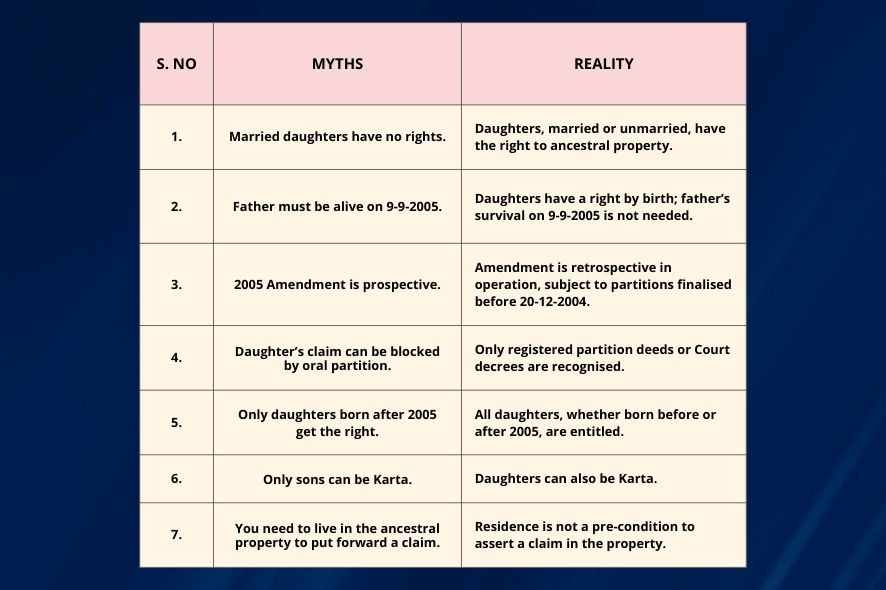
Bursting Common Myths around Daughters’ Rights in Property
Frequently Asked Questions (FAQs)
-
Do married daughters have a share in the ancestral property?
A daughter’s coparcenary rights exist by birth, and her marital status does not affect her right. Such a right is not extinguished by marriage.
-
Does Section 6 of the Hindu Succession Act, 1956 apply only to ancestral or coparcenary property?
Yes. Section 6 applies only to ancestral property. In case of self-acquired property, if the father dies intestate, daughters can inherit just like the sons as they are Class-I heirs.
-
Should the father be alive on 9-9-2005?
No. It has been clarified in Vineeta Sharma (supra), that the father need not be alive for the daughter to assert her rights as her rights are not dependent on her father’s survival.
-
Is the Hindu Succession (Amendment) Act, 2005, prospective in operation?
No. The Amendment has retroactive operation and applies to daughters born even before it came into force i.e. 9-9-2005, provided no partition is concluded before 20-12-2004.
-
If an oral family settlement happens before 20-12-2004, will it affect the daughter’s right?
A daughter’s right is not affected if the family settlement is oral. Only a registered partition deed or a Court’s decree remains unaffected.
-
If the Court passed a preliminary decree in 2003, can the daughter claim her share?
Yes, the daughter can claim her share. The Court can pass a fresh preliminary decree to reflect the amended law.
-
Can partitions finalised before 2004 be reopened by the daughter?
No. If a partition is finalised by a registered partition deed or by a decree passed by a competent Court, before 20-12-2004, the daughter cannot reopen the partition to assert her right.
-
Will the daughter have to bear family debts?
The debts are to be satisfied by all the coparceners, and daughters bear equal liabilities attached to the ancestral property.
-
Can a daughter born before 2005 claim a share?
The daughter’s coparcenary rights are by birth and therefore, unless there is no concluded partition before 20-12-2004, she can claim a share in the ancestral property.
-
Can the father will away his ancestral property to exclude his daughter?
Since devolution is by succession and not by survivorship, a coparcener can only will away his undivided share. Thus, the father cannot bequeath the entire ancestral property to defeat his daughter’s birth right.
-
Will the amendment apply to adoptive daughters?
Yes. The amendment is applicable to both natural born daughter as well as adoptive daughters, whether they were adopted before or after the amendment.
-
Can daughters be Karta?
Yes. Earlier only the eldest male member of the family could be the Karta, but since the 2005 Amendment came into force, daughters can also be the Karta, provided she is the senior-most coparcener.
-
For a daughter to claim a share in the coparcenary property, does she need to live in it?
No. Residence is not a pre-condition for the daughter to assert her rightful claim in the coparcenary property.
-
Can only a financially dependent daughter put forward a claim?
No. Financial status of a daughter has no relevance in matters of coparcenary shares.
Conclusion
The regulations pertaining to inheritance and succession influence families’ economic foundation rather than being merely technical clauses in a statute. Earlier, sons were at the centre of the coparcenary system of joint family property. Coparcenary rights now accorded to daughters refer to the legal acceptance and parity treatment of sons and daughters in joint family systems when it comes to inheriting ancestors’ property.9 The 2005 Amendment to the Succession Act placed daughters on an equal footing with sons by recognising their status as coparceners by birth in ancestral property.
The key takeaways are:
- Daughters are coparceners by birth with equal rights and liabilities as sons.
- Daughters’ rights are by birth – not by the father’s death.
- Partitions and transactions concluded prior to 20-12-2004 not affected.
-
Oral partitions do not affect daughter’s rights.
A daughter’s right to coparcenary property is ancestral, automatic, and unconditional. Vineeta Sharma (supra) cemented this transformation when it held that it was immaterial whether the father was alive on 09-09-2005 as the daughter’s rights flow from birth itself. The Supreme Court has paved way to advance gender justice and to ensure that women can fully realise their property rights as daughters.10
1. Tracing the root of women’s property and recent developments under Hindu law, 2.3 JCLJ (2022) 310
2. https://economictimes.indiatimes.com/wealth/legal/will/ancestral-vs-inherited-property-key-hindu-succession-rules-every-family-must-know-in-2025/what-is-not-ancestral-property/slideshow/124841260.cms
3. Madhubala Sheokumar Shukla, Coparcenary Rights of Women: A Journey from Non-Existence to Full Existence, Vol. 11 Issue 4, International Journal of Research (IJR) < https://zenodo.org/records/11209133 >
4. http://www.scconline.com/DocumentLink/7stFp3DE, Read FN 6
5. Id. at 170
6. http://www.scconline.com/DocumentLink/N5gyaXFt
7. Madhubala Sheokumar Shukla, Coparcenary Rights of Women: A Journey from Non-Existence to Full Existence, Vol. 11 Issue 4, International Journal of Research (IJR), p.173 < https://zenodo.org/records/11209133 >
8. Ritesh Dhar Dubey, Critical Analysis of Interpretation of Succession Rights of Women Post Prakash v. Phulavati Judgment, Vol. 13 Issue 3 International Journal of Creative Research Thoughts, p. g145 < IJCRT2503705.pdf >
9. Daughters as Coparceners : A Step towards Gender Equality, 4.1 JCLJ (2023) 607
10. Id. at g149






If daughter had died before partition their children are entitled to get share in ancestral property?
A daughter death in 2000 then his legal heairs claim in her mothers father ancestors property
Good
Best understanding of daughter’s rights in ancestral property and elaborately discussing the march of law.. Kudos