


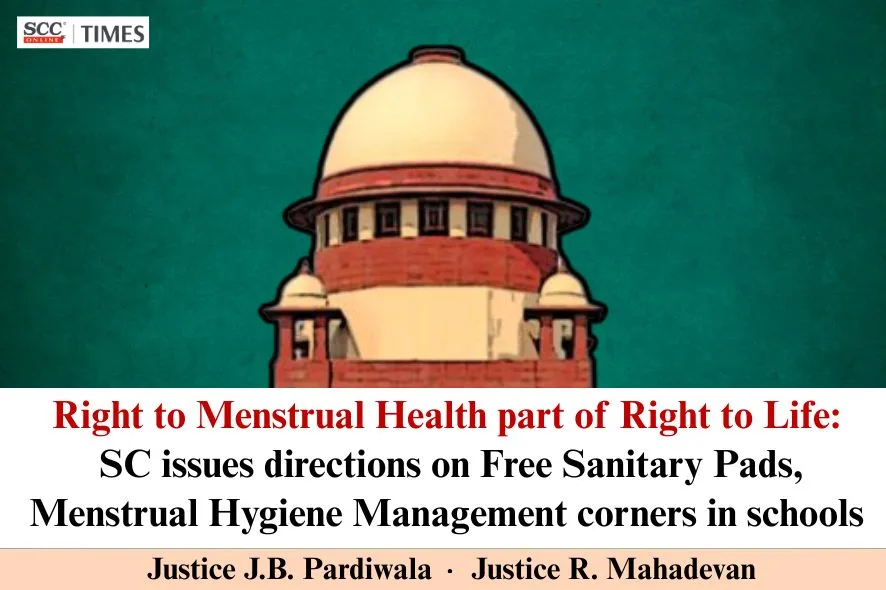
Supreme Court: While considering this writ petition seeking appropriate directions for providing free sanitary pads to every schoolgirl and separate toilets for females in all government aided and residential schools and other consequential reliefs, the Division Bench of J.B. Pardiwala and R. Mahadevan, JJ.*, held that the right to education is a ‘multiplier right’ as it enables exercise of other human rights. Right to education forms part of the broader framework of the right to life and human dignity, which cannot be realized without access to education. The Court further concluded that inaccessibility of menstrual hygiene management measures undermine the dignity of a girl child and that the right to life under Article 21 of the Constitution includes the right to menstrual health.
“Access to safe, effective, and affordable menstrual hygiene management measures helps a girl child attain the highest standard of sexual and reproductive health. The right to healthy reproductive life embraces the right to access education and information about sexual health”.
With the afore-stated significant conclusions, the Court gave the following directions:
For ensuring “toilet and washing facilities”, the Court directed that:
-
All States and Union Territories shall ensure that every school, whether Government-run or privately managed, in both urban and rural areas, is provided with the functional, gender-segregated toilets with usable water connectivity.
-
All the existing and newly constructed toilets in schools shall be designed, constructed, and maintained so as to ensure privacy and accessibility, including by catering to the needs of children with disabilities.
-
All school toilets shall be equipped with functional handwashing facilities, with soap and water available at all times.
As regards the “availability of menstrual absorbents”, the Court directed that:
-
All States and Union Territories shall ensure that every school, whether Government-run or privately managed, in both urban and rural areas, provides oxo-biodegradable sanitary napkins manufactured in compliance with the ASTM D-6954 standards free of cost. Such sanitary napkins shall be made readily accessible to girl students, preferably within the toilet premises through sanitary napkin vending machines, or, where such installation is not immediately feasible, at a designated place or with a designated authority within the school.
-
All States and Union Territories shall ensure that every school, whether Government-run or privately managed, in both urban and rural areas, establish Menstrual Hygiene Management (MHM) corners. Such MHM corners shall be equipped with, including but not limited to, spare innerwear, spare uniforms, disposable bags, and other necessary materials to address menstruation related exigencies.
For “disposal of sanitary waste”, the Court directed that:
-
All States and Union Territories shall ensure that every school, whether Government-run or privately managed, in both urban and rural areas, is equipped with a safe, hygienic, and environmentally compliant mechanism for the disposal of sanitary napkins, in accordance with the latest Solid Waste Management Rules.
-
Each toilet unit shall be equipped with a covered waste bin for the collection of sanitary material, and cleanliness and regular maintenance of such bins shall be ensured at all times.
For ensuring “awareness and training about menstrual health and puberty”, the Court directed that:
-
NCERT and State Council of Educational Research and Training (SCERT) shall incorporate gender responsive curricula, more particularly, on menstruation, puberty, and other related health concerns (PCOS, PCOD, etc.), with a view to break stigma and taboo associated with menstrual health and hygiene.
-
All teachers, whether male or female, shall be adequately trained and sensitized on menstrual hygiene, including appropriate ways of supporting and assisting menstruating students.
-
Information regarding the availability of Jan Aushadhi Suvidha Oxo-Biodegradable Sanitary Napkin shall be widely disseminated through advertisement in social media, print media, radio advertisement, TV advertisement, cinema advertisement, and outdoor publicity like bus queue shelter branding, bus branding, auto wrapping, wall paintings.
-
The child helpline set up by the National Commission for Protection of Child Rights in furtherance of Rule 26 of the RTE Rules be disseminated forthwith through social media, print media, radio advertisement, TV advertisement, cinema advertisement, etc.
Given the gravity of the issue and for ensuring substantial compliance with the directions, the Court issued a continuing mandamus.
Background:
The writ petition was filed by a social worker for necessary directions to the Government free sanitary pads to every female child studying between classes 6 & 12; separate toilet for females in all government aided and residential schools and other consequential reliefs including the maintenance of toilets and the spread of awareness programmes.
Issues Framed:
-
Whether unavailability of gender-segregated toilets and nonaccess to menstrual absorbents could be said to be in violation of the right to equality for adolescent girl students under Article 14 of the Constitution?
-
Whether the right to dignified menstrual health could be said to be part of Article 21 of the Constitution?
-
Whether unavailability of gender-segregated toilets and non-access to menstrual absorbents could be said to be in violation of the right of participation and equality of opportunity as constitutional guarantees enshrined under Article 14 of the Constitution?
-
Whether unavailability of gender-segregated toilets and nonaccess to menstrual absorbents could be said to be in violation of the right to education under Article 21A, and the right to free and compulsory education under the Right of Children to Free and Compulsory Education Act, 2009?
Court’s Assessment:
Perusing the petition, the Court delved into what menstrual poverty or period poverty means. The Court explained that menstrual poverty refers to the financial burden and obstacles that women face in affording menstrual hygiene, or sanitary products because they are unable to maintain such expenditure. The Court identified that the issue of lack of menstrual hygiene management (MHM) in schools across the country has two-fold dimensions- first, absenteeism; and secondly, completely dropping out of school due to lack of MHM measures.
Delving in depth into the issues framed, the Court stated that Education is a fundamental human right, as it ensures full and holistic development of a human being. Right to education is not confined to the physical existence or formal availability of schools. It extends to the ability of a child to participate in education in a meaningful, continuous, and non-discriminatory manner. The Court pointed out that several research have indicated that the lack of sanitation facilities in schools hindered the ability of girls to manage menstruation healthily, safely, and with dignity. The grimly noted that the availability of water for cleaning and flushing of toilets still remains a major concern. Accessibility of MHM measures provides the same opportunities for all students in school, while recognizing unequal distribution of resources with the objective to attain equal access to human rights. The responsibility of the State is further heightened in the case of a child with disability, as the intersection of disability with gender compounds the disadvantage faced during menstruation. The Court highlighted that for a menstruating girl child who cannot afford menstrual absorbents, the disadvantage is two-fold. First, vis-à-vis menstruating girl children who can afford menstrual absorbents. Secondly, vis-à-vis male counterparts or non-menstruating counterparts. Further, when the menstruating girl child is also a child with disability, she is not merely facing disadvantages arising from menstrual poverty but is additionally subjected to other disadvantageous consequences flowing from the intersection of gender and disability.
The Court added that the fundamental right to education under Article 21A and the RTE Act comprises free, compulsory, and quality education. Free education includes all kinds of charges or expenses that would prevent a child from pursuing and completing elementary education.
Holding that Right to Menstrual Hygiene is an integral part of Article 21 of the Constitution, the Court opined that all schools, whether run by the appropriate Government or privately managed, must act in accordance with the norms and standards laid down in Section 19. In case of a school not established, owned, or controlled by the appropriate Government or the local authority is found to be in contravention of the provisions of the RTE Act, it would be de-recognized and the consequences therefrom would follow. Insofar as a school established, owned, or controlled by the appropriate Government or the local authority is found to be in contravention of the provisions of the RTE Act, the State would be held accountable.
Notably, the judgment also dedicated a section on the Role of Men in Menstruation. The Court opined that menstruation should not be a topic that is only shared in hushed whispers. It is crucial that boys are educated about the biological reality of menstruation. A male student, unsensitized towards the issue, may harass a menstruating girl child which may discourage her from attending school. Furthermore, male teachers must be sensitized to the needs of a girl child. “Time is over ripe that we recognize menstrual health as a shared responsibility rather than a woman’s issue. Awareness must not be limited to girls, but extends to boys, parents, and teachers. When menstruation is discussed openly in schools, it ceases to be a source of shame. It is recognized as what it is, a biological fact. Needless to say, it must be seen as a collective effort rather than a constitutional pull”.
Additional Important Directions:
-
Court directed the District Education Officer (DEO) to conduct periodic inspections, preferably once in a year, of school infrastructure, particularly with regard to toilet and washing facilities, availability of menstrual absorbents, sanitary waste disposal mechanisms and training/awareness measures undertaken by the concerned school. DEO must mandatorily obtain anonymous feedback in the form of a tailored survey from the students themselves.
-
Action taken by the DEO must be in accordance with Section 18 of the RTE Act read with Rule 16 of the RTE Rules. For the purpose of ensuring that transparency and accountability is fixed on part of both the DEO and the concerned school respectively, the DEO must annex a copy of the report of the periodic inspection and a copy of the consolidated responses received from the student survey along with the notice which is to be issued under Rule 16(1)(a) of the RTE Rules.
-
The Court requested National Commission for Protection of Child Rights (NCPCR) and the State Commission for Protection of Child Rights (SCPCR), to oversee the implementation of the aforesaid directions. In case of noncompliance, the NCPCR and SCPCR shall take necessary steps as provided under Sections 15 and 24 of the Commissions for Protection of Child Rights Act, 2005.
-
The Court clarified that the Directions issued in the Judgment along with the Union’s Menstrual Hygiene Policy for School Girls, shall operate as mandatory standards in addition to the steps being taken by the States through its policies, schemes, programmes etc.
“This pronouncement is not just for the stakeholders of the legal system, it is also meant to be for the classroom where girls hesitate to ask for help, it is for the teachers who want to help but are restrained due to lack of resources, and it is for the parents who may not realize the impact of their silence, and for the society to establish that progress is measured how we protect the most vulnerable. We wish to communicate to every girl child, who might have become a victim of absenteeism because her body was perceived as a burden, that the fault is not hers. These words must travel beyond the courtroom, law review reports, and reach the everyday conscience of society at large”.
[Dr. Jaya Thakur v. Government of India, 2026 SCC OnLine SC 133, decided on 30-1-2026]
*Judgment by Justice J.B. Pardiwala and Justice R. Mahadevan
Advocates who appeared in this case :
For Petitioner(s): Mr. Varun Thakur, Adv. Mr. Deepak Goel, Adv. Mrs. Tanuj Bagga Sharma, Adv. Mr. Ramkaran, Adv. Ms. Shraddha Saran, Adv. Mr. M.K. Ravi, Adv. For M/s.Varun Thakur & Associates, AOR
For Respondent(s): Mrs. Aishwarya Bhati, A.S.G. Ms. Archana Pathak Dave, A.S.G. Mr. Amrish Kumar, AOR Mr. Veer Vikrant Singh, Adv. Mr. Rohit Pandey, Adv. Ms. Shradha Deshmukh, Adv. Mr. Manish Kumar, AOR Mr. Ravi Shanker Jha, Adv. Mr. Arjun D Singh, Adv. Ms. Ankita Sharma, AOR Mr. Guntur Pramod Kumar, AOR Ms. Prerna Singh, Adv. Mr. Dhruv Yadav, Adv. Mr. Abhimanyu Tewari, AOR Ms. Eliza Barr, Adv. Ms. Swati Ghildiyal, AOR Mr. Prashant Bhagwati, Adv Ms. Devyani Bhatt, Adv. Ms. Neha Singh, Adv. Mr. Vaibhav Srivastava, A.A.G. Ms. Sugandha Anand, AOR Mr. Nishe Rajen Shonker, AOR Mrs. Anu K Joy, Adv. Mr. Alim Anvar, Adv. Ms. Mrinal Gopal Elker, AOR Mr. Abhimanyu Singh, Adv. Mr. Mukesh Kumar Verma, Adv. Ms. Chhavi Khandelwal, Adv. Dr. Ravindra Chingle, Adv. Mr. Siddharth Dharmadhikari, Adv. Mr. Aaditya Aniruddha Pande, AOR Mr. Pukhrambam Ramesh Kumar, AOR Mr. Karun Sharma, Adv. Mr. Indrajit Prasad, Adv. Ms. Rajkumari Divyasana, Adv. Mr. Avijit Mani Tripathi, AOR Mr. T.K. Nayak, Adv. Ms. Marbiang Khongwir, Adv. Mr. Daniel Lyngdoh, Adv. Mr. Upendra Mishra, Adv. Mr. P.S. Negi, Adv. Mr. Siddhesh Shirish Kotwal, AOR Ms. K. Enatoli Sema, AOR Ms. Limayinla Jamir, Adv. Mr. Amit Kumar Singh, Adv. Ms. Chubalemla Chang, Adv. Mr. Prang Newmai, Adv. Mr. Karan Sharma, AOR Mr. Akshat Kumar, AOR Ms. Anubha Dhulia, Adv. Mr. Amit Anand Tiwari, Sr. A.A.G. Mr. Sabarish Subramanian, AOR Ms. Devyani Gupta, Adv. Mr. Vishnu Unnikrishnan, Adv. Ms. Tanvi Anand, Adv. Mr. C Kranthi Kumar, Adv. Mr. Saushriya Havelia A, Adv. Mr. Danish Saifi, Adv. Mr. Sravan Kumar Karanam, AOR Mr. Aniket Singh, Adv. Mr. Shuvodeep Roy, AOR Ms. Madhumita Bhattacharjee, AOR Ms. Srija Choudhury, Adv. Mrs. Aishwarya Bhati, A.S.G. Mrs. Archana Pathak Dave, A.S.G. Ms. Shradha Deshmukh, Adv. Mr. Veer Vikrant Singh, Adv. Mr. Rohit Pandey, Adv. Mr. Raman Yadav, Adv. Mr. Jagdish Chandra Solanki, Adv. Mr. Piyush Beriwal, Adv. Ms. Kanu Agrawal, Adv. Mr. Vatsal Joshi, Adv. Mr. Harish Pandey, Adv. Mr. Varun Chugh, Adv. Mr. Krishna Kant Dubey, Adv. Ms. Mrinal Elkar Mazumdar, Adv. Ms. Sansriti Pathak, Adv. Mr. Apoorv Kurup, Adv. Mr. Shreekant Neelappa Terdal, AOR Mr. Mukesh Kumar Maroria AOR


I want to express deep respect and appreciation for the SCC Online blog post on the Supreme Court’s recognition of the right to menstrual health as part of the right to life under Article 21 of the Constitution, because this landmark development not only affirms menstrual hygiene as a fundamental condition of human dignity, health, and equality but also underscores the need for tangible action, from providing free biodegradable sanitary products and gender-segregated, accessible toilets in all schools to incorporating awareness and training that breaks long-standing taboos, while holding both government and private institutions accountable for ensuring that adolescent girls can participate in education with dignity, safety, and equal opportunity.