


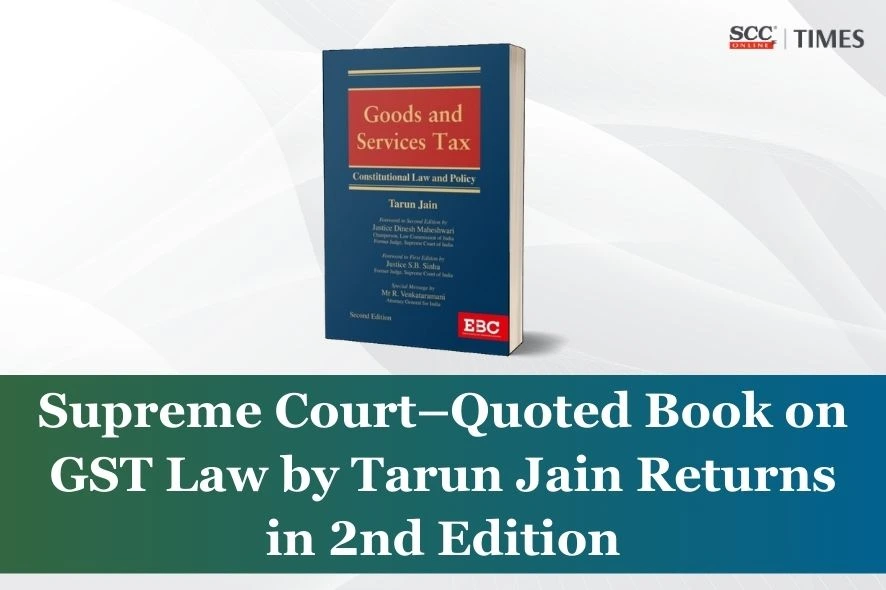
The second edition of Goods and Services Tax: Constitutional Law and Policy by Tarun Jain has been released recently. This book on GST Law explains the constitutional law and policy behind GST in a clear and structured manner. It traces the evolution of the constitutional amendment and the policy journey that led to the introduction of GST. The core portion provides a provision-wise analysis of the Constitution Amendment Act, covering policy background, the 2011 and 2014 Amendment Bills, parliamentary debates, and developments after enactment. The book also explains the key legal and economic concepts forming the foundation of GST, making it a valuable guide for understanding the constitutional framework of GST.
Why was this book written?
Passing of the GST law marked a tectonic shift in constitutional, legal and fiscal spaces and gave life to a largely neglected specie of Federal Governance the world over, when it occasioned the movement of the world’s largest democracy on the path of Cooperative Federalism.
There is an acute shortage of scholarly analysis, particularly in the context of cooperative federalism in fiscal space. World over no country has ever experimented, at this scale, with shared exercise and implementation of fiscal powers by the federal and provincial units. Undeterred, India has moved on this experiment which on a pragmatic plane, and it carries the potential to influence the consumption pattern of each and every individual in the country. The success of this regime hinges upon a delicate balance constantly required to be maintained by both the federal and provincial units, aligning their policy and actions to the last detail. The ground implementation of GST on this count alone, therefore, provides for an intriguing space for constitutional and administrative law experts.
The author has written this authoritative work to bridge the gap in legal scholarship on this topic. The book aims to provide a nuanced constitutional and policy-oriented analysis of GST, supported by references to GST legislation for practical understanding, while recognising that such legislation reflects—but does not define—the full scope of constitutional provisions.
What is the structure of this book on GST Law?
The book is structured into four main sections that together provide a comprehensive appraisal of the constitutional and policy framework underlying the Goods and Services Tax (GST) in India.
The first part offers an introduction to the constitutional amendment process that led to GST, outlining the evolution of the reform, the key stakeholders involved, and the role their views played in shaping the current GST design.
The second part undertakes a detailed, provision-wise examination of the Constitution Amendment Act. Each chapter analyses the background policy discussions, the 2011 and 2014 Amendment Bills, parliamentary debates, committee reports, post-enactment developments, and finally presents an integrated analysis linking these elements with existing constitutional and statutory provisions. This approach enables both a detailed and holistic understanding of the amendment in the broader GST context.
The third part provides a cross-sectional analysis of the legal and economic concepts that form the conceptual foundation of GST as a tax on the supply of goods and services. Although not explicitly addressed in the Constitution Amendment Act, these concepts are integral to GST’s design and interpretation. Drawing, inter alia, on comparative jurisprudence such as that of the European Court of Justice, the section highlights the importance of design-led interpretation in resolving complexities and ambiguities in fiscal law.
The fourth part, presented as an appendix, compiles key documents that are essential for understanding the historical, policy, and interpretative dimensions of the GST regime and the Constitution Amendment Act.
Why you need to buy the 2nd edition of this book
The following updates have been added to the second edition of this seminal work
-
A new chapter has been introduced in Part I, presenting reflections from the working of the GST Council.
-
In Part II, the chapter on the State of Jammu and Kashmir has been omitted, with relevant constitutional case updates integrated into the discussion.
-
In Part III, the chapter on “Special Area Tax Schemes and Special Economic Zones” has been dropped, reflecting how the “one nation, one tax” paradigm has diminished area-specific tax considerations. The chapter on “Fiscal Neutrality” has been significantly revised to capture recent judicial treatment of this central tenet of the GST framework.
-
Part IV introduces a new analytical section on landmark Supreme Court decisions that illuminate key aspects of GST’s constitutional design and legislative challenges.
-
Part V has been restructured to replace statutory text with historic constitutional documents, thereby realigning the Appendix with the book’s overarching theme of tracing the evolution and constitutional philosophy underlying the GST regime.
Quoted by Supreme Court in a judgment
The first edition of this book was quoted by Supreme Court in the cases of Union of India v. Mohit Minerals Pvt Ltd, (2022) 10 SCC 700
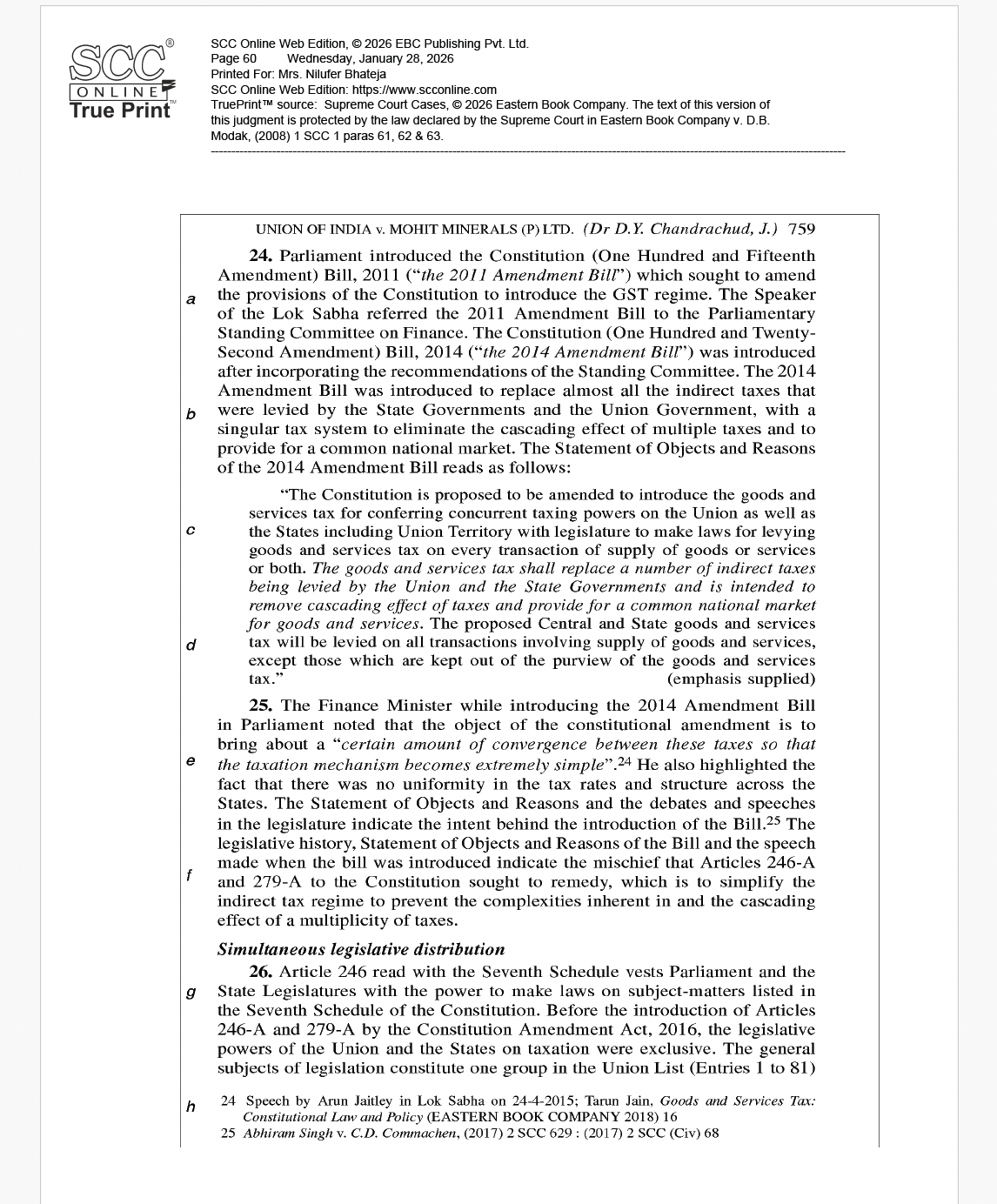
The first edition was also cited by the Kerala High Court in in Sheen Golden Jewels (India) (P). Ltd. v. STO, 2019 SCC OnLine Ker 973 decided on 11-01-2019 (Ker HC). The Court said,
“Tarun Jain’s Goods and Services Tax, already copiously quoted, observes that in constitutional terms, GST is unique because of these aspects of its design: 1. It provides for the concurrent exercise of taxing powers by the Centre and the States on the same subject—a unique and unprecedented measure. 2. Both the Centre and the States are to act in tandem based on the GST Council’s recommendations.”
Praise for the book by legal luminaries
No wonder that the first edition of this work, released soon after the enactment of the GST laws, found wide acceptance in the legal fraternity, attesting to its scholarly rigour. The present edition builds upon that foundation, incorporating subsequent judicial pronouncements, legislative refinements, and evolving policy debates. In doing so, it mirrors the evolution of the GST regime itself—still unfolding yet increasingly guided by constitutional principles and institutional learning.
Justice Dinesh Maheshwari
Former Judge, Supreme Court of India
Chairperson
Law Commission of India
Ministry of Law & Justice
Government of India
The author needs to be unreservedly congratulated for undertaking this intensive and path-breaking effort to exhaustively present before us the various shades of the prism in which the constitutional law and policy underlying and governing the GST regime requires appreciation. I am of the sincere hope that this monumental piece will be an inspiration to many in the legal fraternity while also serving as a guide to those aspiring to unravel the unprecedented changes brought about in the constitutional design of an important tax structure and procedures.
—R. Venkataramani
Attorney General for India
The author [Tarun Jain], a practising lawyer who has created a niche for himself in the domain of indirect tax laws, does a commendable job of putting forth the entire context [of the GST Constitutional Amendment] in its proper perspective. He furthermore elucidates the amendment provisions Article-wise. Lastly, he discusses the various economic and legal concepts and makes a liberal use of case laws pertinent to the subject to enhance one’s understanding.
—Extract from the Foreword by
Justice S.B. Sinha
Former Judge, Supreme Court of India
Many lawyers, leave alone laymen, will find it difficult to analyse and absorb the contours of GST, which has revolutionised the tax regime in this country. This book, which analyses in detail the constitutional amendments carried out for implementing GST and also provides an international perspective on GST, will be a useful tool in the hands of legal practitioners and academicians who will help steer the legal discourse on GST.
—K.K. Venugopal
Senior Advocate and Former Attorney General for India
GST is arguably the biggest tax reform undertaken in the world in recent times. The book is a remarkable analysis of the necessary constitutional amendments that were the result of suc-cessful cooperative federations between the Centre and the States. The author has carefully ex-plained the conceptual foundation of various provisions of the GST with extensive references to Indian and foreign case law, particularly from the European Union.
—Arvind P. Datar
Senior Advocate, Supreme Court
Having perused its contents, I find that Tarun Jain’s scholarly piece is the need of the hour to guide and inspire both the legal professionals and law students alike on this specialised area where an intertwined appreciation of constitutional and fiscal laws is essential.
I am sure that the seminal analysis that the Author has undertaken will lead genera-tions of legal professionals and also serve as a formidable resource for further appreciation and deeper research on the subject.
—Vikas Singh
Senior Advocate, Supreme Court
President, SCBA
Not to Miss Work by the same author!
Watch an episode of Masterclass by EBC Authors, where author and Advocate Tarun Jain, Supreme Court of India unpacks GST not merely as a tax reform but as a constitutional re-engineering of India’s federal structure. From the 101st Constitutional Amendment to Supreme Court rulings and the institutional design of the GST Council, this masterclass explores how GST has transformed legislative power, Centre—State relations, and cooperative federalism. Watch here:
A copy of the book can be purchased here
I genuinely appreciate this announcement of the second edition of Goods and Services Tax: Constitutional Law and Policy by Tarun Jain because it not only offers a clear and structured explanation of the constitutional and policy foundations of GST, tracing its evolution through amendment Bills, parliamentary debates, and landmark developments, but also serves as a vital resource that bridges the gap in scholarly analysis on this transformative reform, presenting nuanced insights into cooperative federalism, provision-wise interpretation, and key legal concepts that will continue to guide lawyers, students, and practitioners in understanding how GST reshapes India’s fiscal and constitutional landscape.