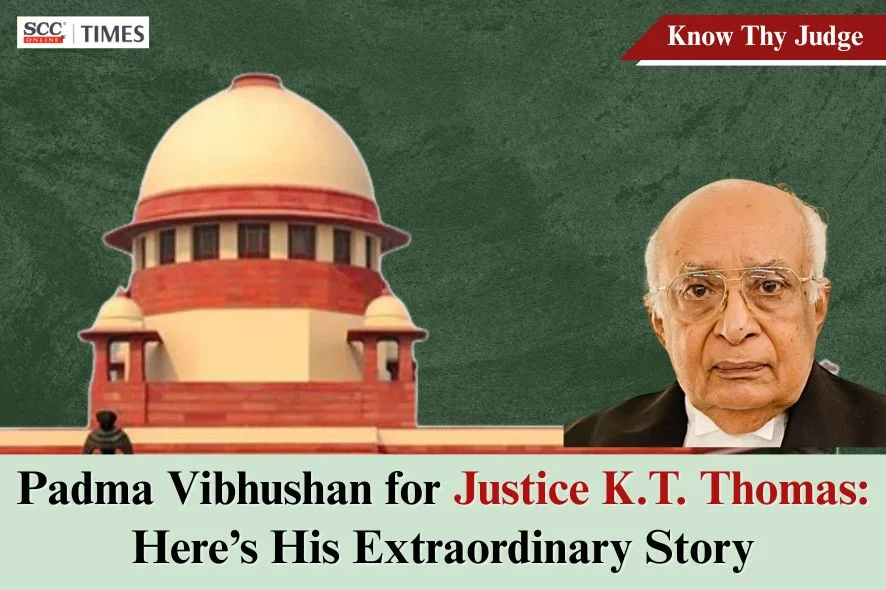
On 25-1-2026, the Ministry of Home Affairs notified the conferment of Padma Vibhushan to former Supreme Court Judge, Justice K.T. Thomas for his contributions in the field of Public Affairs1. Previously, Justice K.T. Thomas was awarded with the Padma Bhushan in 20072. Padma Vibhushan is the 2nd Highest Civilian Award which is conferred for exceptional and distinguished services3 and in 2026, this award has been conferred to 5 individuals for their contributions ranging from arts to literature and public affairs.
Academic and Legal Career of Justice K.T. Thomas
Born on 30-1-1937 Justice Thomas, Kallupurackal Thomas4 did his education at Baker Memorial Kindergarten school and C.M.S. College High School and C.M.S. College, Kottayam, and graduated from St. Albert’s College at Ernakulam. Justice KT Thomas took his law degree from Madras Law College5.
Justice K.T. Thomas enrolled as an advocate in 1960 and he also joined the chambers of senior advocate Joseph Maliakal. Thereafter, Justice Thomas set up independent practice for both civil as well as criminal side of the profession.
Justice Thomas was made the leader of the Indian Delegation to attend a world conference on peace held in Texas in 1976 under the auspices of World Alliance of YMCAs.
In 1977 he secured first rank in a selection made directly from the Bar to the post of District and Sessions Judge. He was the Principal District and Sessions Judge at Trichur, Calicut, Quilon and Trivandrum6. He became a Selection Grade District and Sessions Judge from 19817.
In 1985 Justice K.T. Thomas was elevated as Additional Judge of the High Court of Kerala and in July 1986, he was appointed as permanent Judge of the Kerala High Court8. In September 1995 he was appointed officiating Chief Justice of Kerala High Court and he held that office for about seven months9.
In March 1996 he was elevated as Judge of the Supreme Court of India and retired in the year 2002.
Post retirement, on the recommendation of the Chief Justice of Kerala, Justice KT Thomas was appointed as Chairman of three Committees.
*Did you Know? Justice KT Thomas agreed to the Chairmanship of the 3 Committees without accepting any salary. Furthermore, Justice Thomas also authored several books in Malyalam10.
The Chief Minister also acceded to Justice Thomas’ request to make his hometown, Kottayam as headquarters for the functioning of the following three commissions:
-
Commission on supervising the admissions in all the unaided professional colleges in Kerala.
-
Commission on fixing the fees in all such professional colleges for next three years.
-
Commission on suggesting reforms regarding the Performance and Accountability of Police force in Kerala.
Notable Judgments by Justice K.T. Thomas
*Did you Know? Justice K.T Thomas authored over 200 judgments during his tenure as Supreme Court Judge11.
Sunder v. Union of India, (2001) 7 SCC 211
In this 5 Judge Bench decision, the coram comprising of Dr AS Anand, CJ, K.T Thomas, R.C. Lahoti, N. Santosh Hegde and S.N. Variava, JJ., had to answer whether State is liable to pay interest on the amount envisaged under Section 23(2) of Land Acquisition Act, 1894. The Court held that Question of payment of interest would arise only when the compensation is not paid or deposited on or before the date of taking possession of the land. It is inequitable that the person who is deprived of the possession of the land on account of acquisition proceedings is not given the amount which law demands to be paid to him; any delay thereafter would only be to his detriment. There must be a provision to buffet such iniquity. It is for the purpose of affording relief to the person who is entitled to such compensation when the payment of his money is delayed that the provision is made in Section 34 of the Act.
State v. Nalini, (1999) 5 SCC 253 [Rajiv Gandhi Assassination case]
In this high-profile Rajiv Gandhi Assassination case, the 3-Judge Bench of KT Thomas, DP Wadhwa and SSM Quadri, JJ., affirmed the death sentence given to 4 convicts (including a woman) who were held guilty by the Trial Court for former PM Rajiv Gandhi’s assassination.
Justice K.T. Thomas upheld death penalty for 3 convicts; however, vis-a-vis the female convict (Nalini), Justice Thomas opined that her death penalty should be commuted to that of life imprisonment. Per KT Thomas, J., “A-1 (Nalini) belongs to the fourth category. In the normal spectrum of consideration, death penalty is the first priority to be chosen for her. She is an elderly and educated woman. One gets the impression, on reading her confession, that she was led into the conspiracy by playing on her feminine sentiments. She became an obedient participant without doing any dominating role. She was persistently brainwashed by A-3 (Murugan) who became her husband and then the father of her child”. Justice Thomas had further opined that she is the mother of a little female child who would not have even experienced maternal cuddling as that little one was born in captivity. “Of course the maxim “justitia non novit patrem nec matrem” (justice knows no father nor mother) is a pristine doctrine. But it cannot be allowed to reign with its rigour in the sphere of sentence determination. As we have confirmed the death sentence passed on the father of that small child, an effort to save its mother from the gallows may not militate against jus gladii so that an innocent child can be saved from imposed orphanhood”.
K.C. Sareen v. CBI, (2001) 6 SCC 584
The Division Bench of KT Thomas and SN Variava, JJ., held that though the power to suspend an order of conviction, apart from the order of sentence, is not alien to Section 389(1) of the CrPC, its exercise should be limited to very exceptional cases. Merely because the convicted person files an appeal in challenge of the conviction the court should not suspend the operation of the order of conviction. The court has a duty to look at all aspects including the ramifications of keeping such conviction in abeyance. It is in the light of the above legal position that Court has to examine the question as to what should be the position when a public servant is convicted of an offence under the PC Act. No doubt when the appellate court admits the appeal filed in challenge of the conviction and sentence for the offence under the PC Act, the superior court should normally suspend the sentence of imprisonment until disposal of the appeal, because refusal thereof would render the very appeal otiose unless such appeal could be heard soon after the filing of the appeal. “But suspension of conviction of the offence under the PC Act, dehors the sentence of imprisonment as a sequel thereto, is a different matter”.
Shamnsaheb M. Multtani v. State of Karnataka, (2001) 2 SCC 577
The 3-Judge Bench of K.T. Thomas, R.P. Sethi and B.N. Agrawal, JJ., had to consider that would there be occasion for a failure of justice by adopting such a course as to convict an accused of the offence under Section 304-B IPC when all the ingredients necessary for the said offence have come out in evidence, although accused was not charged with the said offence? The Court held that the expression “failure of justice” would appear, sometimes, as an etymological chameleon. The criminal court, particularly the superior court should make a close examination to ascertain whether there was really a failure of justice or whether it is only a camouflage. One of the cardinal principles of natural justice is that no man should be condemned without being heard, (audi alteram partem). But the law reports are replete with instances of courts hesitating to approve the contention that failure of justice had occasioned merely because a person was not heard on a particular aspect. However, if the aspect is of such a nature that non-explanation of it has contributed to penalising an individual, the court should say that since he was not given the opportunity to explain that aspect there was failure of justice on account of non-compliance with the principle of natural justice.
Navinchandra N. Majithia v. State of Meghalaya, (2000) 8 SCC 323
The 3-Judge Bench of KT Thomas, RP Sethi and SN Varavia, JJ., held that financial crunch of any State treasury is no justification for allowing a private party to supply funds to the police for conducting investigation. Augmentation of the fiscal resources of the State for meeting the expenses needed for such investigations is the lookout of the executive. Failure to do it is no premise for directing a complainant to supply funds to the investigating officer. Such funding by interested private parties would vitiate the investigation contemplated in the Code. A vitiated investigation is the precursor for miscarriage of criminal justice. Hence any attempt, to create a precedent permitting private parties to supply financial assistance to the police for conducting investigation, should be nipped in the bud itself. No such precedent can secure judicial imprimatur.
Rathi Menon v. Union of India, (2001) 3 SCC 714
The Division Bench of KT Thomas and RP Sethi, JJ., provision for payment of interim relief indicated in Section 126 of the Act has no utility for deciding as to what should be the total amount of compensation payable to the injured or other claimant. The right of the injured to claim compensation as well as the liability of the Railway Administration are both reposed in Section 124-A of the Railways Act, 1989. The right is to maintain an action and recover damages. The liability is to “pay compensation to such extent as may be prescribed”.
Akmal Ahmad v. State of Delhi, (1999) 3 SCC 337
The Division Bench of KT Thomas and DP Mohapatra, JJ., held that Departure from India is the point of time envisaged in Section 3 of the Passports Act. Unless there is departure or at least an attempt to depart from India, there is no question of invoking Section 3 of the Passports Act.
1. https://www.mha.gov.in/sites/default/files/Padma_Awards2026W_25012026.pdf
2. https://lawreformscommission.kerala.gov.in/index.php/justice-k-t-thomas
3. https://www.padmaawards.gov.in/padmaawards/AboutAwards
4. https://www.sci.gov.in/judge/justice-k-t-thomas/
5. https://lawreformscommission.kerala.gov.in/index.php/justice-k-t-thomas
6. supra
7. https://www.sci.gov.in/judge/justice-k-t-thomas/
8. supra
9. https://lawreformscommission.kerala.gov.in/index.php/justice-k-t-thomas
10. https://lawreformscommission.kerala.gov.in/index.php/justice-k-t-thomas
11. scconline.com | Judge Only feature