
Disclaimer: This has been reported after the availability of the order of the Court and not on media reports so as to give an accurate report to our readers.
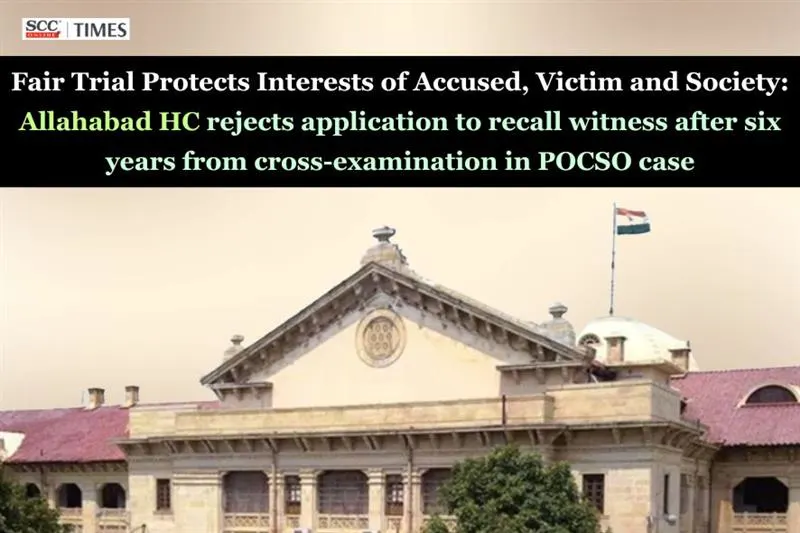
Allahabad High Court: While considering an application challenging the order passed by the Additional Sessions Judge/Special Judge Protection of Children from Sexual Offences Act 2012 (‘POCSO Act’) whereby the application seeking recall of Opposite party 3 for further cross-examination was rejected, a Single Judge Bench of Vivek Kumar Singh, J., held that fair trial entails the interest of the accused, the victim and the society and, therefore, the grant of fair and proper opportunities to the persons concerned, must be ensured being a constitutional goal, as well as a human right.
Accordingly, the Court rejected the application at hand and stated that it was preferred either to delay the trial or to win-over the victim, who has already been examined and cross-examined at length.
Background
In the present case, an FIR was filed by Opposite party 2 under Sections 363, 366 and 120B of the Penal Code 1860 (‘IPC’) and Sections 7 and 8 of the POCSO Act. After due investigation, chargesheet was submitted under Sections 363, 366 and 120B of the IPC and Sections 16 and 17 of the POCSO Act. After due investigation, the Investigating Officer submitted a charge-sheet under Sections 363, 366, 120-B of the IPC and Sections 16 and 17 of the POCSO Act. Statements of the victim were recorded under Sections 161 and 164 of the Criminal Procedure Code 1973 (‘CrPC’), whereafter the Trial Court took cognizance and framed charges. The accused pleaded not guilty and claimed trial.
During the trial, the first informant was examined. Thereafter, the victim was examined on 26-4-2019, and owing to paucity of time, her cross-examination was deferred to 10-5-2019, on which she was cross-examined at length.
Subsequently, the applicant moved an application under Section 348 of the Bharatiya Nagarik Suraksha Sanhita (‘BNSS’) seeking recall of the victim for further cross-examination which was rejected by the Trial Court.
Aggrieved by which the applicant approached the High Court.
Analysis and Decision
The Court stated that it is well settled that the power under Section 311 of the CrPC. or Section 348 of the BNSS must be exercised with care, caution and circumspection and only for strong and valid reasons. The recall of a witness already examined should not be a matter of course, and the discretion given to the Court in this regard must be exercised judicially to prevent failure of justice.
The Court declared that it is conscious of the position that the trial is basically for the accused and the Court should afford an opportunity to them in the fairest manner possible, however the Court should bear in mind that fair trial entails the interest of the accused, the victim and the society and, therefore, the grant of fair and proper opportunities to the persons concerned, must be ensured being a constitutional goal, as well as a human right.
The Court emphasized that “The above observations cannot be read as laying down any inflexible rule to routinely permit a recall on the ground that earlier correct facts could not be brought on record. While advancement of justice remains the prime object of law, it cannot be understood that recall can be allowed for the asking or reasons related to mere convenience.”
The Court stated that the jurisdiction under Section 528 of the BNSS was extraordinary, and it could be used only in such cases where there was gross injustice or clear abuse of process of law. It could not be used to help such a person who was not cooperating in a fair trial. Such power could not be invoked to harass the witness who has already been examined or for causing delay in the trial.
The Court further stated that power conferred under Section 348 of the BNSS is to be invoked by the Court to meet the ends of justice, for strong and valid reasons and it is to be exercised with great caution and circumspection. The determinative factor would be whether the summoning or recalling of the witness is essential to the just decision of the case keeping in view that entailing the interests of the accused, the victim and of the society is the main object of the criminal procedure and the Court is to ensure that such fairness is not hampered or threatened in any manner.
The Court stated that POCSO Act is a special legislation, which was enacted to protect children from sexual offences and for safeguarding interests and ensuring the well-being of the child at every stage of trial of offences such that Section 33(5) of the POCSO Act cast a duty upon the Special Court to ensure that a child is not repeatedly called to give his/her testimony before the Court. The Court emphasized that the legislative intent behind the same is to ensure that the child who has suffered a traumatic experience of sexual assault is not called time and again to testify about the same incident.
Thus, the Court held that a witnesses who has already been examined and cross-examined, cannot be recalled and re-examined to deny the evidence he/she has already given before the Trial Court and no opportunity at a later stage can be given to him to completely erase the evidence already given by him under oath.
The Court held that the application under Section 348 of the BNSS was preferred either to delay the trial or to win-over the victim, who has already been examined and cross-examined at length. Thus, it was not a bonafide application and was filed after six years from the date of cross-examination of the victim.
Hence, the Court upheld the order and stated that the Trial Court rightly rejected the recall application.
[Neelam v. State of UP, 2026 SCC OnLine All 51, decided on 12-1-2026]
Advocates who appeared in this case:
For the Applicant: Ajeet Kumar Srivastava, Arvind Kumar Srivastava, Neelam Srivastava, and Satyendra Kumar Srivastava, Advocates
For the Opposite Party: G.A.
Buy Protection of Children from Sexual Offences Act, 2012 HERE
Buy Penal Code, 1860 HERE
Buy Code of Criminal Procedure, 1973 HERE