
1. About the University
National Law University, Tripura (NLUT) is a premier legal education institution established under the National Law University Act, 2022, enacted by the Tripura State Legislature. The University is dedicated to advancing legal education, research, and advocacy with a particular focus on constitutional values, access to justice, and regional socio-legal challenges of North-East India. NLUT aims to nurture competent legal professionals, scholars, and policymakers through rigorous academic training, research excellence, and community engagement.
The University of Engineering & Management (UEM), Kolkata, established in 2014 under the West Bengal Act 25 of 2014 and located in New Town near the airport, is a nationally recognized institution known for academic excellence, innovation and strong industry integration. Ranked among India’s top ten institutions in NPTEL alongside IITs and NITs, UEM has achieved consistent student placements and fosters research, creativity and discipline. The university holds multiple accolades, including an “AAA” NPTEL ranking, QSI-GAUGE Gold Rating, Progress Global Award 2021, and a 4.5-star IIC rating from MHRD-AICTE, and has hosted the IEEE UEMCON 2016 at Columbia University.
The conference is jointly organised by the Centre for Environment, Law and Climate Change (CELCC) and the Centre for Intellectual Property Studies (CIPS), in collaboration with the University of Engineering & Management (UEM), Kolkata, through its Department of Business Administration and Department of Law (IIIJS).
2. About the Conference
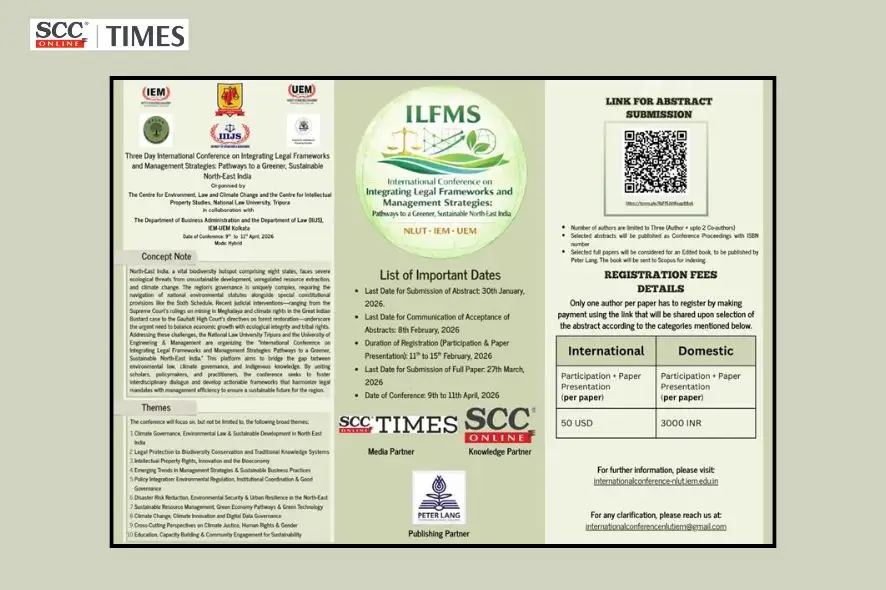
The Three Days International Conference on “Integrating Legal Frameworks and Management Strategies: Pathways to a Greener, Sustainable North-East India” seeks to provide an interdisciplinary platform for examining environmental governance challenges in the North-East region of India. The Conference aims to foster dialogue among legal scholars, management professionals, policymakers, environmental scientists, industry representatives, and community stakeholders to develop integrated, actionable frameworks for sustainable development, climate resilience, and ecological justice.
Dates: 9th — 11th April, 2026
Mode: Hybrid
3. Theme
-
Climate Governance, Environmental Law & Sustainable Development in North- East India
-
Legal Protection to Biodiversity Conservation and Traditional Knowledge Systems
-
Intellectual Property Rights, Innovation and the Bioeconomy
-
Emerging Trends in Management Strategies & Sustainable Business Practices
-
Policy Integration: Environmental Regulation, Institutional Coordination & Good Governance
-
Disaster Risk Reduction, Environmental Security & Urban Resilience in the North-East
-
Sustainable Resource Management Green Economy Pathways & Green Technology
-
Climate Change, Climate Innovation and Digital Data Governance
-
Cross-Cutting Perspectives on Climate Justice, Human Rights & Gender
-
Education, Capacity Building & Community Engagement for Sustainability
4. Sub-Themes
The Conference will focus broadly, the following sub-themes which are synchronous to the above-mentioned themes:
1.1 Legal and policy reforms for climate resilience in the North-East
1.2 Environmental rule of law and judicial interventions
1.3 Integrating climate change concerns into regional development planning
1.4 Role of State Pollution Control Boards and regulatory authorities
1.5 Climate diplomacy, cross-border environmental issues with neighbouring countries
1.6 Harmonising customary laws with statutory environmental regulations
2.1 Biodiversity governance in fragile ecosystems of the North-East
2.2 Legal mechanisms under the Wildlife Protection and Forest Conservation Laws
2.3 Community-led Forest management and rights under the Forest Rights Act
2.4 Documenting and safeguarding indigenous ecological practices
2.5 Challenges in protecting biodiversity hotspots and endemic species
2.6 Benefit-sharing under the Biological Diversity Act
3.1 Protecting traditional knowledge and genetic resources under IPR regimes
3.2 Innovation-driven climate adaptation technologies
3.3 Patent issues in green technologies and renewable energy
3.4 Commercialisation of biodiversity-based products from the North-East
3.5 Geographical Indications and their role in sustainable regional development
3.6 Addressing biopiracy and misappropriation of indigenous resources
4.1 Corporate Sustainability, ESG compliance and environmental audits
4.2 Climate risk assessment and management frameworks
4.3 Climate-smart agriculture and livelihood strategies in the North-East
4.4 Green entrepreneurship and start-up ecosystems
4.5 Low-carbon transitions in MSMEs and local industries
4.6 Sustainable infrastructure and green supply chain management
5.1 Coordination mechanisms between Central, State and Local bodies
5.2 Implementing environmental norms in ecologically sensitive zones
5.3 Institutional challenges in monitoring and enforcement
5.4 Role of local governance institutions and autonomous district councils
5.5 Transparency, accountability and public participation in environmental decision-making
5.6 Strengthening regulatory institutions for climate governance
6.1 Legal frameworks for disaster management and climate emergencies
6.2 Urban planning, smart cities and green infrastructure
6.3 Adaptive strategies for floods, landslides, cyclones and earthquakes
6.4 Community-based disaster risk reduction models
6.5 Environmental security and internal displacement due to climate change
6.6 Climate-proofing of public infrastructure
7.1 Water governance, river basin management and hydro-power challenges
7.2 Sustainable mining and natural resource utilisation
7.3 Green finance, carbon credits and climate investment tools
7.4 Eco-tourism, adventure tourism and cultural tourism in the North-East
7.5 Circular economy and waste management innovations
7.6 Energy transition: solar, wind, biomass and hydro energy systems
8.1 AI, GIS and satellite technologies for environmental monitoring
8.2 Legal frameworks for climate data governance
8.3 Smart management systems for urban sustainability
8.4 Digital innovation in agriculture, forestry and biodiversity mapping
8.5 Cybersecurity and privacy concerns in climate-tech
8.6 Data-driven decision-making for governance institutions
9.1 Climate justice for tribal and marginalised communities
9.2 Human rights-based approach to climate legislation
9.3 Gendered impacts of environmental degradation
9.4 Migration, displacement and environmental refugees
9.5 Children’s rights and climate obligations
9.6 Ensuring access to environmental information and remedies
10.1 Role of universities and research institutions in climate literacy
10.2 Community-based environmental education
10.3 Training law enforcement and administrative officials on environmental compliance
10.4 Strengthening climate governance through academic—industry partnerships
10.5 Capacity building for local governance bodies
10.6 Integrating sustainability in curriculum and institutional policies
5. Who Can Submit
Submissions are invited from:
-
Academicians and researchers
-
Legal professionals, judges, and members of the Bar
-
Policymakers, regulators, and government officials
-
Environmental scientists and development practitioners
-
Industry professionals and CSR experts
-
Research scholars and students
6. How to Submit
-
Abstracts must be submitted through the designated Google Form within the stipulated timeline.
-
Upon acceptance of the abstract, authors will be required to submit the full paper as per the guidelines communicated by the organisers.
7. Submission Categories
-
Abstract Submission
-
Full Paper Submission
-
Paper Presentation (selected abstracts and papers)
8. Submission Guidelines
-
Abstract Length: Maximum 300 words with at least 5 keywords
-
Full Paper Length: 5,000—8,000 words
-
Number of Authors: Maximum 3 per paper
Formatting Requirements:
-
Font: Times New Roman
-
Title: 16 pt, Bold, Centre aligned
-
Headings: 14 pt, Bold, Left aligned
-
Main Text: 12 pt, 1.5 line spacing, Justified
-
Footnotes: 10 pt, single spacing
-
Citation Style: APA 7th Edition (Footnotes)
Additional Requirements:
-
Original and unpublished work only
-
Plagiarism similarity below 10%;
-
AI-generated content must be 0%
-
Mandatory originality disclaimer
9. Processing Charges
Registration Fees (Per Paper):
Payment details will be communicated to the selected participants separately.
The number of authors for each paper is limited to three (3) (Author + up to 2 Co-authors)
10. General Instructions
-
Only one author per paper is required to register.
-
No Travel Allowance (TA) will be provided.
-
Participants must arrange their own accommodation.
-
Selected abstracts will be published with an ISBN.
-
Selected papers will be published in an edited volume by Peter Lang proposed to be submitted for Scopus indexing.
11. Contact Details
Conference Website:
https://internationalconference-nlut.iem.edu.in/
Email for Queries:
internationalconferencenlutiem@gmail.com
Venue:
National Law University, Tripura
Link for Submission of Abstract: https://forms.gle/jt9SxPU9dwUsqv1t5