


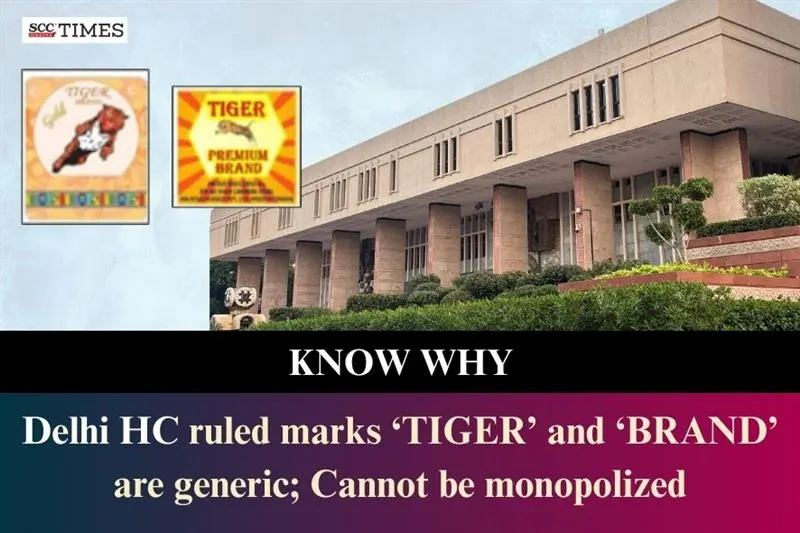
Delhi High Court: While hearing an application filed under Order 39, Rules 1 and 2 of the Civil Procedure Code, 1908, seeking an interim injunction restraining the Defendants 1 to 3 from using a trade mark deceptively similar to that of the plaintiff, the Single Judge Bench of Tejas Karia, J, held that the marks ‘TIGER’ and ‘BRAND’ were generic in nature, were used widely for various goods and services in India and therefore were incapable of monopolization.
Accordingly, the Court held that the marks were not deceptively similar and dismissed the application for interim injunction.
Background
The plaintiff had claimed infringement of copyright, passing off, misrepresentation and dilution of their trade mark ‘TIGER GOLD BRAND’/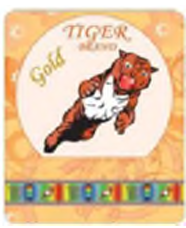 (‘plaintiff’s marks’) by the respondent’s use of the mark ‘TIGER PREMIUM BRAND’/
  (‘impugned marks’). Vide order dated 6-5-2025, the parties had been referred to Delhi High Court Medication and Conciliation Centre, to amicably resolve the disputes between them, however, the parties had been unable to settle the dispute and thereafter, notice had been issued in the present application.
Defendants 1 to 3 had contended that the term ‘TIGER’ cannot be monopolized by the plaintiff as ‘TIGER’ is common to the trade and a generic word. It was contended by Defendants 1 to 3 that the mark ‘TIGER’ is commonly used for goods falling under Class 7 and the word ‘TIGER’ in standalone has no trade mark value and is not capable of distinguishing the goods and services. Defendants 1 to 3 had further averred that in absence of the registration of word mark ‘TIGER’ or any ‘TIGER’ formative marks, which is relevant for examining the deceptive similarity of the impugned mark, the plaintiff had not been able to establish ownership over the mark ‘TIGER’.
Analysis, Law and Decision
The Court noted that the the marks ‘TIGER’ and ‘BRAND’ are generic in nature and, therefore, were incapable of registration as trade marks. The plaintiff did not possess any exclusive right to use the word marks “TIGER” and “BRAND.” The Court further stated that there existed extensive and widespread use of the mark “TIGER” in relation to various goods and services across India. Consequently, the mark “TIGER” was publici juris, common to the trade, and was not exclusively or uniquely associated with the plaintiff’s goods or services. Further, the plaintiff had failed to place on record any material to demonstrate that the mark “TIGER” had acquired a secondary meaning. The Court opined that in the absence of any distinctive or exclusive character, the mark “TIGER” could not confer any exclusive proprietary rights upon the plaintiff, and the plaintiff was, therefore, not entitled to claim exclusivity over the same.
On the question of deceptive similarity, the Court noted that when viewed in its entirety, the impugned mark was wholly dissimilar and visually distinct from the plaintiff’s mark, including the depiction of the “TIGER” device. The colour scheme of the impugned mark was also different, and when considered as a whole, the plaintiff’s mark and the impugned mark were distinguishable, inter alia, due to the use of the word “PREMIUM.” Further, the descriptive and commonly used nature of the words “TIGER” and “BRAND” in the hospitality industry negated any likelihood of deceptive similarity.
The Court opined that since the marks “TIGER” and “BRAND” were generic and common to the trade, the plaintiff could not claim exclusive ownership over those elements forming part of the impugned mark. In terms of Section 17 of the Trade Marks Act, 1999, registration conferred exclusive rights only in respect of the trade mark taken as a whole. As the plaintiff had no exclusive rights over the words “TIGER” and “BRAND,” no deceptive similarity could be established. It is well settled that registration of a device mark does not automatically confer exclusive rights over the words contained therein.
Thus, the Court held that the rival marks were neither identical nor deceptively similar, and consisted of generic elements incapable of monopolisation. The plaintiff had failed to establish misrepresentation by the defendant or to prove any damage arising from the adoption of the impugned mark. Additionally, the plaintiff had not demonstrated goodwill or reputation, and consequently, no prima facie case of passing off was made out. There was no likelihood of confusion among consumers that could have harmed the plaintiff’s reputation or diluted its mark.
Accordingly, the Court dismissed the application.
[Mayank Jain v. Atulya Discs, 2026 SCC OnLine Del 107, decided on 9-1-2026]
Advocates who appeared in this case:
For the Plaintiff: R.P. Yadav, Riju Mani Talukdar, Advocates
For the Respondent: Amit George, Manish Gandhi, Vaibhav Gandhi, Muskan Gandhi, Dushyant Kishan Kaul, Rupam Jha, Rohini Sharma, Chanchal Sharma, Advocates