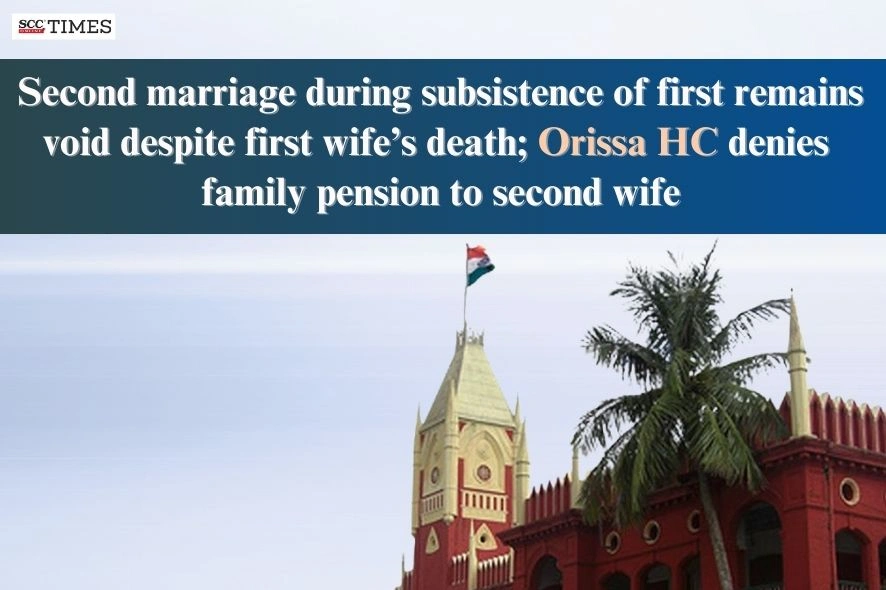
Orissa High Court: In a matter concerning entitlement to family pension under the Odisha Civil Services (Pension) Rules, 1992 (‘Rules’), the Division Bench of Dixit Krishna Shripad* and Chittaranjan Dash, JJ., held that a second wife, whose marriage was contracted during the subsistence of the first marriage, is not entitled to family pension, as such marriage is void in law. The Court noted that the Rules are payable to the widow on the death of an employee, subject to compliance with certain terms and conditions, and that to be a widow, a valid marriage between the woman and the deceased employee is a sine qua non; what is void ab initio does not become valid by the happening of a subsequent event.
Background
The dispute arose from an order dated 12-11-2021, whereby the competent authority negatived the claim for family pension. It was observed that the deceased employee had acquired a second wife during the lifetime of his first wife. Relying on the Note below Clause (d) of Sub-Rule (6) of the Rules, the authority held that the second wife was not entitled to family pension, not being the legally married wife.
The appellant argued that the Rules specifically employ the expression “wife/wives,” and therefore, the second wife should be entitled to family pension, particularly after the demise of the first wife. The respondents opposed the appeal, justifying the impugned order and the reasons on which it was structured.
Analysis and Decision
The Court emphasised that after the enactment of the Hindu Marriage Act, 1955 (‘the Act’), monogamy is the thumb rule with no exception whatsoever. It was noted that the idea of a second marriage during the subsistence of the first abhors the pith and substance of the Act. The Court observed that the Act does not recognise childlessness as a justifiable circumstance for entering into wedlock with a person who is already in the subsisting wedlock with another.
The Court highlighted Mayne’s Hindu Law, which state that the bigamous marriages are void and punishable under Section 17 of the Act read with Sections 494 and 495 of the Penal Code, 1860 (‘IPC’). It was further observed that family pension under the Rules is payable to the widow on the death of an employee subject to complying with certain terms & conditions and to be a widow, a valid marriage between the woman and the deceased employee is a sine qua non. The Court held that the word ‘wives’ appearing in the Rules does not authorise an employee to contract marriage with multiple persons by way of polygamy or polyandry.
The Court observed that the appellant entered the wedlock with the deceased employee during the subsistence of first marriage with another woman and that act itself constitutes the offence of bigamy punishable under Section 17 of the Act and Section 495 IPC, therefore granting family pension to the so called ‘second wife’, amounts to placing premium on illegality. The Court further noted that what is void ab initio, does not become valid by the happening of subsequent event.
Additionally, the Court referred to Mahalakshmamma v. Department of Rural Development & Panchayathraj, 2023 SCC OnLine Kar 100, wherein it was held that recognizing such relations arising from second marriage during the subsistence of first one is detrimental to public interest inasmuch as that would facilitate directly or indirectly the employees contracting the second marriage, which is legally impermissible.
Therefore, in the above circumstances, the Court rejected the writ appeal as devoid of merits.
[Kankalata Dwibedi v. State of Orissa, 2026 SCC OnLine Ori 147, decided on 13-01-2026]
*Judgment authored by: Justice Dixit Krishna Shripad
Advocates who appeared in this case:
For the Appellant: Madhumita Panda, J. Bhuyan & D. Behera, Advocates
For the Respondents: J.K. Khandayatray, ASC
Buy Penal Code, 1860 HERE