
Disclaimer: This has been reported after the availability of the order of the Court and not on media reports so as to give an accurate report to our readers.
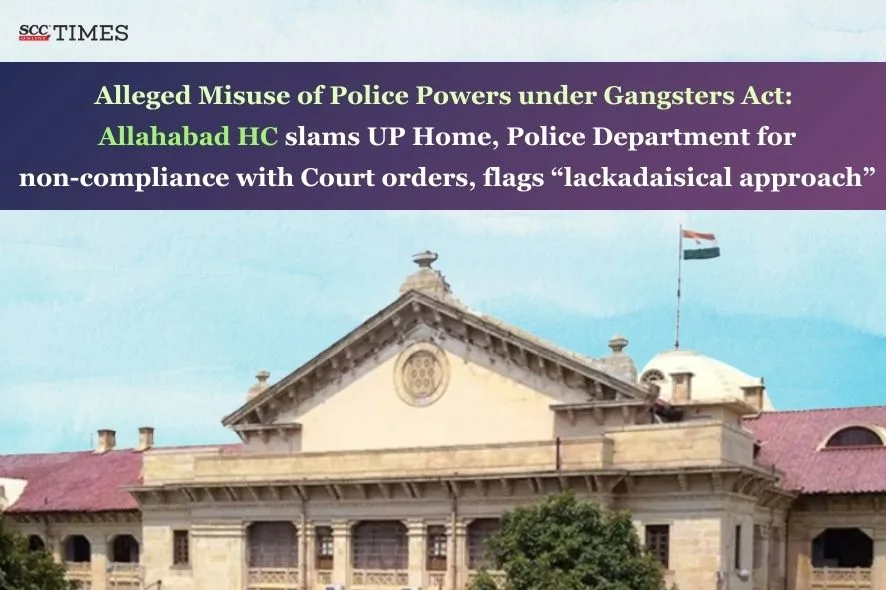
Allahabad High Court: In an application filed for quashing of two FIRs, the Court had been questioning alleged misuse of police powers under the Uttar Pradesh Gangsters and Anti-Social Activities (Prevention) Act, 1986 (“Gangsters Act”). After repeated failures of the State Authorities to comply with the Court orders, the Single Bench of Vinod Diwakar, J., issued a ‘show-cause notice’ to the Additional Chief Secretary (Home) seeking an explanation of the reasons and the legal impediments, if any, which resulted in the repeated failure of the Home Department to furnish the specific and pointed details sought by the Court.
Background
The petitioner filed the present application seeking quashing of two FIRs filed against the accused under Sections 406, 504, 506 and 420, 406, 506 of the Penal Code, 1860. He claimed that there was no allegation of the use of force, coercion, threat, violence, or intimidation in the main cases, therefore, there was no finding to arrive to a subjective satisfaction to invoke the provisions of the Gangsters Act.
It was further contended that the complainants were different in both cases, there was no subjective satisfaction that the applicants were working as a gang, and the gang chart had not been approved by the District Magistrate. No joint meeting was convened between District Magistrate and the Superintendent of Police(“SP”), therefore, the gang chart was approved in contravention of Section 5(3)(a) of the U.P. Gangsters and Anti-Social Activities (Prevention) Rules, 2021 (“the Rules”). The petitioner contended misuse of police powers in invoking the provisions of the Gangsters Act.
Previously, the State sought and was granted time to place on record the relevant notification pertaining to the delegation of powers of the District Magistrate to the Commissioner of Police for approval of the gang chart under the Commissionerate system. Thereafter, the Court directed the Additional Chief Secretary (Home) and Commissioner of Police, Ghaziabad, to file affidavits addressing a few issues. However, the justification addressing the core issue involved in the case was found to be lacking in the affidavits so filed.
Subsequently, the matter was listed 17 times.
On 27-11-2025, the Court issued extensive directions for Secretary, Home Department, Government of Uttar Pradesh and Director General of Police (Prosecution) regarding affidavits which had to be submitted by them. The Secretary, Home Department, was directed to file an affidavit containing:
-
the empirical data gathered from the district(s) and/or Commissionerate(s) on the basis of which the Police Department has arrived at its subjective satisfaction that, under the Commissionerate system functioning in terms of the Gangsters Act, the exclusion of the District Magistrate from the joint meeting mandated under Rule 5(3)(a) was justified and in the interest of the State and its citizens, and further had been capable of achieving the aforesaid objectives;
-
details of any data, comparative analysis or study, conducted by the Police Department to substantiate its claim that, subsequent to the introduction of the Commissionerate system, the crime rate has decreased in the district(s) where the system has been implemented as compared to those district(s) where the Commissionerate system has not been adopted,
-
details of any training programmes imparted to police officers who have been assigned to discharge functions earlier performed by the District Magistrates, along with particulars of any study undertaken by the State Government demonstrating whether the Home Department has been successful in achieving the intended objective
-
the name(s) and number of officers of rank SSP/SP/DCP and above in police, and Joint Director (Prosecution) and DGC in prosecution department against whom disciplinary or administrative action has been taken during the last ten years for acts of corruption, inefficiency, negligence, procedural lapses, misuse of power, or violation of guidelines in matters pertaining to the Gangsters Act or in any other ancillary issue
-
the nature of such action, including warnings, adverse entries, suspensions, transfers, departmental inquiries, or any other penalties imposed.
Similarly, the Director General of Police (Prosecution) (“DGP”) was directed to file an affidavit furnishing comprehensive district-wise data in respect of cases under the Gangsters Act for the last ten years, including:
-
number of cases registered;
-
number of charge-sheets filed;
-
number of convictions secured;
-
number of acquittals of charge-sheeted accused(s), with a comparative analysis vis-à-vis the non-Commissionerate district(s)
-
the systemic reforms and policy decision(s), if any, taken by the Home Department to improve police working, so far as the approval of the gang-chart is concerned.
The Court sought this information considering the fact that both the Supreme Court and itself had consistently encountered cases revealing gross misuse of police powers, particularly in relation to the indiscriminate approval of gang-charts and the initiation of proceedings under the Gangsters Act.
In compliance with the order dated 27-11-2025, the Secretary (Home) filed an affidavit highlighting the purported “noble objective” behind adopting the Commissionerate system and described it as a national best practice in certain districts of Uttar Pradesh, with the stated aim of achieving zero tolerance towards crime and criminals. However, the DGP sought a week for compliance.
Analysis
The Court stated that the affidavit filed by the Secretary (Home) failed to satisfy the requirements of the said order in its letter and spirit. Furthermore, upon perusal of the affidavit(s) filed on behalf of the Home Department, prima facie, it appeared that the officers concerned either failed to advert to the orders rendered by the Court or approached the matter in a lackadaisical manner.
“Such an approach seemingly proceeds on the erroneous assumption that the power to issue notifications, being vested in the executive branches, may be exercised without due application of mind, by resorting to unfettered discretion and without examining the consequential effects thereof.”
While the Court refrained from delving into the reasons underlying such conduct, the Bench remarked that it could not remain a mute spectator and would not hesitate to exercise the powers vested in it in the interest of the citizens of the State and for upholding the sanctity and authority of the judicial process.
The Court further remarked that, “even the most well-intentioned and ostensibly noble ideas are liable to miscarry when placed in the hands of poor administrators namely, those who are inadequately trained and lacking in institutional competence, yet highly ambitious and adept at manoeuvring constitutional authorities.”
The Court added that a fundamental flaw of traditional bureaucratic ethics laid in its tendency to treat morality as something external to the day-to-day practice of administration, rather than as an integral component of decision-making.
Underscoring that discretion conferred on civil servants by the legislature was intended to be exercised strictly in furtherance of the policy and underlying object of the statute, the Court stated that the policy and purpose of any gazette notification must be ascertained by construing the parent enactment as a whole.
“Courts have had no difficulty in reasserting their rights to intervene in cases where administrative decisions are irrational, abusive and arbitrary. Courts, in the other words, instead of acting as a guarantors of the rule of law, have taken to outsourcing this obligation to the executive branch for effectively implementing the State policy, and not otherwise.”
Accordingly, the Court issued a ‘show-cause notice’ to the Additional Chief Secretary (Home) seeking an explanation of the reasons and the legal impediments, if any, which resulted in the repeated failure of the Home Department to furnish the specific and pointed details sought by this Court through its orders.
The matter was listed for 20-01-2026.
[Rajendra Tyagi v. State of U.P., 2026 SCC OnLine All 42, decided on 09-01-2026]
Advocates who appeared in this case:
For the applicant: Ronak Chaturvedi
For the respondent: Additional Advocate General Anoop Trivedi and Additional government Advocate Paritosh Kumar Malviya
Buy Penal Code, 1860 HERE