Disclaimer: This has been reported after the availability of the order of the Court and not on media reports so as to give an accurate report to our readers.
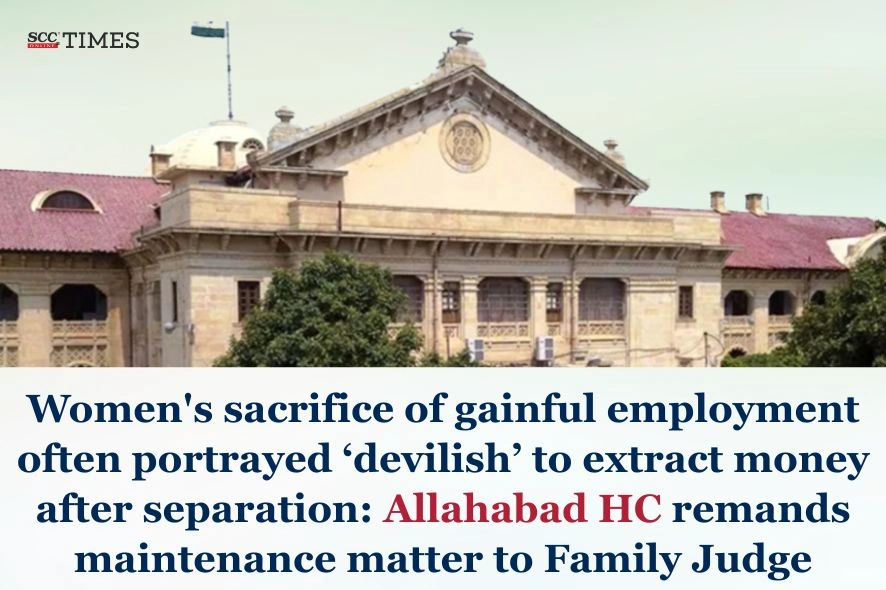
Allahabad High Court: In a revision filed by the Revisionist 1-wife, under Section 125 of the Criminal Procedure Code 1973 (‘CrPC’), against the judgment and order passed by the Additional Principal Judge, Family Court, whereby her application for maintenance against Opposite Party 2-husband was rejected, a Single Judge Bench of Garima Prashad, J., took note of women’s sacrifice of employment for family and held that it is a matter of social reality that women devote themselves to domestic responsibilities and take care of children and are unable to be gainfully employed and when a marital discord arises and parties get separated, then the very sacrifice is often portrayed as a devilish act intended to extract money from the husband.
Further, the Court stated that the maintenance of Rs. 3,000 awarded to the minor son under the said order meager amount and set aside the said order remanding the matter to the Family Judge for fresh determination of maintenance.
Background
The marriage between the parties was solemnized in May 2006 and from the wedlock, a son was born. It was alleged that due to physical and mental cruelty, including beatings and harassment, the wife, along with her son, was driven out of the matrimonial home in 2015.
An earlier application for maintenance was disposed of in November 2005 by the Family Court on the assurance of the husband that he would keep the wife properly. Pursuant thereto, she returned to the matrimonial home and withdrew the said case. However, in January 2020, she was allegedly beaten again and expelled from the matrimonial home along with her son on account of dowry demand.
The wife stated that though educated, she was a homemaker and did not possess any vocational skills such as tailoring, embroidery, or knitting, and had no independent source of income. She further stated that she was presently residing at her parental home and was financially dependent upon them. The husband was stated to be employed as a Class-IV employee at Primary School, earning approximately Rs. 35,000 per month as salary. Accordingly, she filed an application under Section 125 of the CrPC in April 2021 seeking maintenance of Rs. 15,000 per month for herself and Rs. 10,000 per month for her minor son.
The Family Court held that the wife was living separately without sufficient cause solely on the ground that she had refused to go back to the matrimonial home during the proceedings initiated by the husband under Section 9 of the Hindu Marriage Act 1955 (‘HMA’). The Court partly allowed the application and directed an amount of Rs. 3,000 per month to be paid by the husband to his minor son. Aggrieved by the same, the wife approached the High Court.
Analysis and Decision
The Court referred to Rina Kumari Alias Rina Devi Alias Reena v. Dinesh Kumar Mahto Alias Dinesh Kumar Mahato (2025) 3 SCC 33 and held that the Family Court erred in applying wife’s refusal to stay away from her matrimonial home as disqualification and holding that she was not entitled to maintenance. The Court opined that the Family Court also erred in holding hat since no dowry related case or complaint for assault had been filed by the wife against her husband, there was no proof of cruelty or demand of dowry which forced her to live separately.
The Court stated that “The preponderance of the judicial thought weighs in favour of upholding the wife’s right to maintenance under Section 125 CrPC and the mere filing of a petition for restitution of conjugal rights by the husband would not, by itself, be sufficient to attract the disqualification under Section 125(4) CrPC.” Further, the Court viewed that the husband’s denial of the fatherhood to the minor child would have been probably the last straw, adding to the suffering due to the ill treatment in her matrimonial home.
The Court stated that Rs. 3,000 per month as maintenance to the minor son was a meager amount considering that the boy was an adolescent needing support to study well and grow in a healthy environment. The Court opined that the husband had been creating ways and means to evade payment of maintenance to his legally wedded wife and minor son. The Court stressed upon Rajnesh v. Neha (2021) 2 SCC 324 and held that maintenance amount should be about 25 per cent of the husband’s net salary.
The Court stated that “The object of the provisions contained in Section 125 of the CrPC cannot be lost sight of. Indisputably, the provision is a measure of social justice, and its objective is to prevent destitution and vagrancy.” The Court further stated that the wife’s statutory right to maintenance cannot be permitted to be parted away and infringed by setting up a case that she had the capacity to earn. The fact that the wife could work or earn some money was not the end of the matter. Neither the mere potential to earn nor the actual earning, howsoever meager it may be, is sufficient to deny the claim of maintenance.
The Court opined that the wife could have the capacity to earn from tailoring, which may not be sufficient to support her and her son’s livelihood and afford her to maintain the same standard of living which she will get if she was residing with the husband. Thus, she was entitled to maintenance from the husband even if she had the capacity to work.
The Court stated that the exercise was not a mere adjudication on a claim for money, but a judicial responsibility that affects the dignity, sustenance and stability of life of the applicant. Therefore, orders on maintenance must reflect not only correctness in law but also an understanding of human conditions that lie beneath the pleadings presented before the Court.
Thus, the Court held that the said order was passed without properly appreciating the wife’s financial incapacity. The mere fact that she was a postgraduate and has done an ITI Diploma in tailoring itself could not lead to the conclusion that she was working for gain.
The Court further stated that it is a matter of social reality that women devote themselves to domestic responsibilities and take care of children and are unable to be gainfully employed. It is misplaced for a husband to rely solely on the qualifications of his wife to evade his legal obligation to maintain her. When a marital discord arises and parties get separated, then the very sacrifice is often portrayed as a devilish act intended to extract money from the husband. Such sweeping assumptions are not only unfair but deeply insensitive to the social and emotional realities that women face.
The Court emphasized that in the present case, the wife was staying at her parental home and taking care of her child without any financial or emotional support from the husband. Thus, the Court observed that the Family Court must adopt a practical and humane approach.
The Court held that the wife’s assertion that she is unemployed, burdened with the responsibility of single-handedly taking care of a young child and residing with her parents without any independent source of income was credible in the absence of any contrary evidence. Her situation reflected the reality faced by many women, who, despite their education, find it difficult to join the workforce after years of domestic duties and childcare responsibilities.
Hence, the Court held that the said order could not be sustained. Considering that complete responsibility of meeting the daily need, education and medical expenses of a minor child lies upon both the parents, the Court held that both the wife and minor son were equally entitled to maintenance from the husband and he was legally liable to maintain both. Thus, the Court set aside the said order and remanded the matter to the Family Judge for fresh determination of maintenance.
[Suman Verma v. State of UP, 2026 SCC OnLine All 14, decided on 8-1-2026]
Advocates who appeared in this case:
For the Revisionist: Deepak Kumar Yadav, Advocate
For the Opposite Party: G.A., Shashank Tripathi, Advocate
Buy Code of Criminal Procedure, 1973 HERE