
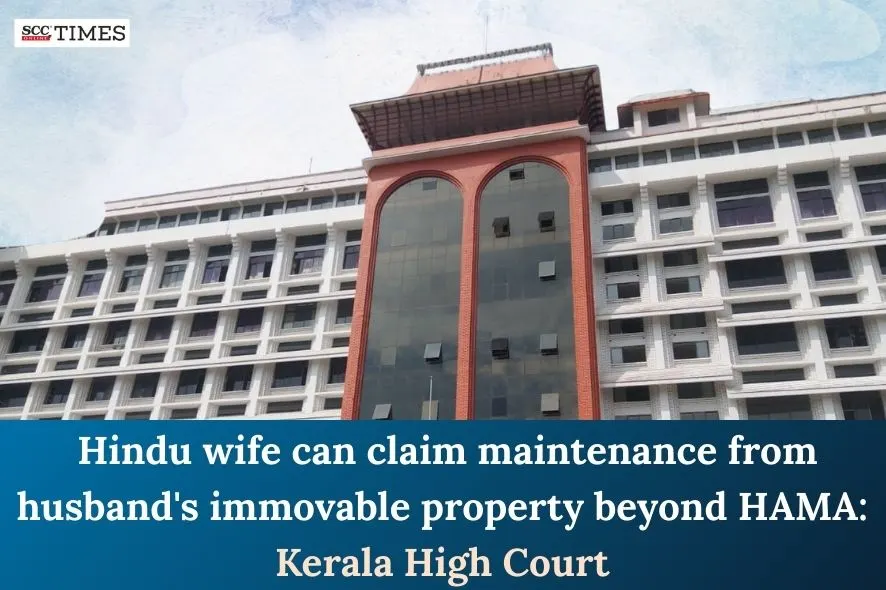
Kerala High Court: In a matter addressing whether a Hindu wife is entitled to receive maintenance from the immovable property of her husband dehors the provisions of the Hindu Adoptions and Maintenance Act, 1956 (‘HAMA’), the three-Judge Bench of Sushrut Arvind Dharmadhikari, P.V. Kunhikrishnan and G. Girish*, JJJ., held that a Hindu wife possesses the right to claim maintenance from her husband’s immovable property dehors HAMA, and that such a right transforms into an enforceable claim once legal proceedings are initiated or maintenance is denied.
Background:
The dispute arose when the claim petitioner purchased a portion of land from a husband who was estranged from his wife. Subsequently, the wife filed an original petition for maintenance, leading to the attachment of the property on 14-11-2007, and a decree in her favor. The purchaser contended that the wife had no right to receive maintenance from the profits of the property he had lawfully acquired prior to her maintenance petition. But the Family Court rejected his contention, relying on Ramankutty Purushothaman v. Amminikutty, 1997 SCC OnLine Ker 37, that held that Section 39 of the Transfer of Property Act, 1882 (‘TP Act’) applied.
The Family Court’s verdict was challenged by the claim petitioner contending that none of the provisions of the HAMA conferred right upon the wife to receive maintenance from the profits of the immovable property which belonged to her husband, and hence Section 39 of the TP Act did not apply. The Division Bench sought assistance of the Amicus Curiae, who enlightened it on all aspects of the issue, right from the historical development of the principle governing the right of a Hindu wife to have maintenance from the properties of her husband. The Division Bench also noted various case laws and analysed Section 4 of the HAMA.
Ultimately, the Division Bench referred to this Court, the following legal questions as per the order dated 11-7-2025:
-
Is a Hindu wife entitled to receive maintenance from the immovable property of her husband dehors the provisions of the HAMA?
-
Is there not an apparent conflict between the views expressed in Vijayan v. Sobhana, 2007 SCC OnLine Ker 21, and Sathiyamma v. Gayathri, 2013 SCC OnLine Ker 24180, Nysha v. P. Suresh Babu, 2019 SCC OnLine Ker 4838, or Hadiya v. Shameera M.M., 2025 SCC OnLine Ker 1757, and what is the correct law?
Analysis and Decision:
The Court noted that as per Section 39 of the TP Act dealt with the special privilege and protection of a third person’s right to receive maintenance, or provision for advancement or marriage from the profits of immovable property, notwithstanding the transfer of that property, and the person having such right will be entitled to enforce the same against the transferee and the property in his hands, if the transferee had notice of such right, or when the transfer was gratuitous.
The Court observed that the right of a Hindu wife to maintenance emanated from ancient Hindu law, recognized in texts authored by Manu, Narada, and Yajnavalkya, and consistently upheld in judicial precedents. The Court noted that while the HAMA codified these principles, its overriding clause in Section 4 conferred the right on a Hindu wife to have maintenance from her husband.
The Court noted that HAMA did not define ‘dependent’, though Section 21 listed heirs of a deceased who qualified, including widow but not wife of living husband, which suggested that the legislature intended maintenance rights from estates only when the provider was deceased. However, the Court observed that this omission could not mean a wife denied maintenance by her living husband had no recourse against his property. The Court opined that denying her such a right would be unjust and contrary to both ancient Hindu law and the principles of HAMA. Thus, Courts could intervene to allow a wife to enforce maintenance against her husband’s property without violating Section 4 of HAMA.
The Court further observed that Section 39 of the TP Act protected a third person’s right to maintenance or to have a provision for advancement or marriage from the profits of the immovable property, even if it has been transferred by the owner of that property, against whom the aforesaid right of the third person existed. Such a right was enforceable against transferees with notice or gratuitous transferees.
The Court relied on Banda Manikyam v. Banda Venkayamma, 1956 SCC OnLine AP 192, and opined that the right of a Hindu wife to have maintenance from her husband’s properties originated the moment when she got married to him. The Court clarified that her right remained dormant until denial of maintenance or initiation of legal proceedings, at which point it transformed into an inchoate right and later crystallised into a charge upon judicial declaration. Thus, purchasers could not be presumed to have knowledge of such rights unless evidence showed awareness of denial of maintenance or gratuitous transfer.
Thus, the Court observed that the transfer of immovable property would be subject to the right of a third person, conferred under Section 39 of the TP Act, from the stage when such third person had initiated legal steps to receive maintenance from her husband and his properties. Though the inchoate right of the third person would ripen to a typical charge only when a competent legal forum upheld the above right, the claimant would be entitled to enforce the special privilege and protection, akin to a charge, conferred upon him if that property was alienated in the meanwhile, by the owner.
In reconciling conflicting precedents, the Court strongly disagreed with Vijayan (supra) in so far that it observed that the wife and children of a Hindu did not have any right to claim maintenance from the profits of the immovable property of that person, and held that its conclusions were inconsistent with the predominant judicial view expressed in Sathiyamma (supra), Nysha (supra) and Hadiya (supra). The Court opined that if there were evidence to show that the purchaser was aware, at the time of sale, about the denial of maintenance by the seller to his wife and children, and the claim of maintenance raised against the seller by his wife and children, or if there were sufficient reasons to show that the transfer was gratuitous, then the privilege and protection of Section 39 of the TP Act would be available to the claimants in that case.
Consequently, the Court held that a Hindu wife is entitled to receive maintenance from the immovable property of her husband dehors the provisions of HAMA, and that such entitlement is protected under Section 39 of the TP Act and Section 28 of HAMA, once her right is asserted through legal action.
[X v. Y, 2026 SCC OnLine Ker 550, decided on 14-1-2026]
*Judgment authored by: Justice G. Girish
Advocates who appeared in this case:
For the Petitioner: S. Balachandran (Kulasekharam), V.R. Gopu, Advocates.
For the Respondents: G. Krishnakumari, Advocate.
Amicus Curiae: T. Krishnanunni, Advocate.