
Disclaimer: This has been reported after the availability of the order of the Court and not on media reports so as to give an accurate report to our readers.
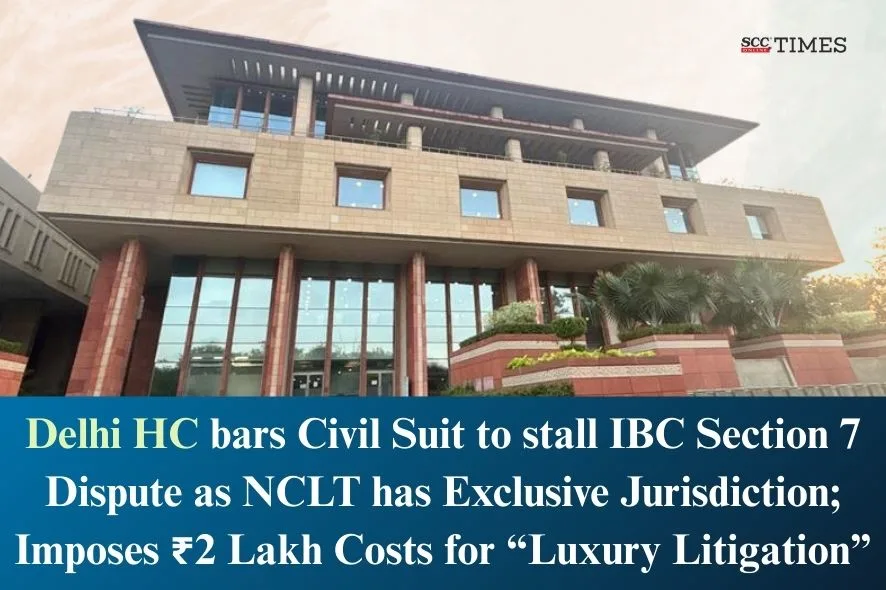
Delhi High Court: In a civil suit seeking declaratory and injunctive reliefs which, in substance, challenged the existence of debt, validity of assignment, and authenticity of documents which formed the basis of a petition filed under Section 7 of the Insolvency and Bankruptcy Code, 2016 (IBC), a Single-Judge Bench of Purushaindra Kumar Kaurav, J., held that such a suit was barred under Sections 63 and 231 of the IBC, as the issues sought to be raised were required to be adjudicated by the NCLT under Sections 65, 75 and 60(5)(c) read with the NCLT Rules, 2016.
The Court further imposed costs of ₹2,00,000 on the plaintiff for indulging in “luxury litigation,” observing that valuable judicial time had been wasted and another litigant had been deprived of hearing.
Factual Matrix
In the instant matter, the plaintiff is a company engaged in real estate and allied commercial activities. Defendant 1 to 5 are also companies operating in the real estate and commercial sector. From 2006 till 2024, Defendant 5 consistently held 50% of the equity shareholding in the plaintiff, while the remaining 50% was held by various entities. During FY 2021—22, Defendant 2 held the remaining shareholding, which was later transferred to Defendant 4 in April 2024.
The plaintiff had availed a term loan of ₹80 crores from Defendant 2 (then Sonata Investments Ltd.) under a Loan Agreement dated 31-10-2006. The loan was originally repayable within 24 months, which period was extended by a supplementary loan agreement dated 31-10-2010.
On 10-11- 2006, Defendant No. 5, being a 50% equity shareholder, executed an undertaking in favour of Defendant 2 stating that it would ensure continued holding of at least 50% of the equity share capital of the borrower and would not dilute or encumber the shareholding so long as any outstanding amounts were due.
At the beginning of 2024, Defendant 2 and 5 allegedly approached Defendant 6 with a proposal to transfer their entire shareholding in the plaintiff (50% each) along with managerial and financial control, for a consideration of ₹88 crores each. The transaction was structured as a composite arrangement in three stages.
In furtherance of this understanding, a Share Purchase Agreement dated 26-02-2024 was executed between Defendant 5 (seller), Defendant 6 (purchaser) and Defendant 2 (confirming party), whereby Defendant 5 transferred its 50% shareholding to Defendant 6 for ₹88 crores.
Subsequently, as per the instructions of Defendant 2, the plaintiff made several payments to Defendant 1 during FY 2023—24 and 2024—25 towards complete discharge of the loan liability. These payments were made with the understanding that they would reduce the plaintiff’s obligation towards Defendant 2 under the loan agreement.
However, in April 2024, Defendant 2 transferred its shareholding in the plaintiff to Defendant 4. An agreement was thereafter arrived at for sale of Defendant 4’s shareholding to Defendant 6 for ₹88 crores, pursuant to which Defendant 6 made payments. Defendant 4, however, resiled from executing the share purchase agreement.
Thereafter, Defendant 1 instituted a petition under Section 7 of the IBC before the NCLT, alleging default in repayment of the ₹80 crore loan, which was claimed to have been assigned in its favour by Defendant 2 under a Business Transfer Agreement dated 05-03-2020.
The plaintiff contended that the Business Transfer Agreement forming the basis of the Section 7 petition was fraudulent, forged, void-ab-initio and not binding upon it. On this premise, the plaintiff instituted the present civil suit seeking declarations and injunctive reliefs.
Moot Point
While adjudicating application under Order VII Rule 11 CPC, the Court crystallised the controversy into a single question —
Whether the present suit is barred by the provisions of IBC, and consequently liable to be rejected under Order VII Rule 11(d) CPC?
For answering the issue, the Court examined the following sub-issues —
-
Whether Sections 63 and 231 of the IBC operate as ouster provisions barring the jurisdiction of the civil court.
-
Whether the issues raised in the suit fall within the adjudicatory domain of the NCLT under Sections 65, 75 and 60(5)(c) of the IBC.
-
Whether allegations of fraud, forgery, collusion and invalidity of the Business Transfer Agreement can be examined by the NCLT.
-
Whether the suit is an impermissible collateral attack on pending Section 7 proceedings.
-
Whether the plaint discloses any independent cause of action justifying trial by a civil court.
Court’s Analysis
The Court examined the scheme, object and purpose of the IBC, referring extensively to the Statement of Objects and Reasons and the Bankruptcy Law Reforms Committee Report. Referring to the Bankruptcy Law Reforms Committee Report, the Court noted that “the current state of the bankruptcy process for firms is a highly fragmented framework… It is problematic that these different laws are implemented in different judicial fora.”
Relying on Swiss Ribbons (P) Ltd. v. Union of India, (2019) 4 SCC 17 and Gujarat Urja Vikas Nigam Ltd. v. Amit Gupta, (2021) 7 SCC 209, the Court noted that the IBC marked a “decisive break from the earlier insolvency framework, replacing a fragmented regime with a time-bound process aimed at maximising the value of the corporate debtor.” The Court held that primary focus of the Code is revival and continuation of the corporate debtor, and not mere recovery.
Sections 63 and 231 of BC bar jurisdiction of civil courts
The Court characterised Sections 63 and 231 as “classical ouster clauses, usually provided in specialised legislations.” Their purpose is to render exclusive the adjudication of matters entrusted to a statutory tribunal.
The Court note that Section 63 stated that “no civil court or authority shall have jurisdiction to entertain any suit or proceedings in respect of any matter on which NCLT or NCLAT has jurisdiction under this Code” and Section 231 further bars civil courts from entertaining any matter where the Adjudicating Authority is empowered to pass orders and prohibits injunctions against actions taken under the Code.
The Court held that the scope of these provisions depends on the width of the powers conferred on the NCLT under the Code. If the subject matter of the suit falls within the statutory remit of the NCLT, the civil court is denuded of jurisdiction.
The Court held that Sections 63 and 231 are mandatory ouster provisions and once it is shown that the NCLT is empowered to adjudicate upon the dispute, the civil court must decline jurisdiction at the threshold.
NCLT’s exclusive jurisdiction u/S 65, 75 and 60(5)(c) IBC
The Court noted that Section 65 IBC empowers the Adjudicating Authority to impose penalties where insolvency proceedings are initiated fraudulently or with malicious intent.
The Court relied on Embassy Property Developments (P) Ltd. v. State of Karnataka, (2020) 13 SCC 308, where the Supreme Court held that “NCLT is vested with the power to inquire into fraudulent initiation of proceedings as well as fraudulent transactions.” The Court observed that adjudication under Section 65 necessarily involves fact-finding, examination of documents and in appropriate cases, evaluation of evidence.
The Court examined Section 75, which penalises furnishing false information or suppression of material facts in a Section 7 application. The Court held that Section 75 confers wide powers on the NCLT to examine the veracity of statements made in insolvency petitions and the Tribunal is empowered to determine whether information is false in material particulars or whether material facts have been suppressed.
The Court described Section 60(5)(c) as a residuary provision conferring wide jurisdiction on the NCLT to decide “any question of law or facts, arising out of or in relation to the insolvency resolution or liquidation proceedings of the corporate debtor.”
Relying on Essar Steel India Ltd. v. Satish Kumar Gupta, the Court held that this provision is designed to ensure that the NCLT alone has jurisdiction over disputes bearing a nexus with insolvency proceedings, thereby preventing parallel litigation and forum shopping.
After analysing Sections 65, 75 and 60(5)(c) of the IBC, the Court held that —
-
The NCLT has jurisdiction to inquire into allegations of fraud, forgery, collusion and malicious initiation of proceedings;
-
The NCLT has wide residuary powers under Section 60(5)(c) to decide questions of law and fact arising out of or in relation to insolvency proceedings; and
-
The statutory framework empowers the NCLT to examine seriously disputed questions of fact and to evaluate evidence.
Plaint and NCLT’s exclusive jurisdiction
The Court examined the prayers in the plaint and found that the plaintiff sought for declaration that the loan stood discharged, Business Transfer Agreement was void ab initio and certain letters were forged and never issued; mandatory injunction for rendition of accounts; and injunction restraining Defendant 1 from proceeding further.
The Court held that these prayers directly assail the existence of debt, the validity of the assignment, and the authenticity of documents forming the basis of the Section 7 petition, hence, all these matters, are squarely within the domain of the NCLT under Sections 65, 75 and 60(5)(c).
The Court cautioned against “this new breed of anti-tribunal suits” and observed that civil courts must “strip the plaint from its artificial nomenclature and find the real substance of the relief being sought.” The Court held that the present plaint was “a textbook example of a proceeding which, though clothed as a civil declaratory action, is in reality an impermissible collateral attack on the jurisdiction and functioning of the NCLT under the IBC.” The Court further held that entertaining such suits would amount to judicially endorsing forum shopping and procedural circumvention.
Non-disclosure of Independent Cause of Action
Rejection the plaintiff’s contention that its right pre-existed under common law and was not created by the IBC, the Court held that there cannot be “a common law right which inherently lies at the teeth of a statutory scheme. A claim that demands disobedience of the law is not a legal right but mere obstinacy.”
The Court found that the so-called right asserted by the plaintiff was nothing but a demand that a civil court adjudicate upon issues which the legislature has consciously entrusted to a specialised tribunal. The Court held that the plaint discloses no independent cause of action maintainable before a civil court.
Court’s Decision
The Court held that the present suit was barred under Sections 63 and 231 of the IBC, as the issues sought to be raised were required to be adjudicated by the NCLT under Sections 65, 75 and 60(5)(c) read with the NCLT Rules, 2016.
Accordingly, the Court allowed the application under Order VII Rule 11 CPC; rejected the plaint; held that the interim application became infructuous; and imposed a costs of ₹2,00,000 on the plaintiff, to be deposited with the Delhi State Legal Services Authority.
[Roseland Buildtech (P) Ltd. v. Vihaan 43 Realty (P) Ltd., 2026 SCC OnLine Del 7, Decided on 05-01-2026]
Advocates who appeared in this case:
Mr. Tanmaya Mehta and Mr. Palash Singhai, Counsel for the Plaintiff
Mr. Darpan Wadhwa, Sr. Adv. with Mr. Amek Vaid, Ms. Chanan Parwani, Mr. Shivam Shukla, Mr. Kaustubh Singh, Ms. Shubhi Agarwal, Mr. Rajat Sinha, Counsel for the Defendant 1
Ms. Ekta Kalra Sikri, Mr. Ajay Pal Singh Kullar and Mr. Prakhar Khanna, Counsel for the Defendant 5
Ms. Pooja M. Saigal, Sr. Adv. with Mr. Shubham Jain, Counsel for the Defendant 6