
Disclaimer: This has been reported after the availability of the order of the Court and not on media reports so as to give an accurate report to our readers.
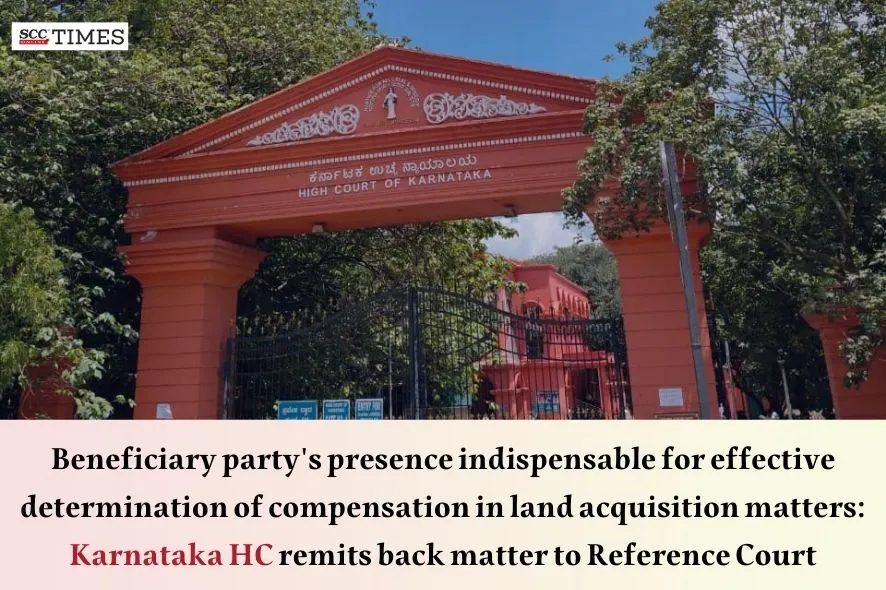
Karnataka High Court: While considering a batch of 67 writ petitions challenging the orders passed by the III Additional District and Sessions Judge and the Land Acquisition Rehabilitation and Resettlement Authority enhancing the compensation payable to the respondents-landowners under Section 64 of the Right to Fair Compensation and Transparency in Land Acquisition, Rehabilitation and Resettlement Act, 2013 (‘RFCTLARR Act’), Single Judge Bench of M.G.S. Kamal, J., ruled on importance of beneficiary party’s presence in land acquisition matters and held that Petitioner-Krishna Bhagya Jala Nigam Ltd. (‘Company’), apart from being a beneficiary and necessary party, also deserved an opportunity to participate in the process of determination of compensation.
The Court further stated that a company incorporated by the State for the implementation of the project was a party interested and beneficiary whose presence was indispensable for the purpose of effective determination of the subject matter. Thus, the Court remanded the matter back to the Reference Court and directed to add Petitioner-Company as a party.
Background
In the case at hand, approximately 75,563 acres of lands forming part of various villages were acquired by Respondent 1 – Special Land Acquisition Officer (‘Special Officer’) for implementation of the Upper Krishna Project-III (UKP-III). Awards were passed by the Special Officer fixing the market value of the acquired lands ranging between Rs. 60,000 – Rs. 4,60,644 per acre for dry and wet lands. Being dissatisfied with the awards, the respondents-landowners sought reference under Section 64 of the RFCTLARR Act, 2013, before the Reference Court seeking enhancement of compensation.
The Reference Court enhanced the compensation ranging between Rs. 6,34,732 – Rs. 28,12,526 per acre for dry and wet lands and further directed payment of 100 per cent solatium with Factor II and interest as provided under the RFCTLARR Act. On securing the records during May 2025, petitioner-Company, a company registered in August 1994 wholly owned by the Government of Karnataka incorporated for implementation of Upper Krishna Project in Karnataka, had discovered irregularities and illegalities in the proceedings, aggrieved by which, it approached the High Court.
It argued that Petitioner-Company being a ‘beneficiary’ and necessary party was neither made party in the proceedings before the Special Officer nor before the Reference Court, and no notice was issued in any of the cases, thereby denying Petitioner-Company the opportunity to present its case on merits or rebut the evidence produced by the respondents-landowners. It was further contended that even the respondent-State, which had filed appeals against some of the orders passed by the Reference Court, had not impleaded Petitioner-Company as a party.
Issues, Analysis and Decision
Considering the office objection raised by the Registry regarding maintainability of the filed petitions against the order of the reference Court in the light of alternate remedy of appeal being available under Section 74 of the RFCTLARR Act, the Court stated that it is a settled law that a writ petition cannot be termed as not maintainable merely because the alternate remedy provided under relevant statute has not been pursued by the parties desirous of invoking writ jurisdiction.
The Court opined that “Availability of an alternate remedy does not operate as an absolute bar to the maintainability of writ petition, and the rule which requires a party to pursue the alternate remedy provided by a statute is a rule of policy, convenience and discretion rather than a rule of law.” The Court held that ‘entertainability’ and ‘maintainability’ are two distinct concepts and a writ petition, despite being maintainable, may not be entertained by a High Court for very many reasons or a relief could even be refused to Petitioner-Company
The Court emphasized that the issue raised in the present petitions was regarding Petitioner-Company being a beneficiary and necessary party, not having been impleaded in the proceedings either before the Special Officer or the reference Court, thereby denying opportunity of being heard and depriving principles of natural justice, which requires consideration at the hands of this Court.
The Court overruled the objection raised by the Registry and stressed that the objection was raised despite earlier being found untenable by the Division Bench of the High Court.
Further, considering the objection raised by the respondents-landowners regarding maintainability on the ground of joinder of causes of action with a reference to provisions contained in Rules 7 and 39 of the Writ Proceedings Rules 1977, the Court opined that purpose of the rule is a matter of convenience which is more of procedure than substantive in nature and in the present case, Petitioner-Company filed the petition being aggrieved by the awards passed by the Reference Court without impleading it as a party.
The Court stated that another issue involved in the case at hand was whether Petitioner-Company was beneficiary and necessary party, if so, whether it had made out a case for setting aside of the award passed by the Reference Court and remand of the matter for fresh consideration. The Court perused the Memorandum of Association (‘MoA’), Articles of Association (‘AoA’) and Award and stated that all of it indicated that the main object of incorporation of Petitioner-Company was regulating and implementation of the said project. Thus, the acquisition of land was for and in furtherance to the incorporation of Petitioner-Company
Therefore, the Court stated that by necessary implication of the language used in the provisions of RFCTLARR Act, Petitioner-Company being the ‘requiring body’ was a person interested in the process of acquisition and was required to be heard in the process of determination of compensation. The Court held that Petitioner-Company, a company incorporated by the State for the implementation of the project, was a party interested and beneficiary whose presence was indispensable for the purpose of effective determination of the subject matter.
Regarding the contention that Executive Engineer of Petitioner-Company was arrayed as party to the proceedings in Reference Court, the Court stated that it would not meet the requirement of law inasmuch as Petitioner-Company being a corporate body incorporated under the provisions of Companies Act, had to be made a party to the proceedings in compliance with Order XXIX of the Civil Procedure Code 1908 (‘CPC’). Executive Engineer, being an employee, could neither be considered as its secretary nor its director nor its principal officer.
The Court stated that Petitioner-Company undisputedly came to existence since 1994 and not an entity which has come into existence after post-acquisition and State at the most could only be a formal party. A balance needed to be maintained between the public exchequer and the right of the landowners under Article 300A of the Constitution. Therefore, the Court held that Petitioner-Company, apart from being a beneficiary and necessary party, also deserved an opportunity to participate in the process of determination of compensation.
The Court stated that the Consent Award as per the October 2025’s Government order should be taken as tentative compensation amount only for the purpose of putting Petitioner-Company on terms while accepting its plea for quashing of the awards and remittance with direction to implead Petitioner-Company as party for fresh consideration.
Thus, the Court allowed the petition and remitted the matter back to the Reference Court and directed the said Court to implead Petitioner-Company as a party. The Court subjected the said remand and liberty to the condition that Petitioner-Company should deposit tentative compensation at the rate of Rs. 30,00,000 per acre of dry land and Rs. 40,00,000 per acre of wet land in cases of submerged land, and at the rate of Rs. 25,00,000 per acre of dry land and Rs. 30,00,000 per acre of wet land in cases where the land was acquired for canal purposes. Further, the Court directed Petitioner-Company to deposit the said tentative compensation amount within three months.
The Court stated that out of the tentative compensation amount so deposited, 50 per cent should be released in favour of the landowners whose lands were acquired for submergence or for canal subject to establishment of their identity. The remaining 50 per cent should be paid or released or adjusted and set off against the final award amount to be determined in accordance with the law. Accordingly, the Reference Court shall dispose of matters within one year.
The Court further stated that upon failure to deposit the tentative compensation amount as directed, the reference orders would stand revived.
[Krishna Bhagya Jala Nigam Ltd. v. Special Land Acquisition Officer, 2025 SCC OnLine Kar 25492, decided on 19-12-2025]
Advocates who appeared in this case:
For the Petitioner: P.P. Hegde, Senior Counsel for Rakshith K.S., Advocate
For the Respondents: Malhar Rao, AAG, Mallikarjun Sahukar, AGA, Sheshadri Jaishankar M., AGA and Harshavardhan R. Malipatil, Advocate
Buy Constitution of India HERE