
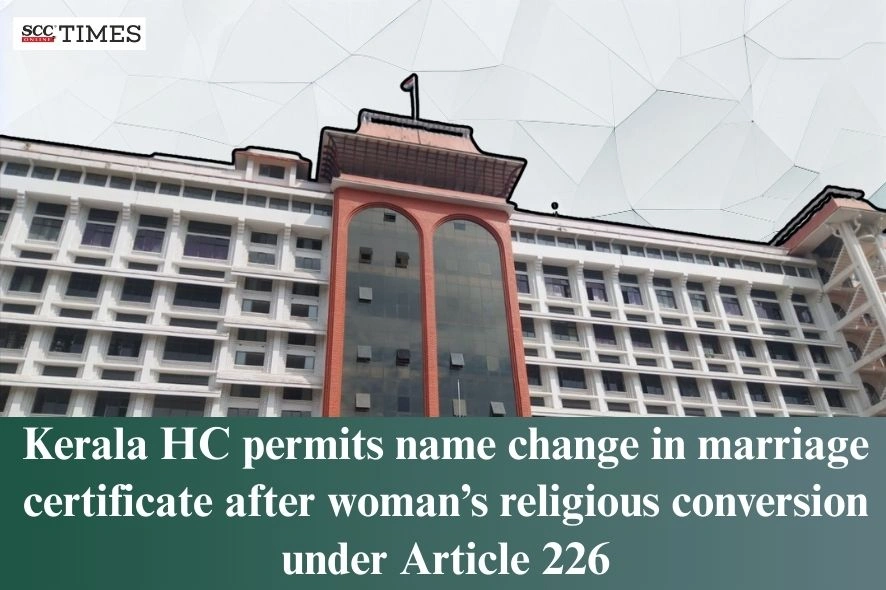
Kerala High Court: In a case revolving around the issue whether a person’s name change after religious conversioncould be incorporated into the marriage certificate issued under the Kerala Registration of Marriage (Common) Rules, 2008 (‘Rules of 2008’), a Single Judge Bench of P.V. Kunhikrishnan, allowed the petition, holding that although major changes in the marriage register are barred under Rule 13 of the Rules of 2008, the extraordinary jurisdiction under Article 226 of the Constitution could be invoked to do complete justice. Accordingly, the Court directed the Registrar to incorporate an additional entry in the marriage register reflecting the petitioner’s new name and issue a revised certificate.
Background:
The marriage was solemnised on 27-1-2017, under the Special Marriage Act, 1954, and duly registered under the Rules of 2008. Approximately six years later, the petitioner voluntarily changed her name through a Gazette notification, and all identity documents like Aadhaar Card, Driving License, etc., were updated accordingly. Even her husband’s passport was revised to reflect the change of her name. Her husband is working in the United Arab Emirates (‘UAE’), and she wants to join her husband there.
The family visas in the UAE are issued by the Federal Authority for Identity, Citizenship, Customs, and Port Security (‘ICP’), which requires that the application for a family visa must include the passports of the wife and children, as well as the attested marriage certificate, among other documents. Therefore, the petitioner required the marriage certificate to reflect her new name. However, the Registrar rejected the request citing a government clarification that major changes cannot be made to marriage certificates.
Issue:
Whether the name of a person entered in a marriage register prepared as per Rules of 2008 can be changed subsequently.
Analysis and Decision:
The Court noted that Rule 13 of the Rules of 2008 restricts major changes in the marriage register, permitting only corrections of errors in form or substance, or fraudulent or improper entries, subject to conditions in sub-rule (2). Corrections, including cancellation of registration, may be made by noting the evidence in the margin of the Register of Marriages (Common), without changing the original entry itself. The Court further noted that the petitioner’s request was not based on any error or fraud, but on a voluntary change of name, which fell outside the scope of permissible corrections.
The Court opined that while the Rules bar against such amendments, the extraordinary jurisdiction under Article 226 of the Constitution could be exercised to do complete justice in exceptional circumstances.
Furthermore, the Court noted that the petitioner’s husband was not appearing before the Court, to which the petitioner informed that he would appear online. Noting this, the Court remarked that the bona fides of the husband were doubtful in the peculiar facts and circumstances in this case. However, acknowledging that the petitioner’s parents had no objection to the name change and wanted to fulfill their daughter’s desire, the Court exercised its jurisdiction under Article 226 of the Constitution. In this regard, the Court relied on Dharmjit Bangarh v. State of Punjab, 2019 SCC OnLine P&H 6759, wherein it was held that subsequent changes in official documents could justify corresponding changes in the marriage certificate.
Accordingly, the Court, while allowing the writ petition, directed the Registrar to incorporate an additional entry in the marriage register with the petitioner’s new name and issue a revised certificate within one month.
[Aayisha Muhsin v. Principal Secretary, 2026 SCC OnLine Ker 231, decided on 5-1-2026]
Advocates who appeared in this case:
For the Petitioner: S. Vinod Bhat, Anagha Lakshmy Raman, V. Namitha, Gitanjali Sadan Pillai, Advocates.
For the Respondents: R. Rajpradeep, Prasudha S., Sreedevi S., P. Jeril Babu, GP, Sri Riyal Devassy.
Buy Constitution of India HERE