
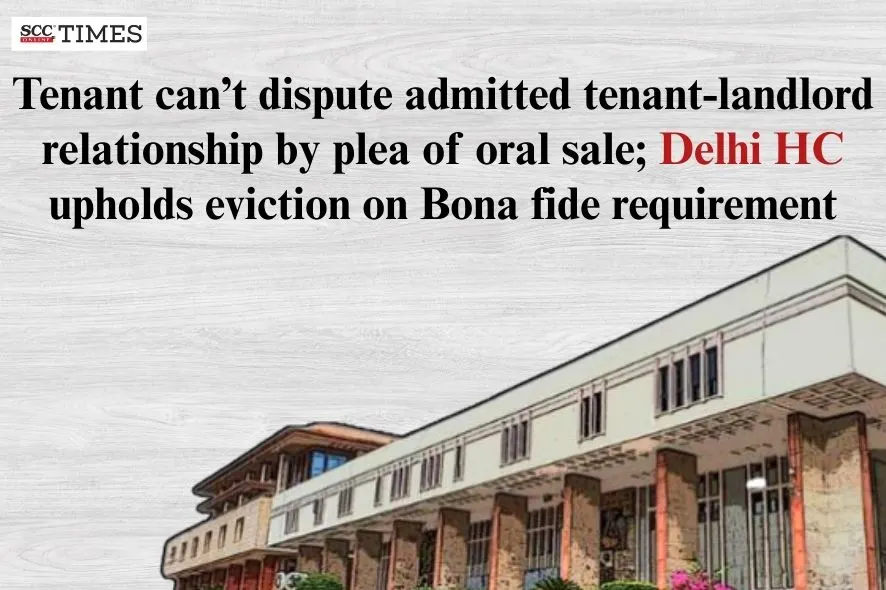
Delhi High Court: In the Revision petitions challenging the eviction orders passed under Section 14(1)(e) of the Delhi Rent Control Act, 1958, whereby the Rent Controller directed eviction of the tenants from two commercial shops on the ground of the landlord’s bona fide requirement, a Single-Judge Bench of Saurabh Banerjee, J., held that a tenant cannot dispute landlord-tenant relationship oral sale plea and hence, upheld the eviction. The Court held that the landlord had established a genuine, natural and sincere need for the premises for himself and his son, and that the tenants had failed to raise any triable issue.
Factual Matrix
In the instant matter, the respondent—landlord filed two eviction petitions under Section 14(1)(e) of the Delhi Rent Control Act, 1958 in respect of two shops. The first eviction petition related to the middle shop (“first subject premises”), which the landlord sought for the bona fide requirement of his younger son for carrying on the business of purchase and sale of old mobile phones and mobile repairs so that he may attain financial independence. The second eviction petition related to the corner shop (“second subject premises”), which the landlord sought for his own use.
The landlord, aged about 71 years, was running a general merchandise business from a tenanted shop at Krishna Market, Sadar Bazaar. Owing to his medical conditions and old age, it had become difficult for him to commute from his residence to Sadar Bazaar. The landlord contended that he required the second subject premises to shift his business nearer to his residence. The landlord stated that he did not have any other suitable alternative accommodation available for his bona fide requirements.
The tenants filed applications seeking leave to defend. After completion of pleadings and hearing the parties, the learned Rent Controller, vide order dated 05-01-2022, dismissed the leave to defend applications and passed eviction orders in favour of the landlord. Aggrieved, the tenants preferred the present revision petitions before this Court.
Petitioners’ Contentions
The petitioners (tenants) contended that the father of the tenants, along with the tenant of the second subject premises, had become owners of the respective shops on the basis of an oral agreement to sell for a total consideration of Rs. 35,00,000/-. It was contended that substantial payments had been made and that rent receipts reflected an amount of Rs. 25,000/- written on the reverse. It was further argued that the Gift Deed dated 15-07-2003, by virtue of which the landlord-respondent claimed title, was under challenge in a pending suit and therefore the landlord had no right to file eviction petitions.
On merits, it was contended that the younger son of the landlord was already settled in business with his elder brother and was not financially dependent. It was stated that the landlord was the owner of the Sadar Bazaar shop and could continue his business there. Further, the landlord had concealed availability of alternative accommodation, including open space behind his elder son’s shop which could be converted into a commercial unit.
Respondent’s Contentions
The landlord supported the impugned orders and submitted that the eviction petitions were rightly allowed as the landlord had established his genuine and bona fide requirement and the tenants had failed to raise any triable issue.
It was argued that the alleged oral agreement to sell was never pleaded in the leave to defend applications and was rightly rejected by the Rent Controller as being beyond the statutory period of 15 days. It was contended that an oral agreement to sell could not create any right in immovable property. Further, the pending suit challenging the Gift Deed was irrelevant, particularly when landlord—tenant relationship was admitted.
Moot Points
-
Whether the tenants could dispute the landlord—tenant relationship by setting up an alleged oral agreement to sell at the revisional stage?
-
Whether the eviction petitions were maintainable in view of the pending suit challenging the Gift Deed?
-
Whether the landlord had established a bona fide requirement under Section 14(1)(e) of the Act?
-
Whether any triable issue was raised by the tenants warranting grant of leave to defend?
Court’s Analysis
The Court held that once the tenants had admitted the landlord—tenant relationship in their leave to defend applications, they could not be permitted to “take a summersault” by setting up a case of ownership on the basis of an alleged oral agreement.
The Court observed that the applications under Section 151 CPC to introduce such a plea had already been dismissed by the Rent Controller and the same had not been challenged. The Court further held the alleged oral agreement to be “nothing but a cock and bull story with no legs to stand on” and could not constitute a triable issue.
The Court reiterated the settled position that “once a tenant, always a tenant” and that mere writing of an abstract figure on the reverse of a rent receipt could not establish ownership.
On the issue of the pending suit, the Court held that the tenants could not take shelter under a litigation in which they were not parties. The Court further held that an eviction petition by one co-owner is maintainable and the landlord was only required to establish a better title than the tenant, which stood proved.
On bona fide requirement, the Court held that the needs projected by the landlord were “genuine, authentic, natural, sincere, actual and valid” as they emanated from his old age and medical ailments, difficulty in commuting to Sadar Bazaar and need to assist his son in attaining financial independence. The Court further held that the requirement of close family members falls within the expression “for his own use” under Section 14(1)(e).
The Court asserted that the landlord cannot be compelled to continue operating from a rented premises far from his residence merely because eviction would cause inconvenience to the tenants. The Court relied on Kanhaiya Lal Arya v. Md. Ehsan, 2025 SCC OnLine SC 432, and reiterated that a tenant cannot dictate the terms of use of the landlord’s property and that “having an additional accommodation is nowhere the same as having an alternative accommodation”.
Court’s Decision
The Court found no perversity, irregularity or illegality in the orders passed by the Rent Controller and held that no case for interference in revisional jurisdiction was made out.
Accordingly, the Court dismissed both revision petitions and upheld the eviction orders dated 05-01-2022. The Court directed tenants to hand over vacant and peaceful possession of the respective premises to the landlord.
[Sandeep Dhawan v. Amarjeet Singh Kohli, 2026 SCC OnLine Del 28, Decided on 05-01-2026]
Advocates who appeared in this case:
Mr. Sudhir Nandrajog, Sr. Advocate with Mr. Kunal Madan, Mr. Gurmukh Singh Arora and Ms. Ankita Singh, Counsel for the Petitioners
Mr. Jugal Wadhwa, Mr. Rishabh Wadhwa, Mr. Raghav Goyal, Mr. Vatsal S. Chadha, Counsel for the Respondent