
Introduction
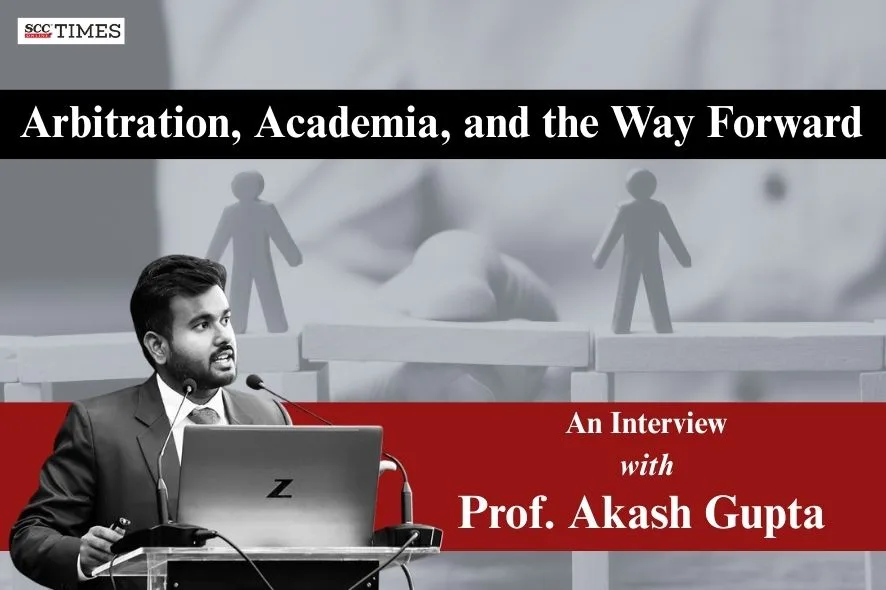
Prof. Akash Gupta is an Associate Professor and Assistant Director of the Centre for alternative dispute resolution (ADR) at Jindal Global Law School, and a Visiting Faculty at National Law School of India University (NLSIU) Bengaluru, where he teaches alternative dispute resolution courses. Appointed to the Young IAMC Steering Committee (2025-2027), he is an alumnus of Tamil Nadu National Law University (TNNLU) and Stockholm University (LLM). He attended the Paris Arbitration Academy and the Hague Academy on full scholarship and sponsorship, respectively. In recognition of his work, he was awarded “Emerging Arbitration Law Teacher of the Year” by the Indian National Bar Association, and “Young ADR Academic of the Year” by the Asia Pacific Centre for Arbitration & Mediation. He publishes his research work in the field of ADR, regularly judges competitions like Vis and Jessup, conducts workshops across India, and serves on Editorial and Advisory Boards of leading Indian and foreign ADR journals.
1. To start with, could you share what motivated you to pursue a career in law and how your journey in this field has unfolded so far?
My interest in law sparked in Class 10 when I was preparing for board exams in Kendriya Vidyalaya, Kankarbagh, Patna. Watching the Sony TV show “Adaalat”, where Ronit Roy plays the role of a lawyer by the name K.D. Pathak, interested me and drawn to the idea of law as a profession.
I went to Kendriya Vidyalaya in Pandit Deen Dayal Upadhyaya Nagar (formerly known as Mughalsarai) Patna and Gorakhpur which introduced me to different learning environments at a young age. I went on to pursue my undergraduate legal education at TNNLU, followed by an LLM in International Commercial Arbitration from Stockholm University. After completing my LLM in 2019, I returned to India and joined Jindal Global Law School as an assistant lecturer. Teaching, mentoring, and engaging with students have since made this journey deeply rewarding
2. Having pursued your legal education at TNNLU and later completing your LLM at Stockholm University, how have these academic experiences shaped your approach to alternate dispute resolution mechanism?
TNNLU provided a solid foundation for my interest in ADR, during my undergraduate studies, I was fortunate participate in five different international arbitration moots, such as the Vis East Moot Hong Kong and Vis Moot Vienna. These were fully sponsored by the Government of Tamil Nadu but that sponsorship itself came after nearly a year of effort by my teammate Carolin and me.
Eventually, the proposal was approved by the then Chief Minister, late Ms J. Jayalalithaa. I was fortunate to receive immense institutional support from Prof. (Dr) Kamala Sankaran and IAS Officer Mr Aruna Roy during this process.
This exposure was broadened by my LLM in Stockholm. It was an unreal experience to represent Stockholm at Vis Moot Vienna where our team placed in the top 16. These academic environments did not just teach me arbitration, they opened doors and shaped my long-term engagement with ADR.
3. You were selected on full scholarship and sponsorship for the Paris Arbitration Academy and the Hague Academy of International Law. What distinctive insights did you gain from these global platforms, and how do they continue to inform your work today?
These experiences fundamentally changed the way I think. They have taught me how to think over issues of law in various ways, to think about myself and to be receptive to thoughts that make me question my assumptions.
In addition to their reputations, the quality of faculties and peers were excellent. Every classroom experience and casual discussion was a learning experience. The networking possibilities were very precious and can never be substituted by online classes or online conferences. The connections that I have developed in these simulated worlds still affect the way I teach, write, and approach ADR today.
4. You frequently judge world-renowned moots such as the Vis and Jessup. What value do you think such competitions bring to the legal profession, and how do they prepare students for the rigours of practice?
Moot court competitions bring the closest possible simulation of real-life legal practice into the classroom. They train students to think on their feet, handle pressure, and respond to unexpected questions exactly the kind of situations lawyers face in practice.
Quite simply, practice makes a (wo)man perfect. The discipline and rigour that moots instil stay with students long after the competition ends.
5. As a member of the Young IAMC Steering Committee (2025-2027), how do you envision your role in strengthening the institution and advancing the ADR ecosystem in India?
My role aligns closely with what I have already been doing since joining Jindal Global Law School, teaching ADR, promoting ADR and institutional arbitration. While awareness around mediation, particularly its effectiveness and enforcement, remains a larger systemic challenge, the transition towards institutional arbitration is another critical issue that requires sustained effort. The aim is to make ADR more accessible, visible, and credible, especially for younger lawyers and students, and we are actively working in that direction.
6. With more than 16 Scopus-indexed publications to your credit, how would you assess India’s digital legal research platforms such as SCC OnLine in comparison with international databases in terms of accessibility and utility? Additionally, what recommendations would you suggest to further enhance their user-friendliness?
Indian platforms such as SCC OnLine are doing commendable work. In fact, even the Peace Palace Library at the International Court of Justice (ICJ) provides access to SCC OnLine for Indian law research, which speaks volumes about its credibility.
Having said that, there is still scope for improvement. A centralised database of Indian law journals would be an advantage to India as it would provide a single platform where scholars can access, find, and see metrics and make their work visible. It would also be useful to develop a collection of Indian arbitral awards, both ad hoc and institutional arbitrations, in an appropriately redacted version. An International Chamber of Commerce (ICC) Digital Library or International Criminal Court (ICC) Cases-like resource would be beneficial to the transparency, research, and uniformity of the Indian arbitration practice.
7. You teach arbitration at both Jindal Global Law School and NLSIU, Bengaluru. From your perspective, how do students perceive ADR as a career path, and what role does academia play in nurturing future ADR professionals?
It is necessary to understand the fundamentals of arbitration. Shortcuts cannot replace a good conceptual base. Reading classic textbooks on arbitration classics by Gary Born, International Commercial Arbitration, or Redfern and Hunter on International Arbitration are non-negotiable.
Reading quality arbitration blogs helps the students keep abreast of the recent happenings. Blogs such as the Kluwer Arbitration Blog, the Indian Journal of Arbitration Law (IJAL) Blog, Mapping ADR, IndiaCorpLaw, the Milon K. Banerji Arbitration Centre Blog, NLUADR Blog, and CADR-RGNUL Blog are very helpful. Regular reading and critical reflection lead to the creation of clarity of doctrine and practical consciousness.
8. As a member of editorial and Advisory Boards of prominent ADR journals, what emerging themes in dispute resolution research excite you the most, and where should young scholars be directing their focus?
Instead of listing out topics, I would choose to emphasise on green flags and red flags of a good research topic.
Green flags:
1. Contemporary and relevant.
2. Analytical in nature.
3. Specific and focused.
4. Offers a fresh contribution.
Red flags:
1. Redundant topics.
2. Purely descriptive work.
3. Overly broad themes.
4. Copied ideas written in another way.
9. Given your exposure to both Indian and International arbitration systems, how would you compare the two landscapes, and what lessons might India adopt from global best practices?
The Indian arbitration has been a going through a set of changes in the positive direction in the past decade, though these steps are not enough to make India a hub for ADR. It requires a series of actions: Formation of the Arbitration Council of India, the Mediation Council of India, and, most importantly, the possibility of giving young lawyers the appointment as arbitrators and mediators. It is not enough to be accredited. There are numerous young lawyers who are accredited by the esteemed institutions and have difficulties with finding a single appointment by a court or an institution. It is time that the focus shifts from accreditation to actual appointments and giving equal opportunities to young lawyers who have the right skill.
10. Finally, what message would you like to convey to young law students and budding professionals who aspire to make a meaningful career in ADR?
Start with mastering the basics of law. Then identify your area of interest and gradually deepen your engagement through internships, moots, ADR competitions, writing blogs and papers in reputed forums, and attending summer or winter schools in that domain.
If done consistently and strategically, it becomes very possible to carve out a meaningful space for yourself in the ADR ecosystem.
1. Associate Professor and Assistant Director of the Centre for ADR, Jindal Global Law School, and a Visiting Faculty, NLSIU Bengaluru.
2. Student Ambassador, Faculty of Law, University of Lucknow.