


Introduction
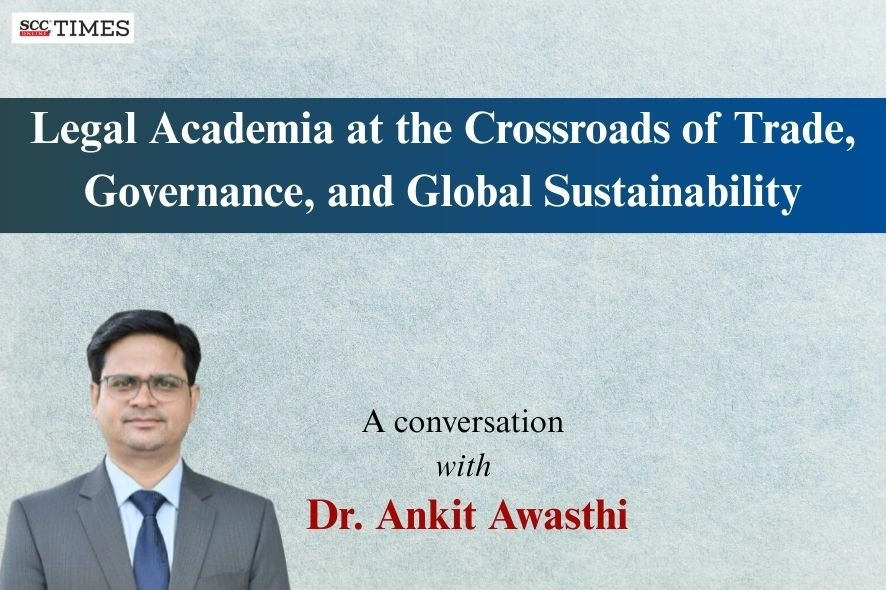
Dr Ankit Awasthi is an Assistant Professor of Law (Senior Scale) and Head of the Centre for World Trade Organization (WTO) & World Intellectual Property Organization (WIPO) Studies, School of Law and Technology (SLT) at Hidayatullah National Law University (HNLU), Raipur. With over 12 years of teaching, research, and academic administration experience, he has significantly contributed to international trade law, corporate governance, and legal policy studies. At HNLU, he holds multiple key roles, including Faculty Coordinator for the Internship and Recruitment Coordination Committee, Alumni Connect, Kautilya Society @HNLU, and TradeLab@HNLU. Dr Awasthi teaches courses at both undergraduate and postgraduate levels and has an extensive record of scholarly publications and editorial engagements. He is closely associated with international organisations such as the Asian Law Schools Association and the International Union for Conservation of Nature (IUCN) Commission on Environmental, Economic and Social Policy, along with several IUCN Commission on Environmental, Economic and Social Policy (CEESP) networks. His leadership in organising national and international level programs reflects his commitment to advancing legal education, research and global policy dialogue.
1. To begin with, kindly introduce yourself. What made you choose a career in law, and legal academia particularly?
I am an Assistant Professor of Law (Senior Scale) and Head of the Centre for WTO & WIPO Studies, SLT at Hidayatullah National Law University (HNLU), Raipur. My journey in law began with a bachelor’s degree from Lucknow University, followed by an LLM and PhD (Corporate Governance) from HNLU. Law operates at the intersection of policy, institutions, and lived realities, offering an expansive landscape for impactful work and scalable solutions at any given moment. I chose a career in law because the subject’s scope and the infinite opportunities it offers for growth and development. Over time, legal academia emerged as a natural choice, as it allowed me to combine teaching, research, and institutional engagement in a meaningful manner.
2. As the Head of the Centre for WTO & WIPO Studies, how do you envision the Centre’s role in advancing interdisciplinary research and contributing to contemporary trade and intellectual property discourse?
The Centre for WTO & WIPO Studies, SLT is envisaged as a platform for interdisciplinary research that bridges the gap between international trade policy and intellectual property rights. In contemporary scenario, trade and intellectual property issues cannot be examined in isolation and therefore the Centre seeks to promote interdisciplinary research, capacity-building programmes, and stakeholder engagement, while also nurturing student participation through simulations, policy briefs, conferences and collaborations with national and international institutions.
In this background it gives me immense pleasure to inform that, we are going to host a three-day in-person International Trade Law Summit titled “The WTO@30 Summit” from 2-October-2026 to 4-October-2026. It will include technical sessions for research paper presentations and panel discussions covering key thematic areas such as digital trade and data governance, sustainable development, institutional reforms, and trade, intellectual property (IP) and competition policy. The Summit will host a Mock WTO Simulation (the first time in India), offering students and young professionals hands-on experience in multilateral trade diplomacy through negotiations and resolution drafting. To provide participants with a broader understanding of trade negotiations and related strategies, a certificate program will also be organised for all registered participants of the Summit prior to the day of the Mock WTO Simulation.
3. Your scholarship spans corporate governance, environmental responsibilities of businesses and international trade. How do these seemingly diverse areas converge in the broader narrative of sustainable development?
These areas are, in fact, deeply interconnected. International trade regimes shape corporate behaviour; corporate governance frameworks determine accountability; and environmental responsibilities reflect the social embeddedness of business operations. These fields converge through the narrative of “sustainable development”. My teaching and research emphasise that businesses must go beyond profit to embrace environmental and social responsibilities. The WTO framework is witnessing a paradigm shift where traditional non-trade concerns, particularly sustainability, are being integrated into the core trade agenda. Addressing these challenges necessitates a multi-layered approach, spanning multilateral agreements and regional initiatives, ultimately manifesting in the domestic regulatory reforms of member states.
4. Your research focuses significantly on institutional reforms and corporate governance. What, in your views, are the key challenges India faces in strengthening its corporate governance framework?
Over the decade, India has made notable progress in formal regulatory reforms; however, challenges persist in effective enforcement and stakeholder-oriented governance. A key concern lies in moving beyond compliance-driven models towards substantive accountability. Additionally, as one of the fastest growing economies of the world, continuously aligning domestic corporate governance standards with evolving global norms without compromising local realities is an ongoing real challenge.
5. You are also a part of multiple IUCN CEESP networks, including those on international policy, business and biodiversity, Asia and youth engagement. What roles do these networks play in shaping global environmental governance?
As per IUCN, “IUCN CEESP contributes to the IUCN’s Mission by generating and disseminating knowledge, mobilizing influence, and promoting actions to harmonize the conservation of nature with the critical social, cultural, environmental, and economic justice concerns of human societies. CEESP members contribute to the mandate of the Commission by providing insights, expertise, and traditional knowledge as well as by promoting policies and actions that relate to the human dimensions of conservation.”
6. You are also a member of the Global Alliance for Justice Education (GAJE). How has GAJE’s philosophy of experiential, justice-oriented legal education influenced your approach to teaching?
GAJE’s emphasis on experiential learning and social justice has had a significant influence on my pedagogical approach. I place strong emphasis on clinical methods, simulations, policy-oriented research, and real-world problem-solving aptitude, while also prioritising critical and cognitive engagement during classroom discussions and through continuous assessment. In this spirit, in collaboration with the Centre for Trade and Investment Law, Indian Institute of Foreign Trade (IIFT), under the aegis of the Ministry of Commerce and Industry, Government of India, we have established TradeLab@HNLU, functioning under the Centre for WTO & WIPO Studies, SLT. The initiative provides students with hands-on exposure to policy-oriented research and practical problem-solving on real trade and regulatory issues entrusted by beneficiaries. Regarding simulations, our focus extends beyond intra-institutional exercises to actively promoting inter-university engagement. The proposed Mock WTO Simulation scheduled for October 2026 stands as a strong example of this commitment to experiential and collaborative legal education.
7. With your experience in internship and recruitment coordination, what general trends do you observe in the employability landscape for emerging legal professionals?
I have observed that the landscape is moving toward a demand for holistic development. Beyond core legal knowledge, employers seek professionals who are committed, consistent, adaptable to technological disruptions and socially relevant. The employability landscape has become increasingly dynamic and diversified. While traditional litigation and law firm roles remain important, there is growing demand in policy research, regulatory practice, international organisations like WTO, compliance, environmental, social and governance (ESG) advisory and technology-driven legal services.
8. Finally, what message would you like to convey to aspiring legal scholars and future practitioners who seek to create impact through academic and policy-driven work?
I would encourage aspiring legal professionals to cultivate intellectual curiosity, methodological rigour, and a strong sense of purpose. Impactful academic and policy work requires patience, consistency, and openness to multidisciplinary and transnational engagement. Meaningful contribution lies in aligning scholarship and practice with broader societal goals of justice, sustainability and good governance.
1. Assistant Professor of Law (Senior Scale) and Head of the Centre for WTO & WIPO Studies, SLT, Hidayatullah National Law University (HNLU), Raipur.
2. Student Ambassador, Faculty of Law, University of Lucknow.

This was such a rich and enlightening conversation — I really appreciate how you framed the discussion at the intersection of law, global trade, and sustainability, which is such an essential but complex space. The interview with Dr. Awasthi offered thoughtful insights into how legal frameworks can evolve to address contemporary demands without sacrificing equity or environmental care. What stood out most was the balance between scholarly depth and real-world application — making the legal concepts feel relevant to practitioners, academics, and students alike. It’s the kind of piece that encourages deep reflection while also inspiring action toward more integrated and forward-thinking governance.