
Disclaimer: This has been reported after the availability of the order of the Court and not on media reports so as to give an accurate report to our readers.
Delhi High Court: In a criminal revision petition filed under Sections 397 and 482 of the Criminal Procedure Code, 1973 (CrPC) challenging the discharge order dated 06-02-2023, in a summons case at the stage of Section 251 CrPC, a Single-Judge Bench of Amit Mahajan, J., set aside the discharge order and remitted the matter to the Magistrate for further proceedings. The Court held that —
-
Magistrates cannot recall summons in complaint-based summons cases.
-
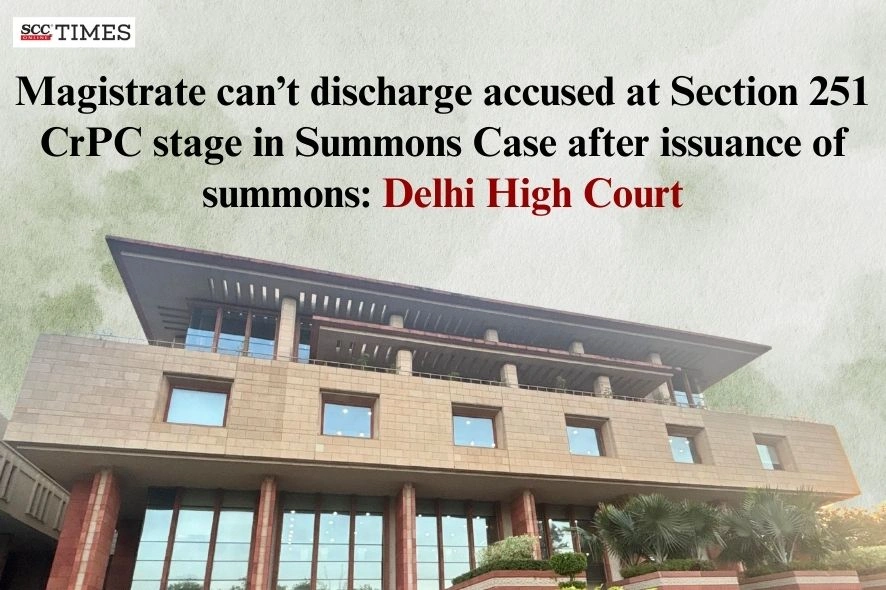
Magistrate can’t discharge accused at Section 251 CrPC stage
-
Discharge under Section 239 CrPC is impermissible in summons trials.
-
Section 251 CrPC is not a stage for adjudicating the sufficiency of evidence.
Factual Matrix
The complainant-petitioner company was incorporated on 21-022013 for setting up a multispecialty hospital near Sonipat, Haryana. The accounts of the petitioner company were maintained from Saxena Hospital (Block B) which also functioned as a back office.
Between 2013 and 2019, the respondents drew substantial consultant fees and directors’ remuneration. In 2019, disputes arose after Respondent No.1 incorporated a separate hospital entity and began diverting his professional time.
The respondents resigned as directors on 04-06-2019. Thereafter, they declined to transfer their shareholding and allegedly usurped Saxena Hospital (Block B), denied access to the complainant company, and unlawfully retained books of accounts, TALLY records and valuable diagnostic and surgical machines valued at approximately ₹1.47 crores.
Procedural History
The petitioner company filed a criminal complaint under Section 452 of the Companies Act, 2013 read with Section 200 CrPC. Magistrate took cognizance and issued summons on 18-11-2020. The summoning order was challenged before the Delhi High Court and withdrawn on 03-05-2021. At the stage of Section 251 CrPC, the Magistrate discharged the accused by applying Section 239 CrPC.
Aggrieved, the petitioner company filed a revision petition under Sections 397 and 482 CrPC challenging the discharge order dated 06-02-2023.
Moot Point
Whether a Magistrate can discharge an accused in a summons case at the stage of Section 251 CrPC after cognizance has been taken and summons have been issued?
Parties’ Contentions
The petitioner contended that the Magistrate acted in disregard of binding precedent. It was stated that in a summons trial governed by Chapter XX CrPC, there is no stage of discharge and Section 239 CrPC applies only to warrant cases under Chapter XIX. It was contended that the Magistrate had no power to recall or review the summoning order. It was argued that the Magistrate’s reliance on Bhushan Kumar v. State (NCT of Delhi), (2012) 5 SCC 424 was misplaced and per incuriam in light of larger bench decisions.
On the other hand, the respondents contended that the Magistrate rightly applied Bhushan Kumar (Supra). IT was argued that at the Section 251 stage, the Magistrate must examine whether any offence is disclosed and if no offence is made out, the accused can be discharged.
Court’s Analysis
The Court examined the scope of Section 251 CrPC and reiterated that “a bare reading of the aforesaid provision shows that the provision only contemplates that the particulars of the alleged offence be stated to the accused and does not empower the Magistrate to conduct a mini-trial.”
Relying upon Subramanium Sethuraman v. State of Maharashtra, (2004) 13 SCC 324; Adalat Prasad v. Roopal Jindal, (2004) 7 SCC 338 and In Re: Expeditious Trial of Cases under Section 138 NI Act, 2021 SCC Online SC 325, the Court held that “a summons case is covered under Chapter XX of the CrPC which does not contemplate a stage of discharge like Section 239 of the CrPC which provides for discharge in a warrant case.”
The Court further held that the Magistrate has no power to recall summons once issued. The Court stated that “the Trial Court cannot be conferred with inherent power either to review or recall the order of issuance of process.”
On the reliance placed on Bhushan Kumar (Supra), the Court applied the “inversion test” and held that the observation regarding discharge at the Section 251 stage was merely a passing reference and not the ratio decidendi.
The Court asserted that “Section 251 of the CrPC contemplates only that the particulars of the offence be explained to the accused and it does not empower the Magistrate to undertake a mini-trial or to evaluate defence on merits.”
Court’s Decision
The Court held that the Magistrate can’t discharge accused at Section 251 stage in a summons case after cognizance has been taken and summons have been issued. The Court further held that the discharging the accused at Section 251 stage amounts to a recall of process with is impermissible in law.
“The Magistrate is not empowered to discharge an accused in a summons trial at the stage of Section 251 of the CrPC after having taken cognizance of an offence and issued summons to the accused. The same would amount to recalling of summons by the Magistrate which as noted in a catena of judgments is impermissible in law.”
The Court allowed revision petition, set aside the impugned discharge order and remitted the matter to the Magistrate for further proceedings. The Court clarified that it had not examined the merits of the complaint.
[Tulip Multispecialty Hospital (P) Ltd. v. Akhil Saxena, 2026 SCC OnLine Del 63, Decided on 05-01-2026]
Advocates who appeared in this case:
Mr. Tanveer Ahmed Mir, Ms. Pooja Mehra Saigal, Senior Advocates with Mr. Tanmay Mehta, Mr. Simrat Singh Pasay, Mr. Ankit Mittal, Ms. Ariana Ahluwalia and Ms. Yashodhara Singh, Counsel for the Petitioner
Mr. Vikram Singh Panwar, Mr. Abhimanyu Singh, Mr. Haresh Nair, Mr. Yash Kadyan and Mr. Yash Luthra, Counsel for the Respondents
Buy Code of Criminal Procedure, 1973 HERE