
Disclaimer: This has been reported after the availability of the order of the Court and not on media reports so as to give an accurate report to our readers.
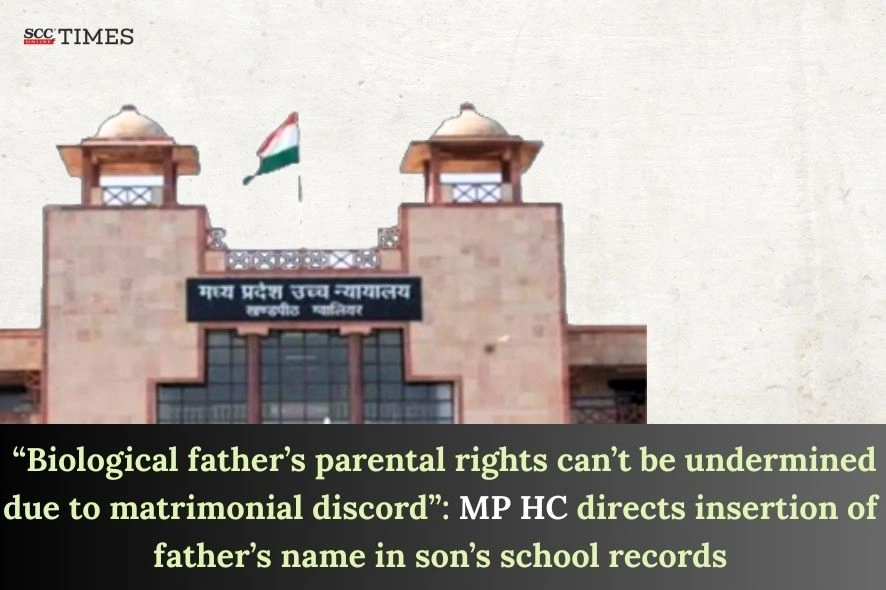
Madhya Pradesh High Court: In a writ appeal filed by a father seeking insertion of his name in his child’s school records, the Division Bench of Anand Pathak* and Anil Verma, JJ., allowed the appeal, holding that the parental rights of a biological father cannot be undermined at the altar of dispute between the couple.
Background
The appellant was the biological father of a minor child who was studying in Little Angels High School, Gwalior (“the school”). In the previous educational institutions of the child in Bengaluru, the appellant’s name was duly recorded as the father in all school records.
Due to a matrimonial dispute, the appellant and his wife got involved in various legal proceedings, including a custody dispute. According to various orders passed by the Karnataka High Court, the appellant was granted visiting rights, and he regularly paid the child’s school fees.
Allegedly, despite compliance, the child’s mother did not allow the appellant meaningful access or contact with his child. Aggrieved, he approached the respondent authorities on multiple occasions, requesting that his name be included in the school records as the child’s father and that he be granted access to the child’s academic records, along with the school app login credentials. However, these requests were refused. Therefore, he filed a writ petition, but it was dismissed on the point of maintainability.
Hence, the present appeal.
Analysis
Regarding maintainability, the Court noted that the child was 8-9 years old, hence he was included in the purview of the Right to Education Act, 2009 (“RTE Act”). Additionally, the child’s school fell under “an unaided school” as per Section 2 (n) (iv) of the RTE Act. The District Education Officer and District Project Coordinator under the District Education Center were part of the local authority that had to perform duties as prescribed in Section 9 of the RTE Act and Rule 10 of the Right of Children to Free and Compulsory Education Rules, 2010 (“RTE Rules”), which included the duty to maintain records of the children. Furthermore, Rule 10 (4) (b) of the RTE Rules stipulated that records must mention the name, address, and occupation of the parent or guardian. Thus, the Court held that it was abundantly clear that, as per the RTE Act, it is the duty of the State to ensure the admission of the child and maintenance of records by the school.
Accordingly, the Court noted that in the present case, the appellant approached the District Education Officer and District Project Coordinator, and, realizing their duties, both authorities issued letters to the school to do the needful regarding the inclusion of the appellant’s name. Although they wrote letters, they failed to cause the incorporation of the appellant’s name. Similarly, the School was also obliged under the RTE Act to maintain a record of children properly, but failed to do so. Therefore, the Court held that a public law remedy was available in the present case, and a writ petition against them was maintainable.
Regarding the Writ Court’s reliance on the judgment in St. Mary’s Education Society v. Rajendra Prasad Bhargava, (2023) 4 SCC 498, the Court stated that the facts of said case were a bit different vis-à-vis the instant case. In that case, an employee of an unaided institute preferred a writ petition against his termination, and therefore, the Supreme Court held that individual wrongs or breach of mutual contracts without having any public element as its integral part cannot be rectified through a writ petition under Article 226. Since the action complained of had a public element and a public law element was involved, the Court held that the decision in St. Mary’s Education Society (supra) supported the cause of the appellant regarding maintainability of the petition.
Therefore, the Court held that the instant writ petition under Article 226 of the Constitution was maintainable and the Writ Court erred in glossing over this legal position.
The Court stated that even otherwise, the appellant could not be rendered remediless. If he wanted the incorporation of his name in the school record and the school is bound to function in a particular manner as per the RTE Act, then it was the duty of the District Education Officer and Project Coordinator to ensure compliance. If any authority or the school does not comply with the provisions, then the only effective remedy is to file a writ petition under Article 226 of the Constitution. No other effective remedy was available to the appellant.
Thus, the Court held that it was the duty of the District Education Officer, District Project Coordinator, and the school to maintain records in a proper manner and as per Sections 8 and 9 of the RTE Act, and Rules 6,9 and 10 of the RTE Rules, the record must include the name, address, and occupation of the parent or guardian. In the present case, admittedly, the appellant was the biological father of his son; therefore, paternity was not doubtful.
Reiterating that the welfare of the child is of paramount consideration, the Court stated that it was in the welfare of the child that he carries his identity correctly and properly. His identity owed to the names of his father and his mother, and this would develop him as a healthy child. Therefore, from this vantage point as well, the Court held that the inclusion of the appellant’s name in the school record of his son was required.
In this regard, the Court referred to Jigya Yadav v. CBSE, (2021) 7 SCC 535, wherein while dealing with the change of name of a student, the Supreme Court held that a writ petition is maintainable against CBSE and discussed regarding identity of an individual based upon his outer characteristics and discussed the significance of the acquired identity in the form of name. Thus, in the present case, the Court held that the incorporation of the name of the father would make the identity complete.
The Court also considered the aspect that a school record would ultimately form the basis of other public documents like a Passport, an Aadhar Card, a Pan Card, a Bank Account, etc. Therefore, the record at the inception deserved to be corrected via the incorporation of the names of both parents. Thus, the Court held that the impugned order deserved to be set aside as the Writ Court glossed over all these aspects and committed an error.
“Parental rights of a biological father cannot be undermined at the altar of dispute between the couple. A child should not suffer the dispute, either emotionally or educationally/ socially.”
Regarding the contention that the appellant had a history of history of verbal and physical abuse with the mother of the child, other relatives and friends, and he ought to be prohibited from directly communicating with the school staff, teachers, or the Principal, the Court directed that restrictions shall be imposed on the appellant from visiting the child at the school or issuing instructions to the school authorities. Additionally, no details about the marital dispute shall be disclosed to any of the school staff or any person related thereto, including the sharing of photographs or any other kind of communication.
Regarding the mother’s apprehension that the school’s app had a feature for sending messages to staff, the Court directed that the appellant shall be prohibited from communicating or sending messages to the school staff.
Accordingly, the appeal was allowed, and the following directions were issued:
-
The school shall make necessary corrections in the school record and incorporate the name of the appellant as the father of his child.
-
The District Education Officer and District Project Coordinator shall ensure correction of the school records as per the RTE Act.
-
The appellant shall have limited access to the progress of his son, which shall be communicated via the school app, but he shall not be permitted to engage with school authorities/staff in any manner on his own.
-
Any detrimental act by the appellant that undermines the welfare of the child shall not be permitted by the school and district authorities.
[Vickramh Kkalmady v. State of Madhya Pradesh, 2025 SCC OnLine MP 9895, decided on 17-12-2025]
*Judgment authored by Justice Anand Pathak
Advocates who appeared in this case:
For the appellant: Advocates Smrati Sharma and Krati Sachdev
For the respondent: Senior Advocate & Additional Advocate General Vivek Khedkar, Govt. Advocate Ravindra Dixit, and Advocates Vishal Tripathi, Prashant Sharma, M.K. Sharma and Divakar Vyas