
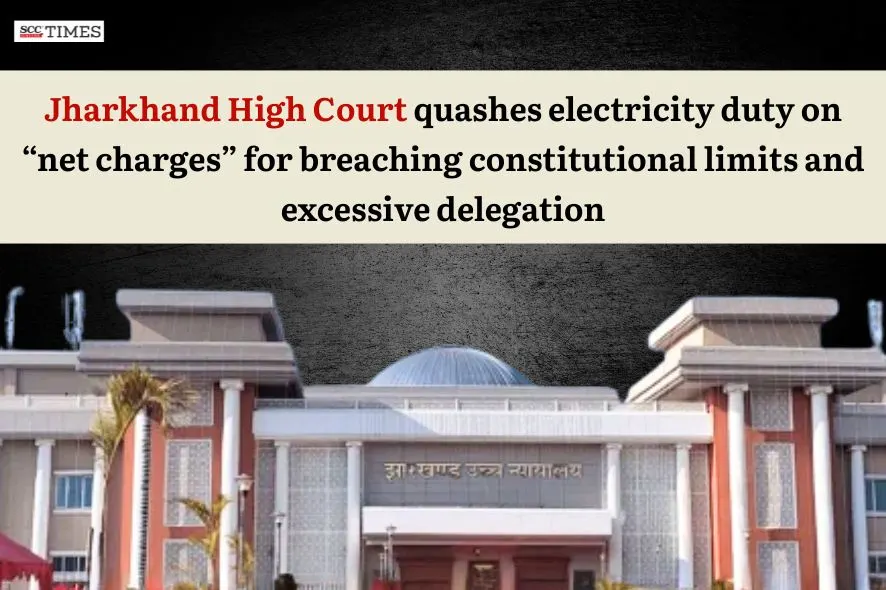
Jharkhand High Court: In writ petitions challenging the Jharkhand Electricity Duty (Amendment) Act, 2021 (‘Act of 2021’) and the Jharkhand Electricity Duty (Amendment) Rules, 2021 (‘2021 Rules’), the Division Bench of Tarlok Singh Chauhan, CJ., and Rajesh Shankar*, J., held that levy of duty on “net charges” was ultra vires the Bihar Electricity Duty Act, 1948 (‘Act of 1948’). The Court stressed that Article 265 of the Constitution bars taxation without authority of law, found excessive delegation to the executive impermissible, and ruled that retrospective application of the 2021 Rules and arbitrary increases in duty violated Article 14 of the Constitution.
Background
The petitions challenged the vires and validity of Sections 2 and 3 of Act of 2021 notified on 07-07-2021, as well as the 2021 Rules notified on 01-04-2022. Captive consumers also challenged the 2nd Amendment Act, 2021 notified on 17-02-2022.
It was contended that prior to the amendment, duty was levied at five paise per unit under Section 3 of the Act of 1948. The 1st Amendment introduced levy at 8 per cent or 15 per cent of “net charges,” drastically increasing liability in one case by nearly 1000 per cent. Petitioners argued that Section 3(1) of the Act of 1948 authorised levy only on units of energy consumed or sold, and that the Schedule could not introduce a new basis of taxation.
Counsel submitted that the proviso inserted by the amendment delegated unbridled power to the executive to alter categories and rates without guidelines, amounting to abdication of legislative function. The term “net charges” was said to be undefined and ambiguous, leading to arbitrary interpretation. Captive power plants argued that levy on “net charges” was unworkable since they generated their own electricity and did not pay charges.
It was further contended that retrospective application of the 2021 Rules was impermissible under Section 10 of the Act of 1948, that anomalies arose because different distribution licensees had different tariffs, and that arbitrary increases in duty violated Articles 14 and 265 of the Constitution.
On behalf of the State, it was submitted that the Act of the 1948 empowered specification of rates in the schedule, that the amendments were prospective, and that the Rules only clarified the calculation methodology of “net charges.” The State argued that higher rates of duty existed in other states, that revenue maintenance justified the increase, and that the legislature was competent to delegate implementation details to the executive.
Analysis and Decision
The Court emphasised that Entry 53 of List II empowers the State Legislature to enact laws on “Taxes on the consumption or sale of electricity.” It was noted that Section 3(1) of the Act of 1948 is the charging section, which provides that duty shall be levied on the units of energy consumed or sold, excluding losses of energy in transmission, at the rate or rates specified in the Schedule.
The Court observed that provisions contained in the Schedule must be in consonance with substantive provisions, and respondents cannot introduce a new basis for levy of tax by amending the Schedule without amending the charging section. It was highlighted that Article 265 of the Constitution mandates that no tax shall be levied or collected except by authority of law, and therefore imposition of duty on net charges was de hors the charging section.
The Court noted that excessive delegation of legislative power to the executive without guidelines was impermissible, and that the proviso inserted by the amendment was hit by the doctrine of separation of powers. It was further observed that the term “net charges” was undefined and ambiguous, leading to scope for arbitrary interpretation.
The Court emphasised that retrospective application of the 2021 Rules was invalid, as Section 10 of the Act of 1948 did not confer such power. It was noted if electricity duty is charged on per cent of ‘net charges’ for energy consumed or sold, then similarly situated persons pay different duty depending on the distribution licensee, since the tariff fixed by the Jharkhand State Electricity Regulatory Commission (‘JSERC’) varies, which would amount to violation of Article 14 of the Constitution.
Accordingly, the Court held that the amendments introducing levy on “net charges” were ultra vires to the parent Act, that retrospective application of the Rules was impermissible, and that arbitrary increases in duty violated constitutional provisions.
[Pali Hill Breweries (P) Ltd. v. State of Jharkhand, 2026 SCC OnLine Jhar 14, decided on 05-01-2026]
*Judgment authored by: Justice Rajesh Shankar
Advocates who appeared in this case:
For the Petitioners: M.S. Mittal, Sr. Advocate, Kavin Gulati, Sr. Advocate, Bharat Rai Chandani, Advocate, Salona Mittal, Advocate, Lavanya Gadodia Mittal, Advocate, Yashdeep Kanhai, Advocate, Divya Choudhary, Advocate, Amrita Sinha, Advocate, Shweta Suman, Advocate, Pragunee Kashyap, Advocate, Indrajit Sinha, Advocate, Sweta Rani, Ankit Vishal, Advocate, Deepak Kr. Sinha, Advocate, Vikas Pandey, Advocate, Omkar Sharma, Advocate, Piyush Poddar, Advocate, Janak Kumar Mishra, Advocate
For the Respondents: Sachin Kumar, AAG-II with Gaurav Raj, Srikant Swaroop, Ashwini Bhushan, Gaurang Jajodia, Srijit Choudhary, Advocate, Sanjoy Piprawall, Advocate, Prince Kumar, Advocate, Ashok Kr. Yadav, Aditya Kumar, Advocate, Varsha Ramsisaria, Advocate
Buy Constitution of India HERE