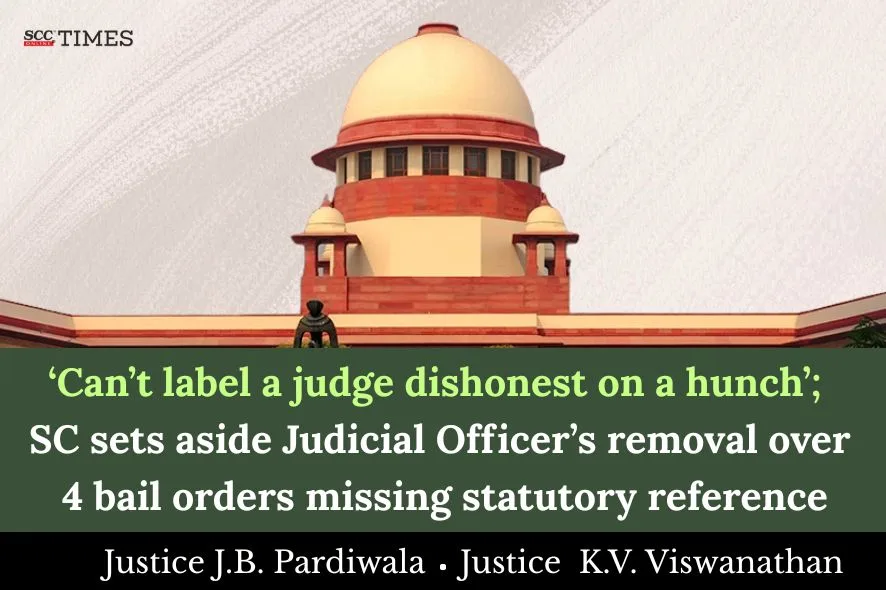
Supreme Court: While considering this appeal filed by a judicial officer challenging his removal after 27 years of unblemished service on account of 4 judicial orders that did not expressly refer to Section 59-A of the MP Excise Act and by which he enlarged certain parties on bail, the Division Bench of J.B. Pardiwala** and K.V. Viswanathan*, JJ., allowed the appeal reasoning that it will be a dangerous proposition to hold that judgments and orders which do not refer expressly to statutory provisions are per se dishonest judgments.
In his supplementary opinion, Pardiwala, J., added that a mere wrong order or wrong exercise of discretion in grant of bail by itself without anything more, cannot be a ground to initiate departmental proceedings. To dunk an officer into the puddle of “doubtful integrity” it is not enough that the doubt fringes on a mere hunch. That doubt should be of such a nature as would reasonably and consciously be entertainable by a reasonable man on the given material. Mere possibility is hardly sufficient to assume that it would have happened. There must be preponderance of probability for the reasonable man to entertain doubt regarding that possibility. Only then there is justification to ram an officer with the label ‘doubtful integrity’.
Background:
The appellant joined service on 31-10-1987 as Civil Judge (Junior Division) in the Madhya Pradesh Judicial Service. The appellant scaled the ladder up and in 2003 was promoted as Additional District Judge and in September 2008 was confirmed in the said post. On 16-05-2011, he was transferred to Khargone, District Mandaleshwar (MP), where he joined as First Additional District & Sessions Judge. In the course of discharge of his duties, he dealt with several matters, including bail applications under the Excise Act.
A resident of Jaitapur, Khargone, lodged a complaint with the Chief Justice of the Madhya Pradesh High Court, Jabalpur, alleging that the appellant was taking bribe through his steno, namely for grant of bail in cases under the Excise Act in which the quantity of seized liquor was 50 Bulk liters or more; that due to such corrupt employee, the judiciary was getting defamed; that even in 1995-96, serious complaints of bribery were made against the said employee on which no action was taken; that the said employee has been posted in Khargone for more than 25 years and is earning money through illegal means and that an inquiry is essential.
A preliminary inquiry was conducted by the District Judge (I & V), Indore Zone, against the appellant and on 06-10-2012, the Principal Registrar (I & V) put up a note based on which it was decided to initiate departmental proceedings against the appellant. In the preliminary inquiry certain orders passed by the appellant in bail proceedings seem to have been examined and few orders pulled out. Two charges were framed against the appellant of which the second charge admittedly was held not proved by the inquiry officer.
The appellant was charged for corrupt motive or that for some extraneous consideration, bail applications were allowed contrary to Section 59-A of the MP Excise Act. It was found in the enquiry that in the 4 orders, Section 59-A of the Madhya Pradesh Excise Act, 1915 was not referred to. A contrast was made with 14 other bail orders, where the appellant had rejected bail.
Madhya Pradesh High Court had opined that in the 14 other orders the appellant’s reference to the said Section implied thereby that he was conscious of the existence of the said Section on the statute. Section 59-A of the MP Excise Act prescribes the “twin conditions” for grant of bail.
Court’s Assessment:
Perusing the matter, the Court had to consider whether the authorities were justified in removing the appellant from service?
Pointing out that the present case is that of a Disciplinary Inquiry against the senior Judicial Officer, the Court observed that a Judicial Officer is tasked with the onerous duty of deciding cases. Invariably one party to the case would lose and go back unhappy. Disgruntled elements amongst them, wanting to settle scores may raise frivolous allegations. The Trial Judiciary also has tremendous work pressure and works under trying working conditions. Large number of cases are listed in a day and most of the judicial officers give their very best while discharging their duties. Equally, if the complaint of misconduct against the judicial officer is prima facie found to be true, prompt action to initiate disciplinary proceeding should be taken and no leniency should be shown if the charges are established. Not only this, in appropriate cases where criminal prosecution is warranted against a judicial officer, the High Court should not hesitate to have the same initiated.
The Court observed that due care and caution must be exercised by the High Court in initiating such proceedings. It should be ensured that only because an order is wrong or there is an error of judgment, without anything more, a judicial officer is not put through the ordeal of a disciplinary proceeding or a prosecution.
Relying on relevant precedents, the Court stated that inference of misconduct or about extraneous considerations having actuated, the decision cannot be drawn merely from a hypothesis that a decision is erroneous. It has been held that a wrong decision can yet be a bona fide error of judgment and inadvertence is consistent with an honest error of judgment. “Ultimately, it is not the correctness of the verdict but the conduct of the Officer in question which is determinative”.
Perusing the relevant precedents on High Court’s approach dealing with such cases, the Court then applied the principles onto the facts of the present case and pointed out that the appellant has been held guilty of misconduct only based on certain judicial orders granting bail without anything more. The Court gave the following reasons:
-
The complaint was primarily against the stenographer who has been working in Khargone for a long time even before the appellant assumed office in Khargone.
-
The complaint neither set out any particulars nor set out any judicial order. It was general in nature.
-
The complainant was not examined in the inquiry. The witnesses examined in support of the charge did not support the charge.
-
The prosecutor who appeared in each of the 18 bail orders was examined on behalf of the defence and even he deposed that the State accepted the orders granting bail without mounting any challenge in the higher court. He categorically deposed that the orders were absolutely proper and were passed on proper grounds.
-
A perusal of the four orders show that reasons have been given, though there is no express mention Section 59-A (2) of the MP Excise Act. In one bail order, the appellant mentions about the filing of the challan and the possibility of the trial consuming lot of time. In the said order, the appellant has relied on Article 21 though he has not expressly mentioned the same. In the other bail orders, he mentions about the applicants being rural farmers and not being a flight risk and so on.
-
No material placed on record to show that there are circumstances from which inference could be drawn that extraneous considerations actuated the passing of those orders of bail. The hypothesis was drawn only on the basis that the order did not make reference to the statutory provision expressly.
-
The finding that in 14 other orders he referred to Section 59-A (2) of the Excise Act is by itself not enough to infer misconduct in the passing of the four bail orders in question.
The Court stated that the High Court made an error by no interfering with the order of dismissal. “We make bold to record a finding that on the available material, no reasonable person would have reached the conclusion that enquiry officer reached”.
Therefore, the Court allowed the appeal and the removal order dated 02-09-2015, the order of Appellate Authority dated 17-03-2016 and the impugned order of the High Court were set aside. The appellant shall be deemed to have continued in service till he attained the normal age of superannuation. Since the appellant has been kept out of service for no fault of his, the Court opined that full back wages with all consequential benefits should be given to the appellant.
Supplementary Opinion by Justice J.B. Pardiwala:
Pardiwala, J., stated that if the complaint of misconduct against the judicial officer is prima facie found to be true then, in such circumstances, disciplinary proceedings must be taken, and no leniency should be shown if the charges are established. In an appropriate case, even criminal prosecution may be instituted against a judicial officer. Such action is necessary to weed out tainted judges from the judiciary. It goes without saying that corruption in the judiciary at any level is intolerable, as corruption severely undermines the core of the administration of justice and erodes public trust in the rule of law. “However, the High Court, which is vested with the supervisory control must keep in mind that a judicial officer of the district judiciary works mostly in a charged atmosphere”.
Pardiwala, J., further elaborated that initiation of departmental proceedings on mere suspicion is one of the primary causes why trial court judges are reluctant when it comes to exercising discretion for the purpose of grant of bail. “This is one reason why the High Courts are flooded with bail applications. The same is the scenario even so far as the Supreme Court is concerned”. For functioning of democracy, an independent judiciary to dispense justice without fear and favour is paramount.
The authorities should not keep the eyes totally closed towards the overall estimation in which the delinquent officer was held in the recent past by those who were supervising him earlier.
[Nirbhay Singh Suliya v. State of MP, 2026 SCC OnLine SC 8, decided on 5-1-2026]
*Judgment by Justice KV Viswanathan
**Supplementary opinion by Justice J.B. Pardiwala
Advocates who appeared in this case:
For Petitioner(s): Mr. Dama Seshadri Naidu, Sr. Adv. Mr. Yash S. Vijay, AOR Mr. Kanu Agrawal, Adv. Mr. Chetan Kanungo, Adv. Ms. Anisha Mahajan, Adv. Mr. Shikhar Aggarwal, Adv.
For Respondent(s): Mr. Arjun Garg, AOR Ms. Sagun Srivastava, Adv. Ms. Arushi Kulshrestha, Adv. Mr. Saaransh Shukla, Adv.