
Disclaimer: This has been reported after the availability of the order of the Court and not on media reports so as to give an accurate report to our readers.
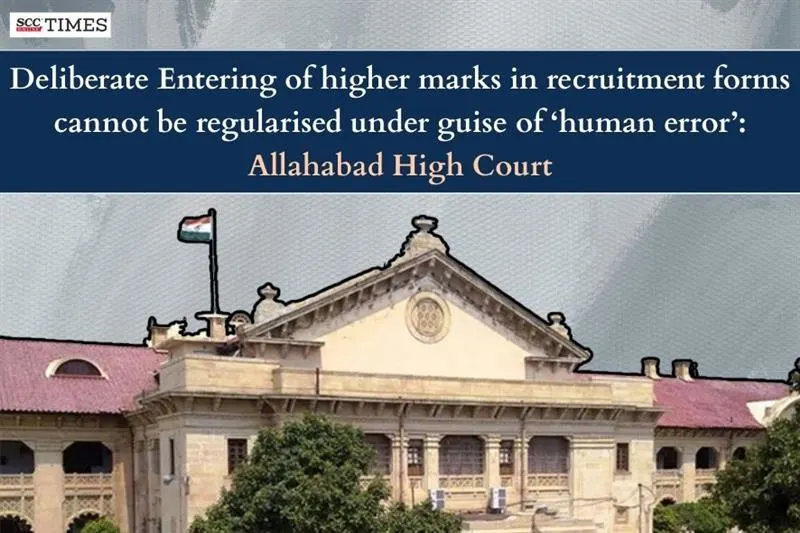
Allahabad High Court: While considering a petition challenging orders passed by Respondents 3 and 4 whereby services of the petitioners were terminated for mentioning increased marks in the application form while applying for Assistant teachers, a Single Judge Bench of Manju Rani Chauhan*, J., held that entering higher marks than actually obtained was not a mere clerical lapse but a deliberate act capable of altering the merit position and could not be regularised under the guise of ‘human error’.
The Court further stated that public employment is a matter of public trust which beings upon the State a constitutional obligation to uphold the integrity of the selection process and any illegality could not ripen into a legal right merely because it remained unnoticed for some time.
Background
In December 2018, the State Government issued a Government Order notifying the holding of Teachers Recruitment Examination 2019 Assistant for the appointment against 69000 posts of Assistant Teachers. The petitioners, being eligible for the post, applied to the said advertisement. When the result was declared in May 2020, the petitioners qualified.
In May 2020, the State Government issued a Government Order for consideration of the appointments of selected candidates as Assistant Teachers pursuant to which petitioners applied for the appointment. Thereafter, a final select list was published by which the petitioners were duly selected.
The District Basic Education Officer (‘District Officer’) conducted counselling and initially some objections were raised against the petitioners. Therefore, the said District Officer published a list of candidates whose cases were kept pending on account of such objections. For rectification, the matter was considered at the level of the State Government, whereafter Government Orders were issued requiring the candidates to furnish individual affidavits before the District Officer. After consideration of petitioners’ cases, appointment orders were issued, and petitioners accordingly joined their services.
In May 2025, Respondent 3 terminated their services in compliance with the instructions issued by Respondent 2 stating that appointments of all teachers who were placed in an advantageous position by mentioning higher marks than they actually secured were to be cancelled. Thus, the petitioners approached the High Court.
The petitioners contended that they had efficiently discharged their duties for almost five years and they were holding regular and permanent appointments, thus, their services could not be dispensed with without following the procedure as specified under the Uttar Pradesh Basic Education Staff Rules, 1973 and Uttar Pradesh Government Servant (Discipline and Appeal) Rules, 1999.
Analysis and Decision
The Court noted that the petitioners failed to satisfactorily respond to the objections raised by the respondents 3 and 4 that the petitioners concerned had mentioned higher marks than those actually secured. The Court further noted that Petitioners 1, 5, 6 and 7 did not mention higher marks than they actually possess, though, the mistake occurred at their end was bonafide.
The Court stated that entering higher marks than actually obtained was not a mere clerical lapse but a deliberate act capable of altering the merit position, therefore it could not be regularised under the guise of ‘human error’. The Court further stated that any undue advantage so obtained was illegal and vitiated the selection itself as entering marks higher than the candidate has actually secured is a conscious act that materially alters the candidate’s position in the merit list. Such conduct cannot be trivialised as a human error.
The Court stated that “It is a cardinal principle of service jurisprudence that fraud vitiates every solemn act. A candidate who enters the selection process by misrepresenting material particulars, such as academic marks that constitute the very basis of merit-based recruitment, cannot invoke the equitable doctrine of estoppel.” Further, the Court stated that public appointments should strictly conform to statutory norms and prescribed eligibility criteria and “Where an applicant manipulates higher marks to obtain an undeserved advantage, the appointment becomes tainted from its inception.” Thus, the Court held that since there could be no estoppel against statute, the employer was empowered and indeed duty-bound to annul an appointment obtained in derogation of the recruitment rules, notwithstanding any administrative lapse or delay.
Further, the Court clarified that the time granted by the appointing authority to rectify the application form was meant to correct bonafide clerical or inadvertent errors, not to sanitise a deliberate falsification of essential data. A procedural indulgence extended by the authority could not be construed as a waiver of its right to scrutinise the veracity of the information furnished or to act upon detection of misrepresentation. Even the issuance of an appointment letter does not confer any indefeasible or vested right to continue in service when the very foundation of the appointment got vitiated. The Court stated that “An employment secured by deceit is voidable at the instance of the employer, and neither length of service nor any administrative oversight can breathe legitimacy into an appointment that is tainted from the outset.”
The Court stated that public employment is a matter of public trust, and the State is under a constitutional obligation to uphold the integrity of the selection process, and an illegality does not ripen into a legal right merely because it remained unnoticed for some time. Once the appointment was shown to have been procured by misrepresentation of marks, the employer was under no legal obligation to continue such an appointment. Since the very entry into service was tainted, the candidate could not claim protection under Articles 14 or 311 of the Constitution.
The Court further viewed that permitting estoppel in such circumstances would undermine the sanctity of meritocracy, distort the selection process, and result in the displacement of genuinely more meritorious candidates. Thus, the Court held that where a candidate deliberately enters marks higher than those actually secured, thereby placing himself/herself in a position of unwarranted advantage and ultimately securing appointment, such appointment cannot be termed legal or valid. Such an act, by any stretch of reasoning, could not be treated as a mere human error or an inadvertent mistake, as it conferred an undue advantage upon the candidate to the prejudice of other eligible aspirants and struck at the very root of fairness and transparency in the selection process. Therefore, their subsequent appointment was vitiated ab initio, and no estoppel could arise to protect an appointment that was fundamentally illegal.
Hence, the Court held that since it was a case of deliberate attempt to mention higher marks than actually possessed, the petitioners were not entitled for any relief. However, the case Petitioners 1, 5, 6 and 7 fell within the criteria of disadvantage, thus, their appointme5, 6nts were based on the merit criteria they possessed. Thus, the Court quashed the termination order with respect to them.
[Awadhesh Kumar Chaudhary v. State of UP, 2025 SCC OnLine All 8077, decided on 16-12-2025]
Advocates who appeared in this case:
For the Petitioner: Siddharth Khare, Sr. Advocate
For the Respondent: Archana Singh, C.S.C
Buy Constitution of India HERE