
Disclaimer: This has been reported after the availability of the order of the Court and not on media reports so as to give an accurate report to our readers.
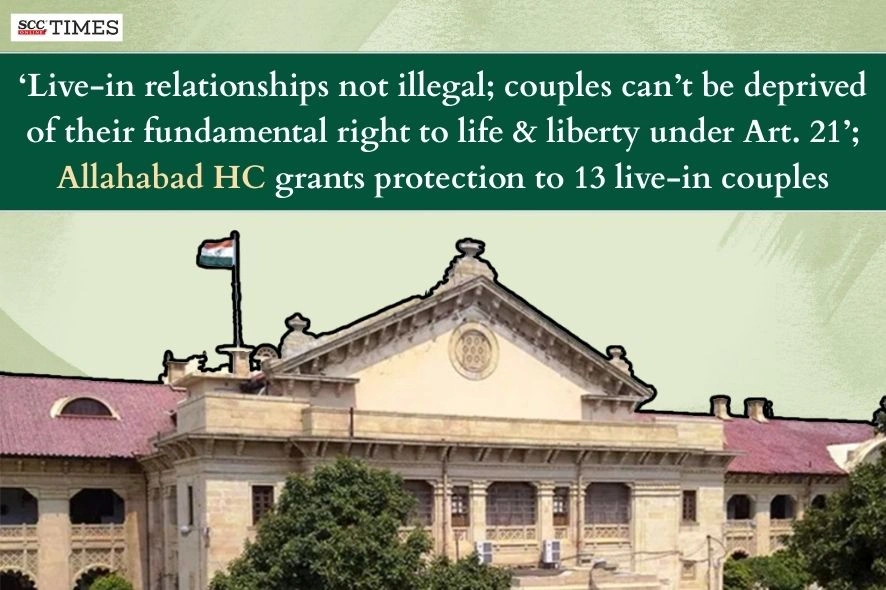
Allahabad High Court: In a batch of 13 writ petitions filed by live-in couples seeking protection from their family and others, the Single Judge Bench of Vivek Kumar Singh, J., allowed the petitions, holding that the petitioners were at liberty to live together peacefully and no person shall be permitted to interfere in their peaceful living. The Court reiterated that live-in relationships are not illegal, constitute marriage under the law, and couples cannot be deprived of their right to life and liberty.
Background
A large number of petitions were being filed in the Court wherein the petitioners had decided to stay together in a live-in relationship. However, they claimed that they had an apprehension of a threat to their lives from the private respondents, and they approached the police, but to no avail.
Hence, the present writ petitions were filed with the prayer that the police be directed to provide protection from private respondents, as well as other family members/relatives/associates of the private respondents, from causing any harm to the petitioners.
Analysis
At the outset, the Court remarked that marriage is a sacred relationship in India. It has its legal consequences, entitles both persons to cohabit, children born out of a legal wedlock have legitimacy as legal heirs, the wife is entitled to maintenance during and after the dissolution of marriage. To avoid these responsibilities and to enjoy the benefits of living together, the concept of living together was invented.
“Live-in relationship provides for a life free from responsibilities and commitment, unlike in a marriage. In this relationship, an unmarried couple lives together under the same roof in a way that resembles a marriage, but without getting legally married.”
Stating how live-in relationships were not socially acceptable in India, the Court stated that the concept is still facing social stigma and moral debate, especially regarding traditional values, children, and differing religious/cultural perspectives. For some, it is immoral, while others see it as a valid choice for compatibility.
Without considering the morality of such relationships, the Court examined whether any illegal act had been committed by the petitioners and whether they were entitled to any relief.
The Court referred to several landmark judgments in this regard. In Badri Prasad v. Dy. Director of Consolidation, (1978) 3 SCC 527, wherein the Supreme Court, for the first time, recognized a live-in relationship and interpreted it as a valid marriage. Furthermore, in Tulsa v. Durghatiya (2008) 4 SCC 520, the Supreme Court stated that there is no rule that shows that living together with someone is unlawful, and children conceived out of such a relationship will not be considered as illegitimate. In the case of S. Khushboo v. Kanniammal, (2010) 5 SCC 600, the Supreme Court held that adults willingly engaging in sexual relations outside the marital setting is not an offence.
The Court questioned, “Can this Court be a silent spectator when its extraordinary jurisdiction under Article 226 of the Constitution is invoked seeking its protection for personal liberty by a young couple whose only fault is that they have crossed the bridge which is not socially acceptable by our society?”
After perusal of several cases wherein both the Supreme Court had ruled in favour of live-in relationships, and the law recognized them as married, the Court stated that evidently the Supreme Court has consistently respected the liberty of an individual who has attained the age of majority. An individual, upon attaining majority, is statutorily conferred a right to choose a partner, which, if denied, would not only affect his/her human rights, but also his/her right to life and personal liberty, guaranteed under Article 21 of the Constitution.
Noting that under the Protection of Women from Domestic Violence Act, 2005, a woman who, is in a domestic relationship has been provided protection, maintenance, etc., the Court stated that, the concept of a live-in relationship may not be acceptable to all, but it could not be said that such a relationship was an illegal one or that living together without the sanctity of the marriage constitutes an offence.
“Once an individual, who is a major, has chosen his/her partner, it is not for any other person, be it a family member, to object and cause a hindrance to their peaceful existence. It is the bounden duty of the State, as per the Constitutional obligations cast upon it, to protect the life and liberty of every citizen.”
The Court further remarked that the right to human life is to be treated on a much higher pedestal, regardless of a citizen being minor or major, married or unmarried. The mere fact that the petitioners have not solemnized marriage would not deprive them of their fundamental right as envisaged in the Constitution, being citizens of India. Being sacrosanct, under the Constitutional scheme, Article 21 must be protected, regardless of the solemnization of marriage or even the absence of any marriage between the parties.
The Court added that the petitioners herein, who are major, had decided to reside together without the sanctity of marriage, and it was not for the Courts to judge them on their decision. Thus, the Court held that if the petitioners herein had not committed any offence, there was no reason why their prayer for the grant of protection could not be acceded to. In this regard, the Court referred to several judgments wherein various High Courts had protected live-in couples.
Accordingly, the Court allowed the petitions, holding that the petitioners were at liberty to live together peacefully and no person shall be permitted to interfere in their peaceful living.
The Court directed that if any disturbance is caused in the peaceful living of the petitioners, they shall approach the Commissioner of Police/SSP/SP concerned with a certified copy of this order, and the Police Officer, after being satisfied that the petitioners are major and willingly living together, will provide immediate protection to them.
The Court added that if the couples were educated, they shall produce their educational certificates and other certificates admissible under law, to prove their majority and that they were living with each other consensually. If they do not have any documentary proof regarding age and they come from a rural background, and or are illiterate/semi-literate, the Police Officer can subject them to an ossification test to verify their correct age and follow the other procedure permissible under the law.
[Akanksha v. State of U.P., 2025 SCC OnLine All 8090, decided on 17-12-2025]
Advocates who appeared in this case:
For the petitioners: Rajeev Kumar Saxena, Sausthav Guha, Dhanraj Singh Yadav, Ajay Kumar and Abhay Kumar Shukla
Amicus Curiae: Senior Counsel Swetashwa Agarwal and Advocate Subir Lal
For the respondent: Yogesh Kumar, Sri Pramit Kumar Pal and Sri Suresh Babu
Buy Constitution of India HERE