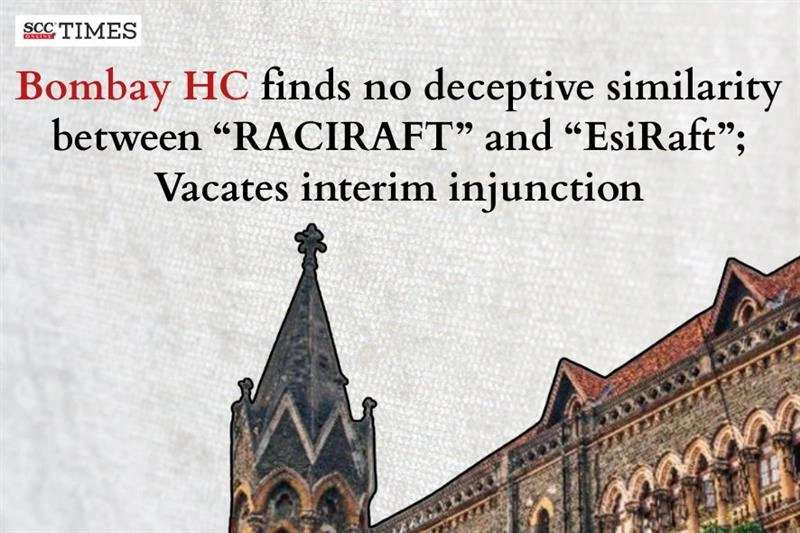
Bombay High Court: While hearing an interim application filed under the Trade Marks Act, 1999 (‘Trade Marks Act’), wherein the plaintiff sought to restrain the defendants from using the impugned trade mark “EsiRaft” or any other mark deceptively similar to the registered trade mark “RACIRAFT” and from passing off their medicinal product as that of the plaintiff, a Single Judge Bench of Sharmila U. Deshmukh, J., held that the marks “RACIRAFT” and “EsiRaft” are prima facie visually and phonetically dissimilar and unlikely to cause confusion among consumers.
Accordingly, the Court vacated the ad-interim relief earlier granted, dismissed the interim application, and extended the relief for one week to enable transition.
Background:
The suit was filed for infringement of trade mark and passing off. The rival products were medicinal preparations used for treatment of identical ailments, namely heartburn and indigestion, containing identical molecules such as Sodium Alginate, Sodium Bicarbonate and Calcium Carbonate, sold in oral suspension/syrup form.
The grievance was that the registered trade mark “RACIRAFT,” coined in January 2022, was infringed by the use of “EsiRaft.” The plaintiff claimed prior adoption, registration in Class 5, and substantial sales turnover demonstrating goodwill and reputation. It was alleged that the defendant dishonestly adopted the impugned mark, used a similar two-colour combination, and procured manufacture from a common manufacturer despite contractual restrictions.
The defence contended that “RAFT” is generic and common to the trade of medicinal preparations, denoting foam formation caused by sodium alginate. It was argued that exclusivity cannot be claimed in “RAFT” or in the two-colour combination, as the registration was for a word mark. The prefixes “RACI” and “ESI” were said to be visually, structurally and phonetically distinct, with “RACI” pronounced as “RAY-see” and “ESI” pronounced as “Easy” or “ESY.” The defence relied on sales turnover, claimed bona fide adoption of “ESI” as Enhanced System Improvement and Esophageal Symptom Index, and argued delay and laches.
Analysis and Decision:
The Court emphasised that Section 2(h) of the Trade Marks Act defines deceptive similarity as resemblance likely to deceive or cause confusion. The Court also highlighted that the well settled principles for assessing the deceptive similarity lays emphasis on visual appearance as well as the phonetic similarity i.e. that the marks have to be judged by the eye as well as the ear, and that the anti-dissection rule requires comparison of marks as a whole.
The Court noted that the registered mark “RACIRAFT” is depicted in capital letters, whereas “EsiRaft” uses a mix of capital and small letters. It was further noted that the use of two-colour combination was common in medicinal preparations and, by itself, not sufficient to establish deceptive similarity.
On phonetic similarity, the Court observed that the opening syllables of the rival marks are completely different. “Raci” begins with consonant “R” pronounced as “RAY-see,” while “Esi” begins with vowel “E” pronounced as “Easy.” It was noted that opening syllables are rarely mispronounced and found no probability of “E” being pronounced as “A.” The Court referred to precedents such as F. Hoffmann-La Roche & Co. Ltd. v. Geoffrey Manner & Co. (P) Ltd., (1969) 2 SCC 716 in Dropovit and Protovit case wherein it was held that greater regard was to be paid to the uncommon element in the two words as it was difficult to hold that one would be mistaken for or confused with the others.
The Court further observed that the explanation for adoption of “ESI” as Enhanced System Improvement and Esophageal Symptom Index was cogent and acceptable. It was noted that the defence of delay without acquiescence is no bar, but also found that the plaintiff failed to demonstrate vigilance in protecting its mark given the defendant’s sales figures and market presence since July 2024.
The Court emphasised that it was unable to find resemblance between the marks, visual or phonetic, which takes the case sufficiently out of the ambit of passing off. It was noted that the overall visual appearance of the rival products was dissimilar, with differences in placement of elements, colour scheme, packaging, and get-up.
Accordingly, the Court held that the plaintiff had failed to establish a prima facie case of infringement or passing off. Finding no deceptive similarity between the rival marks, the Court ruled that the defendant could not be restrained from using the impugned mark. The ad-interim relief previously granted was therefore vacated, the interim application dismissed, and the relief continued for one further week to facilitate transition.
[Sun Pharmaceutical Industries Ltd. v. Meghmani Lifesciences Ltd., 2025 SCC OnLine Bom 5394, decided on 23-12-2025]
Advocates who appeared in this case:
For the Plaintiff: Hiren Kamod with Shetank Tripathi, Radhika Mehta, Vidit Desai, Nipun Krishnaraj and Prem Khullar, instructed by ANM Global
For the Defendant: Ashutosh Kane with Vedangi Soman, Avani Panchabhai, instructed by W.S. Kane & Co.
Court Receiver: Rucha Ambekar