
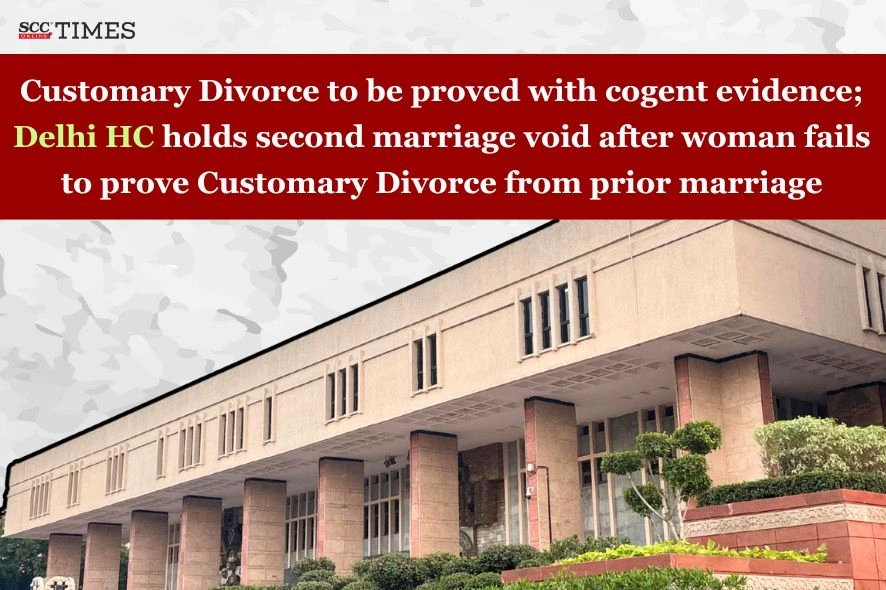
Delhi High Court: In an appeal challenging the family’s court decree of divorce, a Division Bench of Anil Kshetarpal* and Harish Vaidyanathan Shankar, JJ., upheld the Family Court’s declaration that the appellant’s marriage with respondent 1 was null and void, as the appellant failed to establish that she had obtained a valid customary divorce prior to their marriage.
Factual Matrix
In the instant matter, the appellant was previously married and claimed to have obtained a customary divorce on 23-05-2009. Respondent 1 was also previously married and obtained a judicial divorce from a competent court on 25-05-2009.
The appellant and respondent 1 entered into a matrimonial alliance on 16-05-2010, and a son was born on 15-03-2011. The appellant later left her matrimonial home on 12-10-2012. Respondent 1 reportedly learnt on 25-09-2013 that appellant had not in fact obtained a valid divorce from her previous husband and filed a petition for divorce shortly thereafter on 10-10-2013.
The appellant filed the present appeal challenging the judgment and decree dated 07-06-2024 passed by the Family Court which declared her marriage with Respondent 1 null and void under Section 11 of the Hindu Marriage Act, 1955 (the Act), on the ground that it contravened Section 5(i) of the Act.
Moot Point
-
Whether the appellant had successfully proved that the Jat community recognises a valid custom permitting Panchayati divorce?
-
If yes, whether such Panchayati divorce actually took place between the appellant and her previous husband?
Parties’ Contentions
The appellant claimed that her divorce was conducted according to a customary practice of the Jat community. The applied relied on a photocopy of an alleged Deed of Divorce, marked as “X”, asserting it constituted a Panchayati/customary divorce. It was contended that this customary dissolution of marriage was communicated to the respondent and that the parties willingly entered into marriage thereafter.
However, respondent 1 submitted that no valid custom was proved and that there was no evidence of a properly convened or recognised Panchayat decision dissolving her earlier marriage. It was asserted that the appellant was still legally wedded wife of someone else at the time of her second marriage.
Court’s Analysis
The Court noted that the witness admitted that they did not attend the alleged Panchayat meeting. It was noted that no panchayatnama, no original document, and no proof of long-standing custom were produced. The Court further noted that “neither the scribe nor any of these witnesses have been examined in this matter.” The Court held that merely examining interested family members or elderly community members who never attended the alleged Panchayat meeting is insufficient.
On the law of custom, the Court asserted that Section 29(2) of the Act saves any right recognised by custom to obtain dissolution of a Hindu marriage, but custom must be strictly proved.
“Section 29 of the HMA saves any right recognised by custom or conferred by any special enactment to obtain dissolution of a Hindu marriage. Hence, the customary divorce, if validly proved, is saved by the provision of the HMA.”
The Court referred to Bhimashya v. Janabi, (2006) 13 SCC 627, where it was held that “a custom to be valid must have four essential attributes. First, it must be immemorial; secondly, it must be reasonable; thirdly, it must have continued without interruption… and fourthly, it must be certain,” Gokal Chand v. Parvin Kumari, AIR 1952 SC 231 which stated that “a custom, in order to be binding, must derive its force from the fact that by long usage it has obtained the force of law” and Uzagar Singh v. Mst. Jeo, AIR 1959 SC 1041, where it was held that Custom must be proved under Section 57 of the Evidence Act, 1872
The Court stated that “it is not sufficient to prove custom of dissolution of marriage by examining few witnesses,” but must be proved by cogent evidence. The Court stated that the proof included judgments recognising their custom, past instances, and documentary records demonstrating long-standing usage. The Court reiterated that “once the Court is called upon to declare that there exists a custom which is contrary to the codified law, the burden of proof is heavy upon the party asserting custom.”
As to the alleged divorce document, the Court stated that the document produced by the appellant is a mere agreement/mutual settlement between the appellant and her previous husband and there is no reference to any Panchayat or meeting of the respectables of the area.
The Court stated that since no Panchayat members were named, no minutes or resolution was produced, no judicially recognized historical incidence of such divorce was shown and no legal text or precedent validating the custom was presented, herefore, the Court held that the appellant failed to discharge her burden of proof.
Court’s Decision
The Court held that the appellant had not proved that she obtained a customary divorce from previous husband. According as per Section 5(i) of the Act, at the time of her alleged marriage to Respondent 1, the Appellant had a living spouse. Therefore, her marriage was void ab initio. The Court held that the Family Court had erroneously held that the custom existed.
The Court upheld the Family Court’s finding that there exists no Panchayati divorce between the appellant and her previous husband. The Court dismissed the appeal, finding no reason to interfere with the Family Court’s decree.
[Sushma v. Rattan Deep, 2025 SCC OnLine Del 8663, Decided on 28-11-2025]
*Judgment by Justice Anil Kshetarpal
Advocates who appeared in this case:
Mr. SC Singhal, Mr. Parth Mahajan, Ms. Garvita Bansal and Mr. Ritvik Madan, Counsel for the Appellant
Mr. Mrinal Singh and Ms. Priya Rani Jha, Counsel for the Respondents