
Disclaimer: This has been reported after the availability of the order of the Court and not on media reports so as to give an accurate report to our readers.
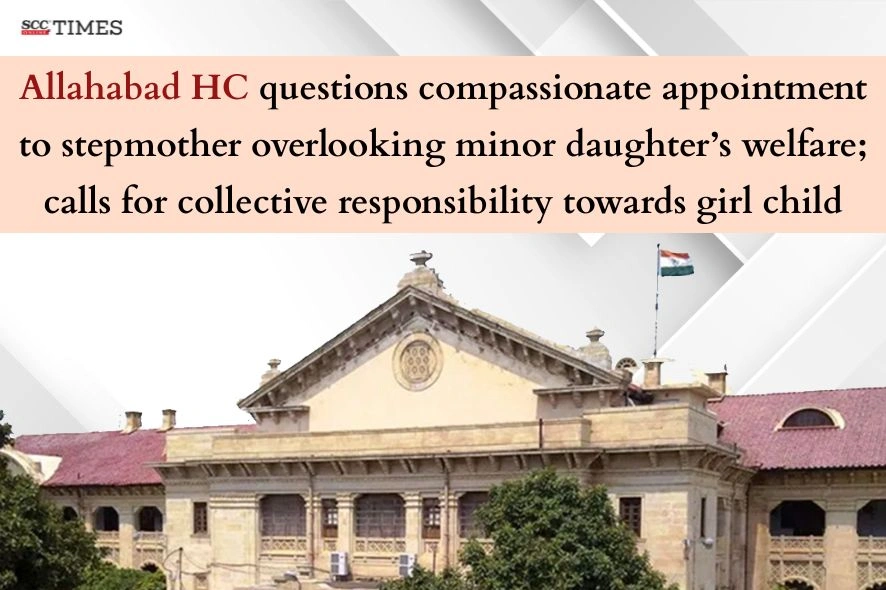
Allahabad High Court: In a writ petition filed by a minor daughter of a decease government servant against her stepmother who had been granted compassionate appointment without any arrangements for her maintenance, the Single Judge Bench of Manju Rani Chauhan, J., directed the respondent authorities to file an affidavit annexing the stepmother’s affidavit wherein she had expressed willingness to provide Rs 5000 as maintenance to the petitioner and mentioning the details of other measures that would be taken for the safety, security, and maintenance of the petitioner.
Background
In 2009, the petitioner’s mother passed away, leaving her as the only heir. After her death, the petitioner’s father remarried respondent 4, i.e., her stepmother. The petitioner’s father, who was working in the Nagar Nigam, died in harness in 2023.
After the death of the petitioner’s father, her stepmother applied for a compassionate appointment, allegedly without disclosing certain facts. She was granted appointment as well as other benefits, allegedly without adhering to the conditions stipulated under the Uttar Pradesh Recruitment of Dependants of Government Servants Dying-in-Harness Rules, 1974 (“the Rules”) regarding maintenance of the dependents of the deceased employee, including the petitioner.
The respondents contended that two cheques amounting to nearly Rs 10.69 Lakhs had already been issued in favour of the petitioner, which were brought before the Court.
On the last date, the Court stated that under the Rules, appointment on compassionate grounds may be granted to only one eligible dependent member of the deceased government servant’s family, subject to fulfilment of the prescribed conditions and satisfaction of the competent authority that the family is in indigent circumstances.
The Court stated, “The underlying obligation remains that the dependent so appointed shall ensure the maintenance and welfare of the other surviving members of the family, keeping in mind the object and spirit of the Rules. Any deviation from this principle would defeat the very purpose for which the compassionate appointment scheme has been framed.”
The Court noted that the petitioner had been placed in a precarious and disadvantageous position, since, without recording any assurance or ensuring her future security, only two cheques of certain amounts were issued in her name, even though she was a minor presently studying in Class XII. The Court stated that it appeared that the petitioner was made to believe that she would be extended other consequential benefits as well; however, failure to do so has left her in an unfortunate and awkward situation.
“The petitioner, a minor student of Class XII, has lost both her parents and is presently under the guardianship of her maternal uncle. In such exceptional circumstances, while granting compassionate appointment to the stepmother, the competent authority was duty-bound to ensure the safety, security, and future welfare of the petitioner.”
Considering the settled position of law and the spirit of the Rules, the Court opined that the competent authority ought to have ascertained, by means of a detailed verification and through an affidavit from the stepmother, that appropriate arrangements had been made for the maintenance, education, and overall well-being of the petitioner. If it was found that the petitioner’s interest was jeopardized or no sufficient safeguards were ensured, appropriate action, including reconsideration of the appointment, should have been undertaken in accordance with the law. However, the Court stated that the record did not indicate that any such inquiry or safeguard was undertaken before extending the benefit of compassionate appointment to the stepmother.
“No affidavit or undertaking appeared to have been obtained from the stepmother assuring the maintenance, education, and future security of the minor petitioner. Such omission reflects a serious lapse in the discharge of statutory duty and undermines the very purpose of the scheme of compassionate appointment.”
The Court held that the competent authority was under a statutory and moral obligation to ensure that the rights and interests of the petitioner, being a minor dependent, were duly safeguarded before the appointment in question was finalized.
Accordingly, the Court directed the Nagar Ayukt, Nagar Nigam, Prayagraj, to appear on the next date and assist the Court.
Upon appearance, the Nagar Ayukt assured the Court that measures would be taken to ensure due care and vigilance in such situations. He also acknowledged the significance of timely intervention and proper supervision in matters concerning the safety and welfare of the dependents of deceased employees and undertook to introduce necessary precautions to avert any lapses in the future.
Respondents 2 and 3 informed the Court that the respondent authority had taken an affidavit from the stepmother wherein she stated that she was ready to pay Rs 5,000 per month to the petitioner for her maintenance.
Analysis
The Court directed the respondents 2 and 3 to file an affidavit annexing the stepmother’s affidavit and mentioning the details of other measures that would be taken for the safety, security, and maintenance of the petitioner.
Considering the circumstances of the present case, wherein the litigant was a minor child who was compelled to approach the Court against her stepmother, the Court remarked that the moral values of society were being depleted in a way that could never have been imagined. Relations were being disregarded, whereas the Government promotes several welfare schemes for the girl child.
The Court added that being a citizen, even if a person who did not have good proximity with their family, should extend contribution towards the well-being of a girl child for the sake of harmony in our society.
“It is not only the duty of the Government, but each and every individual should protect the future of bereaved minors who are in penury, especially the girl child.”
Thus, the Court expressed that it expected the stepmother to extend healthy behaviour to the petitioner.
The Court further stated that the Nagar Ayukt had eloquently explained the precautions that he will undertake while granting compassionate appointments to the dependents of deceased employees. The Court commended his clarity, sincerity, and commitment towards transparency and fairness in the process and appreciated his thoughtful approach and dedication towards improving administrative procedures.
The matter was listed for 20-11-2025.
[Varsha v. State of Uttar Pradesh, 2025 SCC OnLine All 7548, decided on 13-11-2025]
Advocates who appeared in this case:
For the petitioner: Munna Lal Pandey, Parvesh Kumar Pandey, and Vijay Babu
For the respondent: C.S.C., Harshit Pandey