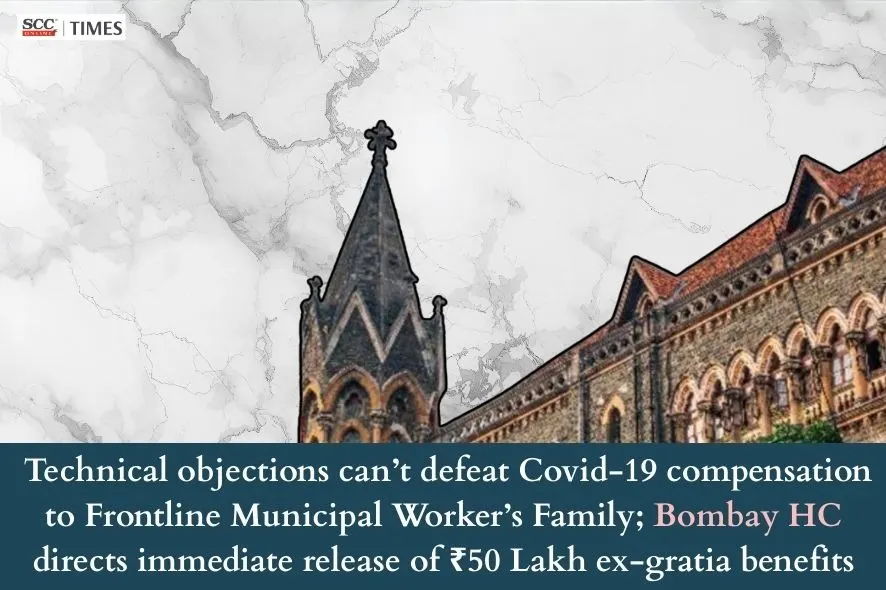
Bombay High Court: While considering a writ petition under Article 226 of the Constitution, the Division Bench of M.S. Karnik* and S.M. Modak, JJ., observed that the legal heirs of a municipal employee who died in harness due to Covid-19 were entitled to ex-gratia compensation of Rs 50,00,000 under Government Resolutions (‘GR’) issued by the State. The Court held that once the Municipal Council had scrutinised and forwarded the proposal with supporting documents, further technical verification could not be insisted upon. Emphasising that denial of compensation merely because the employee was admitted to a private hospital was arbitrary and unjust, the Court directed the Collector to process the claim expeditiously and cautioned against delay on technical grounds.
Background:
The case arose from a writ petition seeking ex-gratia compensation of Rs 50,00,000 for the heirs of a municipal employee who died due to Covid-19. The deceased had been serving as a Class IV employee with the Municipal Council since 1990. On 09-01-2021, he was appointed as force staff to assist in tackling the Covid-19 surge but tragically passed away on 29-03-2021 due to Covid-19.
Following his death, the Municipal Council submitted a proposal on 22-11-2021 to the District Administrative Officer, enclosing the appointment order, office order, medical reports, death certificate, and attendance records. A GR dated 11-02-2022 granted ex-gratia compensation to families of municipal employees who died due to Covid-19. However, the hospital failed to upload the deceased’s name on the Indian Council of Medical Research (‘ICMR’) portal, later tendering an unconditional apology for the lapse. The petitioners contended that denial of compensation on such grounds violated their rights and amounted to dereliction of duty.
The State, on the other hand, maintained that scrutiny and verification under the GR dated 04-08-2021 was necessary before releasing the compensation, and indicated that the Collector would require time to examine the documents before compliance could follow.
Analysis and Decision:
The Court observed that the employee was working as a Sweeper, a Class IV employee with the Municipal Council, for almost 31 years. It was noted that by a letter dated 09-01-2021 he was appointed as force staff to tackle the Covid-19 surge at Dr. Babasaheb Ambedkar Playground and Railway Institute, thereby making him a frontline worker required to address the Covid-19 crisis. The Court examined the proposal submitted by the Municipal Council to the Collector and found it incomplete for want of necessary documents, wherein the hospital on 09-11-2022 tendered an apology stating that due to lack of training, the name of the deceased was not uploaded on the ICMR portal and subsequent attempts failed. However, the certificate of the hospital confirming that the petitioner died due to Covid-19 was on record.
The Court observed that the communication dated 22-11-2021, by which the Municipal Council forwarded the proposal to the Collector, clearly mentioned the cause of death as Covid-19, and therefore, as the claimants had complied with all requirements, the proposal was forwarded. The Court held that there was no reason to doubt the genuineness of the certificate issued by the hospital merely because it was a private hospital. Moreover, the same had already been scrutinised by the Municipal Council and accordingly the proposal was forwarded.
The Court emphasised that the employee died on 29-03-2021, yet the proposal remained pending since 2021. The Court highlighted that at this distance of time, to again subject the proposal to detailed verification and scrutiny would amount to adding to the agony of the family of the deceased employee who had served for 31 years as a Sweeper with the Municipal Council. Further, the employee concerned was admittedly a frontline worker assigned the task of tackling the surge of Covid-19 virus.
The Court noted that the employee died prior to the issuance of the GR dated 04-08-2021 and the subsequent GR dated 11-02-2022. The Court observed that the employee was covered by the GR subject to the fulfilment of conditions, which was not disputed.
The Court examined the argument that the employee was admitted to a private hospital when the requirement of the GR was admission in a government hospital, and moreover the Resolution was issued after the death of the employee. The Court observed that in such trying times, when the employee contracted Covid-19, to expect him to be admitted only in a government hospital for claiming entitlement was arbitrary and unjust. The Court remarked that to subject the proposal to minute scrutiny in terms of the GR issued after the death of the employee would be unjust, particularly when the cause of death was already on record and further when there was no dispute that the concerned employee was a frontline worker tackling the surge of Covid-19 virus.
The Court emphasised that the requirements of the GR were procedural formalities, purely technical in nature, and once the factum of the employee dying due to contracting the coronavirus was on record, it was hardly of any consequence whether he was admitted to a private or government hospital. The Court highlighted that the substance that mattered was whether the employee’s death was due to contracting Covid-19 during the course of his duties in tackling the surge of the virus.
It was held that since the Municipal Council had already scrutinised the proposal and forwarded it, the Court was inclined not to subject the proposal once again to further verification and scrutiny by the Collector and thereafter by the State Government. It was noted that, in the peculiar facts of this case, the Court did not accede to the suggestion which, in the normal course, it would have found no difficulty in accepting.
The Court referred to Vijaya Yashwant Jadhav v. Block Development Officer, 2025 SCC OnLine Bom 6085, wherein while discussing frontline workers, including healthcare professionals such as doctors, nurses, paramedics, sanitation staff, police personnel, and countless others involved in essential services, it was held that their role was not just a professional obligation, it was an act of selfless service as they fought not only against a microscopic enemy but also preserved the very foundation of society by ensuring the continued availability of vital healthcare and public services.
The Court directed the Collector to immediately process the proposal forwarded by the Municipal Council, treating the accompanying documents and certificates as genuine. It was ordered that the proposal be forwarded within four weeks, approvals granted within the following four weeks, and the compensation disbursed within ten weeks. The Court cautioned that any attempt to delay or defeat the claim on technical grounds would be viewed with seriousness.
The Court further directed that the petition be listed for compliance after ten weeks, making it clear that it had no manner of doubt that the Collector, Nashik, and Urban Development Department would process the proposal most expeditiously. It was observed that the very cause for which the petition was filed was to provide some solace to the heirs of the deceased employee who had served the Municipal Council for 31 years.
With these directions, the petition was accordingly disposed of.
[Sulochana Sharad Kulkarni v. State of Maharashtra, 2026 SCC OnLine Bom 1049, decided on 11-02-2026]
*Judgment authored by: Justice M.S. Karnik
Advocates who appeared in this case :
For the Petitioners: Alankar Kirpekar, Sagar Kasar, Ayush Tiwari, Rishabh Tiwari, Amol Wagh i/b Sagar Kasar
For the Respondents: Shriniwas S. Patwardhan a/w A.V. Hardas, Shriram Kulkarni, Pooja Patil, AGP