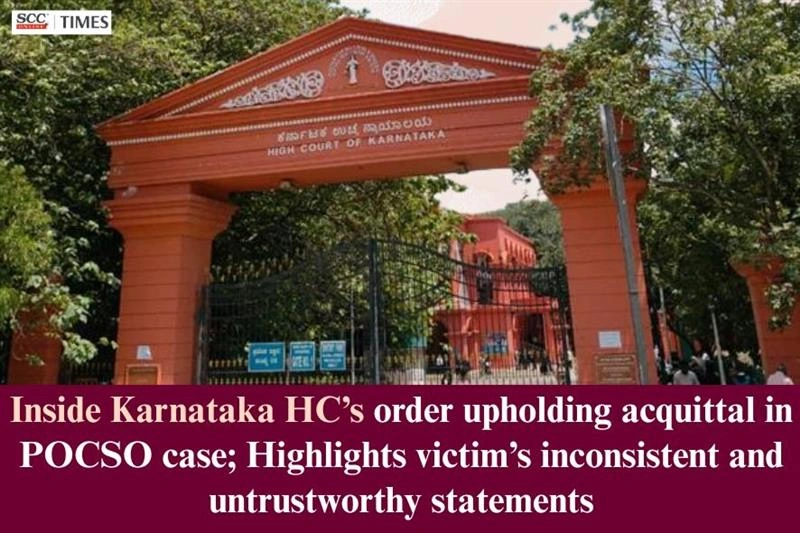
Karnataka High Court: In a criminal appeal challenging the acquittal of the accused for offences under Sections 366-A, 376(1), 354-A of the Penal Code, 1860 (‘IPC’) and Sections 3, 4, 7, 8, 11 and 12 of the Protection of Children from Sexual Offences Act, 2012 (‘POCSO Act’), the Division Bench comprising H.P. Sandesh* and Venkatesh Naik T, J.J., held that the prosecution had failed to establish the minority of the victim or prove the allegations of sexual assault through cogent and consistent evidence. The Court found that the testimony of the victim was materially inconsistent and the same is untrustworthy. Thus, the Court upheld the acquittal and accordingly, dismissed the appeal.
Background
The case of the appellant-State was that the victim girl was a minor at the time of the incident. It was alleged that accused 2, known to the victim, took her on a scooter to a temple and later to a hotel where he allegedly touched her hands and legs and subjected her to sexual harassment. It was further alleged that accused 1 called her, induced her to accompany him on his motorcycle, and thereafter took her to an old house and committed forcible sexual intercourse without her consent.
Based on the complaint, the Women Police Station filed a charge sheet for offences under the IPC and the POCSO Act. During the trial, the prosecution examined 24 witnesses and marked documentary and material exhibits. The accused denied the allegations and did not led any defence evidence.
After considering the evidence, the Trial Court acquitted the accused. Aggrieved by the decision, the State preferred the present appeal seeking leave to challenge the acquittal.
Issues
Whether the prosecution had successfully established that the victim was a minor so as to attract the provisions of the
Analysis
At the outset, the Court examined the Trial Court’s finding regarding proof of age. The Court noted that, except for the medical report indicating the age as approximately 17 years and 6 months, no reliable documentary evidence was produced to conclusively establish minority. The Court observed that where medical opinion is relied upon, an ossification test or similar scientific assessment would ordinarily be necessary, which had not been conducted.
The Court further noted that the victim herself had admitted during evidence that she was about 18 years of age at the time of the incident. The father’s testimony regarding age was found to be inconsistent. In view of the contradictions between oral evidence and medical material, the Court held that the prosecution had failed to prove minority in the manner required by law. Consequently, the primary requirement for invoking the POCSO Act remained unestablished.
The Court then considered the allegation of sexual assault and upon perusal of the victim’s testimony before the Trial Court as well as her statement recorded under Section 164(5) of the Criminal Procedure Code, 1973 (‘CrPC’), the Court found that she had not consistently alleged forcible sexual intercourse. The victim stated that the accused had touched her hands and legs and thereafter left her. The Section 164 of CrPC statement also did not contain any specific assertion of a forcible sexual act.
The Court observed that when the victim herself had not clearly and consistently spoken about sexual assault, the evidence of her father, which was merely hearsay, could not strengthen the prosecution’s case. The absence of medical corroboration further weakened the allegation of rape. With respect to accused 2, the Court noted that there was no material evidence substantiating the prosecution’s allegations. The CCTV evidence relied upon by the prosecution merely showed the victim’s presence and the accused at the hotel and did not establish any sexual offence.
Accordingly, the Court concluded that in the absence of cogent and trustworthy evidence, invocation of offences under Sections 366-A, 376, 354-A of the IPC and the provisions of the POCSO Act was unsustainable.
[State of Karnataka v. X., 2026 SCC OnLine Kar 561, decided on 29-01-2026]
*Judgment authored by Justice H.P. Sandesh
Advocates who appeared in this case:
For the Appellant: Rashmi Patel, High Court Government Pleader
For the Respondents: K. Prasanna Shetty, Advocate; Tejas N., Advocate ;Sachin G., Advocate; Renuka Devi, Advocate.
Buy Protection of Children from Sexual Offences Act, 2012 HERE
Buy Penal Code, 1860 HERE
Buy Code of Criminal Procedure, 1973 HERE