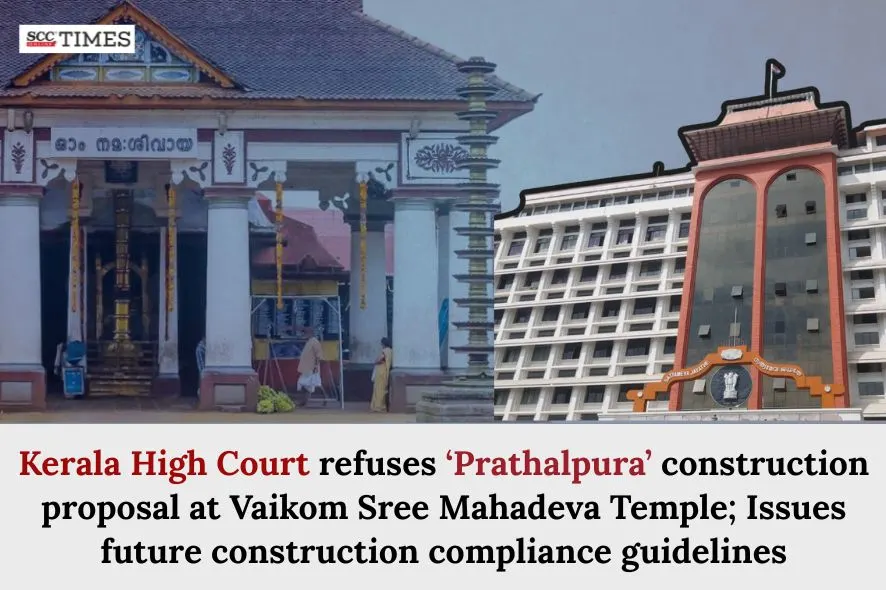
Kerala High Court: In a petition pertaining to the approval for the award of contract for the construction of ‘Prathalpura’ in Vaikom Sree Mahadeva Temple, a Division Bench of Raja Vijayaraghavan V and K. V. Jayakumar,* JJ., refused to approve the award of contract for the construction of the Prathalpura and laid down comprehensive guidelines governing future constructions within temple premises.
Factual Matrix
During the Vaikathashtami festival, lakhs of devotees arrive at Vaikom Sree Mahadeva Temple for Prathal Prasadam. Currently, a temporary shed costing ₹3.5 lakhs is erected every year to provide shade for devotees.
The Board proposed a permanent steel-frame structure with Mangalore-style roofing tiles covering over 13,000 sq. ft, to be located between the Oottupura and the Chuttambalam. M/s G.S. Engineering Works submitted the lowest bid, quoting 5.10% below estimate, and was selected.
The Thanthri of the temple objected in writing and stated that such construction would degrade the Kshethra Chaithanyam and violate earlier Ashtamangallya Prasnam findings that no construction should be undertaken within the temple compound. An Advocate Commissioner was appointed and inspected the premises, and he also opposed the structure on aesthetic grounds. A temple architect also advised against the proposal and suggested the use of temporary structures instead.
The Travancore Devaswom Board filed the present petition seeking approval for awarding a contract for construction of a permanent Prathalpura at Vaikom Sree Mahadeva Temple, estimated at ₹1,92,00,000/- in favour of M/s. G. S. Engineering Works.
Moot Point
Whether approval should be granted for awarding the contract for the construction of the Prathalpura within the premises of Vaikom Sree Mahadeva Temple as per Annexure-III estimate?
Parties’ Contentions
The Travancore Devaswom Board contended that the permanent Prathalpura would prevent devotees from “standing for long hours in the open space” and protect them from sun and rain. It was contended that permanent construction would eliminate recurring costs of temporary sheds erected annually during festival season.
On the other hand, the respondents contended that construction between Chuttambalam and Oottupura violates sacred temple architecture and spiritual sanctity. It was stated that construction of such structures “would, over time, erode and undermine the spiritual essence of the temple.”
Expert Architect opined that Vaikom Temple is a classic representation of Kerala temple architecture based on Vastu principles and any modern permanent construction within the 18-metre spatial zone “would adversely affect the traditional architectural integrity of the temple.”
Court’s Analysis and Reasoning
The Court asserted that the proposed 13,000 sq. ft. steel structure with tiled roofing would be “an eyesore and a blot upon the fundamental architectural principles that govern Kerala temples.” The Court deemed the Thanthri’s spiritual authority and Astrological Prasnam findings as significant and reinforced that construction inside sacred space would degrade temple sanctity.
The Court further noted that on ordinary days, existing arrangements are sufficient in handling 800—1000 devotees daily, therefore, any permanent construction is not required and justified.
The Court suggested natural and temporary alternatives, such as planting Arayal, Peral, Koovalam and Ashoka trees and noted that the Arayal tree is sacred and linked with the Trimurti and would improve aesthetics.
The Court warned that temple premises are heritage structures, and any construction must be approached with utmost restraint and circumspection. The said that
“Unnecessary constructions, without due regard to Vasthu principles, the aesthetic integrity, the archaeological significance, and the traditional architectural grandeur of the temple, ought to be scrupulously avoided. Temples are heritage structures; therefore, any intervention must be sensitive to their cultural, ritualistic, and historic value.”
Court’s Directives for future guidance
The Court laid down mandatory guidelines for future Devaswom construction including —
-
Aesthetic and Architectural Impact Assessment
-
Mandatory Consultation with Thanthri and Temple Architect
-
Assessment of Necessity (avoidance of unnecessary permanent structures)
-
Civil Engineering Feasibility & Preferential In-house Execution
-
Avoidance of unnecessary constructions
The Court further directed that future applications for Devaswom construction exceeding ₹20 lakhs must be filed directly before the High Court and must be accompanied by expert opinions, sanction orders, BOQ, tender details, and agreement documents. With regard to post-construction compliance, the Court directed that both contractor and Executive Engineer must file detailed affidavits within 30 days of completion.
Court’s Decision
The Court refused to approve the construction of the Prathalpura in Vaikom Sree Mahadeva Temple, rejecting both the steel-frame plan and the later modified lien-type design.
[Travancore Devaswom Board v. Kerala State Audit Dept., 2025 SCC OnLine Ker 13111, Decided on 28-11-2025]
*Judgment by Justice K. V. Jayakumar
Advocates who appeared in this case:
G. Biju, SC, Travancore Devaswom Board, Counsel for the Petitioner
S. Rajmohan, Sr GP and Sri P Ramachandran, Amicus Curiae with P Rajeeve, Advocate Commissioner, Counsel for the Respondent