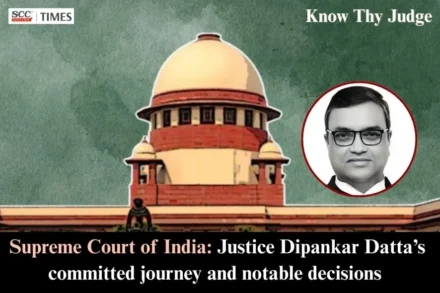
Justice Dipankar Datta
Know thy Judge

Justice Dipankar Datta served as a Judge in the Calcutta High Court, and as Chief Justice of Bombay High Court, prior to being sworn in as Supreme Court Judge on 12-12-2022.

environmental compensation based on project turnover
Case BriefsSupreme Court

The NGT is empowered to quantify environmental compensation on the basis of project cost or scale of operations in order to enforce the polluter pays principle where construction is carried out in violation of environmental laws.

Writ Court cannot direct filing of charge-sheet
Case BriefsSupreme Court

A litigant cannot be placed in a worse position merely for having approached the court.

Invoking section 175(4) BNSS
Case BriefsSupreme Court

The Court stated that since Section 175(4) BNSS merely provides an additional protective layer in cases involving public servants, all mandatory procedural requirements governing the exercise of power under Section 175(3), must necessarily be complied with.

West Bengal SIR
Case BriefsSupreme Court

“It appears that approximately 1.40 crore individuals have been issued notices for the purpose of document verification.”

Wait-listed candidate has no vested right
Case BriefsSupreme Court

“The judiciary would do well to remain circumspect of these practical realities, and interpret service rules in a manner that furthers the very object of a selection process, that is, the selection of the most suitable candidates from suitable candidates for appointment in a timely manner.”

impeachment proceeding against High Court Judge
Case BriefsSupreme Court

“Constitutional safeguards for Judges cannot come at the cost of paralysing the removal process itself. The first proviso must, therefore, be construed to balance prescribed protection with the effective functioning of the mechanism for removal of a Judge from office triggered by the peoples’ representatives, and not to frustrate it altogether.”

Landowners in Joint Development Agreement Not Consumers
Case BriefsSupreme Court

Supreme Court granted liberty to the appellants to institute a civil suit with entitlement to claim exemption from limitation under Order VII Rule 6 CPC read with the Limitation Act, 1963.

willful default rent
Case BriefsSupreme Court

In the present case, the lessee challenged the fixation of fair rent but did not seek a stay of its operation before the appellate or revisional for a.

directions by Court without notice to parties
Case BriefsSupreme Court

Litigants might fear that seeking justice through the courts could leave them in a worse position than they were in before initiating legal proceedings. This could seriously impact access to justice and consequently the very rule of law.

Using Article 226 to Quash FIR
Case BriefsSupreme Court

In the present case, the High Court could have examined the petitioner’s grievance, since it is evident from the petition, that the petitioner sought to invoke the twin jurisdiction under Article 226 of the Constitution and Section 528 of the Bharatiya Nagarik Suraksha Sanhita, 2023, to quash the FIR.

In-service Teachers needing to qualify TET exam
Case BriefsSupreme Court

“TET is indeed a qualification, necessary to be held by a person seeking appointment as a teacher in a school. Only upon a person obtaining such qualification can he become eligible for appointment as a teacher”.

In-House Procedure inquiry judicial misconduct
Case BriefsSupreme Court

The Court found the provision in paragraph 7(ii) of the Procedure requiring the CJI to write to the President and the Prime Minister along with the report of the Committee to be in order, legal and valid.

Supreme Court recalls its own judgment obtained by fraud
Case BriefsSupreme Court

The application of the doctrine of merger, in every case, shall be accompanied by an awareness of its limitations and shall not be wielded to close avenues for addressing genuine concerns. Prioritizing justice and fairness shall supersede an absolute insistence on finality.

Section 197(1) CrPC
Case BriefsSupreme Court

In the matter at hand, the accused was an Executive Engineer, Municipal Corporation, Chandigarh, and caused wrongful loss in excess of Rs. 13.66 crore to the Government exchequer by changing the terms and conditions of the Detailed Notice Inviting Tender.

overqualification is not disqualification
Case BriefsSupreme Court

The Court refused to grant relief under Article 142 of the Constitution to a candidate applying for post of Boat Lascar, as he gained entry through a process which was not legal and valid.

Compassionate appointment
Case BriefsSupreme Court

“Judicial decisions abound that in deciding a claim for appointment on compassionate grounds, the financial situation of the deceased employee’s family must be assessed. In a situation otherwise, the purpose of the scheme may be undermined; without this evaluation, any dependent of an employee who dies while in service might claim a right to employment as if it is heritable.”

Know Thy Judge| Supreme Court of India: Justice Dipankar Datta
Know thy Judge

Justice Dipankar Datta served as a Judge in the Calcutta High Court, and as Chief Justice of Bombay High Court, prior to being sworn in as Supreme Court Judge on 12-12-2022.

filthy language insult modesty
Case BriefsSupreme Court

“It will be essential for the Court to carefully assess the evidence presented, in order to determine whether there is sufficient material to establish the intention and knowledge to insult the modesty of the complainant or, whether any act was intended to shock the sense of decency of the complainant being a woman”.

Disciplinary action against doctor
Case BriefsSupreme Court

“While it is true that principles of natural justice supplement, and not supplant, the law, such principles have been declared by the Court to be a constituent feature of Article 14. Validity of any disciplinary action, whenever questioned, has to be tested on the touchstone of Articles 14, 16 and 21 as well as Article 311(2), wherever applicable.”