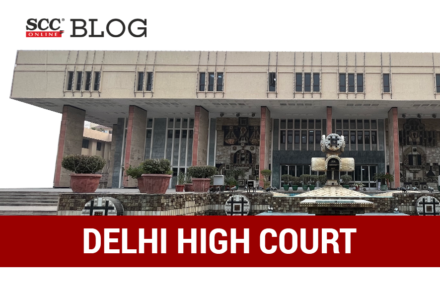


Delhi High Court
Case BriefsHigh Courts

The Delhi High Court held that even if the Contract clearly stated that before resorting to arbitration, the parties agreed to explore Conciliation by the Committee, the same cannot be held to be mandatory in nature. Further, the Court held that in case of urgency, arbitral proceedings can be initiated even when conciliation proceedings were pending.

Delhi High Court
Case BriefsHigh Courts

An arbitration agreement that is embedded within a contract would always be considered as a separate and severable clause, and despite a reference being made by the court the arbitrator is free to decide on their jurisdiction including the existence of the arbitration agreement in accordance with the kompetenz-kompetenz principle

Madras High Court
Case BriefsHigh Courts

Madras High Court held that the petitioners are not entitled to join respondents 3 to 5 as parties to arbitral proceedings, as they do not qualify as “alter egos” of the first respondent or as successors-in-interest.

Delhi High Court
Case BriefsHigh Courts

The ground of Patent illegality gives way to setting aside an Arbitral Award with a very minimal scope of intervention. A party cannot simply raise an objection on the ground of patent illegality if the Award is simply against them. Patent illegality requires a distinct transgression of law, the clear lack of which thereof makes the petition simply a pointless effort of objection towards an Award made by a competent Arbitral Tribunal.

Delhi High Court
Case BriefsHigh Courts

All that the respondent wished for was a better roof over the head of his family. It was for this objective that the collaboration agreement was devised, but the appellant subjected the respondent to undue harassment on account of his illegal designs which led to the registration of the FIR, and the respondent had to run from pillar to post due to the direct acts of the appellant. Such circumstances do warrant awarding of damages on account of mental agony and harassment.

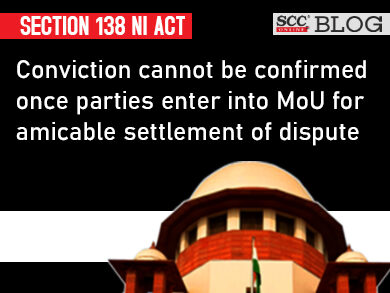
Section 138 NI Act| Conviction cannot be confirmed once parties enter into MoU for amicable settlement of dispute: Supreme Court
Case BriefsSupreme Court

The Supreme Court observed that such settlement is nothing but a compounding of the offence and hence, the Court cannot override such compounding and impose its will.

Case BriefsHigh Courts

Bombay High Court: In a petition filed by Gammon Engineers & Contractors Pvt. Ltd. under Section 34 of the Arbitration Act, 1996

Case BriefsSupreme Court

Upholding the Karnataka High Court order, the Supreme Court held that the Karnataka High Court has not committed any error in permitting the respondents to file affidavits/additional evidence in the proceedings under Section 34 of the Arbitration Act. However, permitted the appellant to cross-examine and/or produce contrary evidence.

Delhi High Court
Case BriefsHigh Courts

Where there exists any iota of inconsistency between two provisions of a same instrument, the former clause shall prevail over the latter one

Delhi High Court
Case BriefsHigh Courts

Delhi High Court: In a review petition filed under Section 114 read with Section 151 of the Civil Procedure Code on behalf

Delhi High Court
Case BriefsHigh Courts

The Court has a duty to ensure compliance with the principles of natural justice and when an award has been passed without complying with the mandatory principles of natural justice, this Court being the custodian of rights and liberties of parties must take its guard to correct the infirmities which have already been carried out.

Delhi High Court
Case BriefsHigh Courts

The Delhi High Court dismissed an application filed for “recall of earlier order” under Section 151 of CrPC and held that the settled things could not be permitted to be unsettled at the behest of a person who had not been careful enough with regard to his rights and claims.

Court of Appeal (Civil Division)
Case BriefsForeign Courts

The Court of Appeal upheld the decision of the High Court setting aside the arbitral award observing that the application for the Principle of Separability requires a binding arbitration agreement.

Delhi High Court
Case BriefsHigh Courts

Grant of injunction in favour of the plaintiff company would cause irreparable injury to the Artist which cannot be compensated in monetary terms as he would be forced to continue with the contract of personal service even though mutual trust has been lost between parties.

Case BriefsHigh Courts

Any document in writing exchanged between the parties which provide a record of the agreement and in respect of which there is no denial by the other side, would squarely fall within the ambit of Section 7 of the Arbitration and Conciliation Act, 1996 and would amount to an arbitration clause.

Delhi High Court
Case BriefsHigh Courts

The parties may choose to enter two different contracts covering the same transaction at different points of time, however, the purchase orders do not in any manner supersede the contract between the parties.

Delhi High Court
Case BriefsHigh Courts

The Court, while exercising powers under Section 11 of the Act, can refuse to refer the parties to arbitration only where “it is manifestly and ex facie certain that the arbitration agreement is nonexistent, invalid or the disputes are non-arbitrable, though the nature and facet of non-arbitrability would, to some extent, determine the level and nature of judicial scrutiny.”

Legal RoundUpSupreme Court Roundups

With 1263 judgments delivered; three Chief Justices of India taking turns to lead the judiciary; a number of judges retiring and a

Delhi High Court
Case BriefsHigh Courts

The Delhi High Court ruled that the moratorium granted by the NCLAT, staying the institution of suits and proceedings against the Corporate Debtor, after the resolution process was initiated against it under Sections 241 and 242 of the Companies Act, 2013, was akin to an order of moratorium passed under Section 14 of the Insolvency and Bankruptcy Code, 2016.

Delhi High Court
Case BriefsHigh Courts

While exercising the power conferred by Section 11 of the Act, the Court ceases to be a Court of Record and the review or reopening of proceedings which is sought is not with respect to any power exercised by the Court under Section 11 on merits but on account of the evident factual mistake in that order.