
HIGH COURT APRIL 2025 WEEKLY ROUNDUP | Stories on Hauz Khas ‘Social’; Nepal Student’s Death; Karuvannur Bank Scam; Harley-Davidson trade mark; and more
A quick legal roundup to cover important stories from all High Courts this week.

Bringing you the Best Analytical Legal News


A quick legal roundup to cover important stories from all High Courts this week.

The main accused, Ajay Agrawal, a businessman from Bulandshahr, Uttar Pradesh, and owner of Agarwal Traders, also has been arrested for adulterating dairy products.
Honey trap typically involves an individual, often an intelligence agent, who assumes a false identity and cultivates a relationship with the target. Such a relationship is built on the foundation of trust and intimacy exploiting the target’s vulnerability and desires.
“If any newborn infant is trafficked from any hospital, the immediate action against the hospital should be suspension of licence to run the hospital over and above other actions in accordance with law”.
The expression “soon before her death” in Section 304-B of Penal Code, 1860 must be read as an expression of continuity of time and not an expression of mere length of time. The legislature in its wisdom had used the phrase as “soon before” and not “immediately before”.

Top criminal cases on quashing of proceedings, arrest, bail, acquittal, and more.
As March comes to a close, it’s time to reflect on the significant judgments, orders, and developments from the Supreme Court. This roundup provides an overview of the top stories, important cases, and key updates that made headlines this month. It also highlights some never-before-reported judgments, notable cases from SCC Weekly, a “Know Thy Judge” feature, as well as appointments and transfers by the Supreme Court.

On 06-03-2025, the Kerala High Court denied anticipatory bail to Shuhaib.
“Considering the pendency of very old criminal appeals, priority is usually given to the hearing of the appeals where the accused are in prison. The appeals against conviction where the accused are on bail take a backseat”.
The CCTV footage exhibited before the Court does not clearly reveal the shooter’s identity. Moreover, the forensic analysis of the CCTV footage and the Call Detail Records analysis of the accused’s mobile phone is still pending. Therefore, the Court refrains from drawing any conclusions at this stage.
The applicant, on earlier occasions also, had harassed, ill-treated, and beaten up the victim.
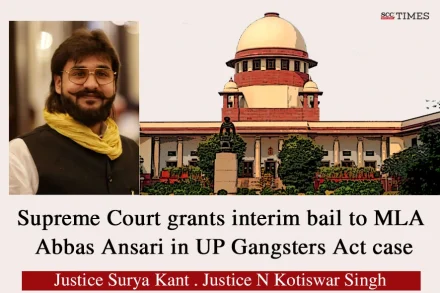
Earlier, the Court had permitted him to attend a ‘Fatiha’ ceremony of his father Mukhtar Ansari, who died on 28-03-2024.

“Whether the investigation under NDPS Act is to be completed within 60 days or 180 days is totally dependent upon FSL report.”
On perusal of the arrest memo shows that though there is column providing for ‘reasons of arrest’ against which it is stated “for the purpose of fair investigation” but neither there is column for ‘grounds of arrest’ in the arrest memo nor it is the case of the prosecution that the ‘grounds of arrest’ were separately served upon the present petitioner at the time of his arrest.”
It is unfortunate that despite directions from Supreme Court and this Court, the trial has not yet concluded. This was unacceptable, considering that such directions were passed while disposing of the bail application, and the accused is in judicial custody for over 10 years. Such prolonged delay in compliance with judicial directions defeats the very purpose of directing expeditious trial.
“Bleak hope of any speedy trial in the matter.”

Top criminal cases on quashing of proceedings, arrest, bail, acquittal, and more.
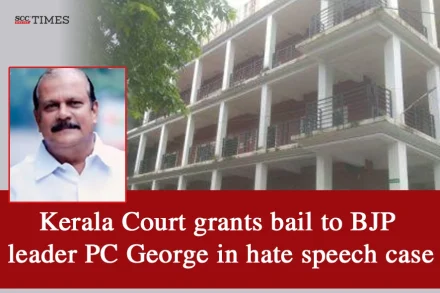
A case was registered against PC George, alleging commission of offences punishable under Sections 196(1)(a), 299 of Bharatiya Nyaya Sanhita, 2023 and Section 120(o) of Kerala Police Act, 2011.
“The victim has left her parents’ house without informing the parents and stayed with the accused for 3 days and 3 nights, she also confessed that she was in love with the accused and travelled along with him to different places and had a consensual encounter.”
Inmates face social stigma which can disrupt relationships with family and friends and the incarcerated persons often suffer long-term consequences from having been subjected to pain, deprivation, and extremely atypical patterns and norms of living and interacting with others.