Disclaimer: This has been reported after the availability of the order of the Court and not on media reports, so as to give an accurate report to our readers.
Delhi High Court: In an appeal against the Commercial Court’s order refusing to grant interim injunction in a trade mark infringement suit on the ground that the expression “Chacha” is a generic and commonplace word over which no monopoly could be claimed, the Division Bench of C. Hari Shankar* and Om Prakash Shukla, JJ., held that the Commercial Court erred in treating the expression “Chacha” as generic, set aside the impugned order and restrained the use of the impugned mark pending trial.
The Court reiterated that distinctiveness must be examined in relation to the goods for which the mark is used and held that use of Chacha CLOTH HOUSE for garments prima facie infringed the registered trade marks Chacha SAREE BAZAR PVT. LTD. and allied marks.
Background
The appellants are registered proprietors of several trade marks, including Chacha Saree Bazar Pvt. Ltd. 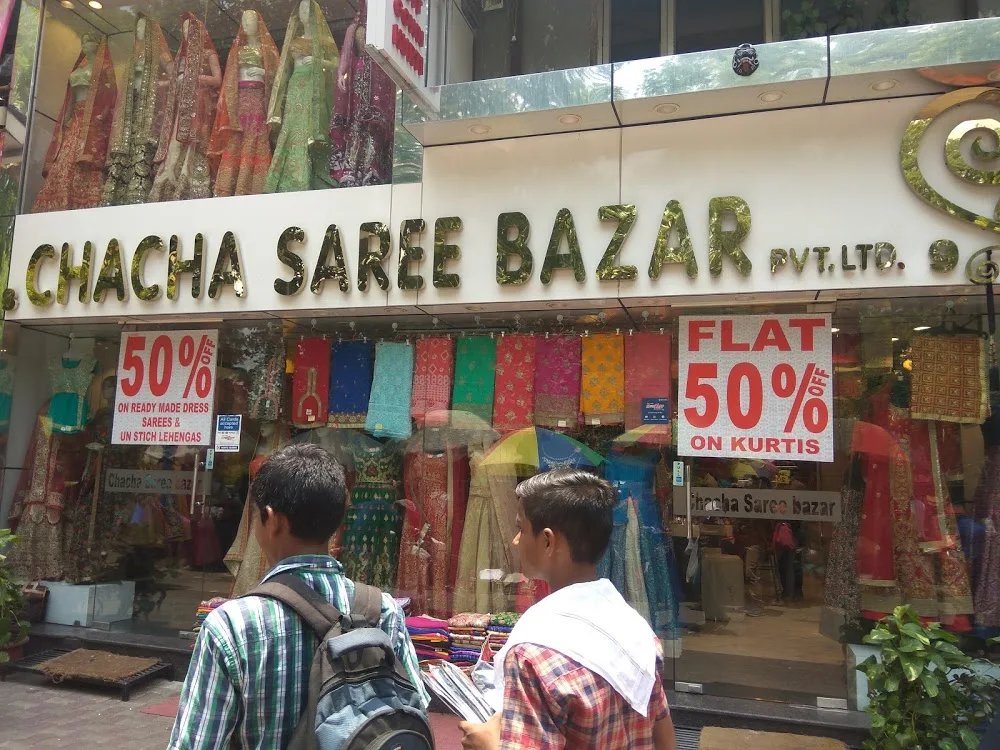 , Chache Di Hatti, and Chacha Suit Gallery, registered under Section 23, Trade Marks Act, 1999 (the Act), in respect of textiles, garments and allied goods falling in Classes 24 and 25. The respondent, admittedly not possessing any registered trade mark, commenced business under the mark Chacha Cloth House as
  and
and  , dealing in identical goods.
The petitioner alleged infringement and likelihood of confusion and instituted a commercial suit seeking a permanent injunction and consequential relief. An ex parte ad interim injunction was initially granted. However, the Commercial Court subsequently vacated the injunction, holding that the word “Chacha”, being a common vernacular expression meaning “uncle”, was generic and incapable of monopoly unless a secondary meaning was established. Aggrieved by the impugned order, the appellants preferred the present appeal.
Issues:
Whether the expression “Chacha” lacked distinctiveness to disentitle trade mark protection, and whether the respondent’s mark constituted prima facie infringement under Section 29, Trade Marks Act?
Analysis
At the outset, the Court noted the settled principles governing trade mark infringement and interim injunctions. The Court relied upon Midas Hygiene Industries (P) Ltd. v. Sudhir Bhatia, (2004) 3 SCC 90, wherein it was noted that, in cases of infringement, an injunction ordinarily follows once infringement is prima facie established, and mere delay cannot defeat relief.
Thereafter, the Court examined the statutory scheme of Sections 28 and 29 Trade Marks Act to emphasise that registration confers an exclusive statutory right and enables the registered proprietor to seek relief against infringing use. The Court reiterated that infringement under Section 29(2)(b) arises where a deceptively similar mark is used in relation to identical or similar goods, resulting in a likelihood of confusion or association in the mind of the public.
The Court relied on Amritdhara Pharmacy v. Satya Deo Gupta, 1962 SCC OnLine SC 13 and Satyam Infoway Ltd. v. Siffynet Solutions (P) Ltd., (2004) 6 SCC 145, to explain the ”likelihood of confusion”. The Court noted that similarity must be assessed from the standpoint of a consumer of average intelligence and imperfect recollection. The Court further emphasised that marks are not to be compared side-by-side with microscopic scrutiny but by examining the overall commercial impression.
“What has to be seen is whether, when the average consumer initially sees the defendant’s mark, having come across the plaintiff’s mark at an earlier point of time, the first impression on the psyche of such a consumer would be of confusion or association. The fact that, later, this impression might be dispelled, does not mitigate the aspect of infringement.”
The Court further examined Section 17, Trade Marks Act. The Court referred to South India Beverages (P) Ltd. v. General Mills Marketing Inc., 2014 SCC OnLine Del 1953, and Stiefel Laboratories v. Ajanta Pharma Ltd., 2014 SCC OnLine Del 3405, wherein the Court held that although the anti-dissection rule mandates comparison of marks as a whole, identification of a dominant or essential feature remains permissible as an analytical tool. The Court also relied on Kaviraj Pandit Durga Dutt Sharma v. Navratna Pharmaceutical Laboratories, 1964 SCC OnLine SC 14, and the Supreme Court’s reasoning in Pernod Ricard India (P) Ltd., 2025 SCC OnLine SC 1701, to clarify that the dominant feature doctrine complements rather than contradicts the anti-dissection rule.
Applying these precedents and principles to the present case, the Court observed that the dominant feature of both rival marks was the expression “Chacha”, while the remaining words merely described the nature of business or goods. Consequently, an average consumer encountering the marks would primarily recollect the dominant element, thereby giving rise to the likelihood of association.
Addressing the central reasoning adopted by the Commercial Court that word “Chacha” was generic, the Court differed from this approach and held that distinctiveness cannot be examined in abstraction but must be evaluated vis-à-vis the goods concerned. A word of common parlance may nonetheless be distinctive when used in relation to goods with which it bears no conceptual or etymological connection. Since the word “Chacha” had no inherent connection with sarees or garments, there existed no basis to treat it as lacking distinctiveness.
“Distinctiveness, by its very nature, has to be examined vis-v-vis the goods or services in respect of which the mark is used. An everyday expression of common parlance, which would ordinarily be “generic”, may be distinctive when used in respect of goods or services with which it has no connection whatsoever.”
The Court further observed that Section 31(1) Trade Marks Act statutorily renders registration prima facie evidence of validity, which necessarily includes prima facie distinctiveness under Section 9(1)(a). Therefore, at the interlocutory stage, the Commercial Court could not disregard the statutory presumption of validity without compelling material.
The Court relied on Pankaj Goel v. Dabur India Ltd., 2008 SCC OnLine Del 1744, while addressing the argument that the expression was “common to trade”. It held that the mere existence of similar marks is insufficient and that the defendant must establish substantial commercial use affecting the plaintiff’s distinctiveness. The Court observed that no evidence regarding market presence, turnover, or extent of use was produced by the respondent, and hence the defence failed.
Furthermore, the plea based on dissimilarity of logos was rejected with reference to K.R. Chinna Krishna Chettiar v. Shri Ambal & Co., (1969) 2 SCC 131, wherein the Supreme Court held that even visually distinct labels may infringe where the dominant textual feature is phonetically similar. The Court observed that the prominent textual component of both parties’ marks was identical, and visual differences could not neutralise infringement.
Cumulatively, the Court concluded that the respondent’s adoption of Chacha Cloth House for identical goods constituted prima facie infringement within the meaning of Section 29(2)(b). The Commercial Court was found to have proceeded on erroneous legal premises, thereby inviting appellate interference in terms of Wander Ltd. v. Antox India (P) Ltd., 1990 Supp SCC 727.
Accordingly, the Court allowed the appeal, set aside the impugned order to the extent it restricts the respondent from using the marks presently in use by them and restrained the respondent from using the marks  and
and  for any goods or services covered by Classes 24, 25 or 35, or any allied or cognate goods or services, pending disposal of the suit.
[Chacha Saree Bazar (P) Ltd. v. Chacha Cloth House, 2026 SCC OnLine Del 761, decided on 12-2-2026]
*Judgment authored by Justice C. Hari Shankar.
Advocates who appeared in this case:
For the Petitioner: Rishi Bansal, Rishabh Gupta, Shruti Manchanda, Vibhor Sethi, Mankaran Singh, Advocates.
For the Respondent: Anukriti Pareek, Advocate.