
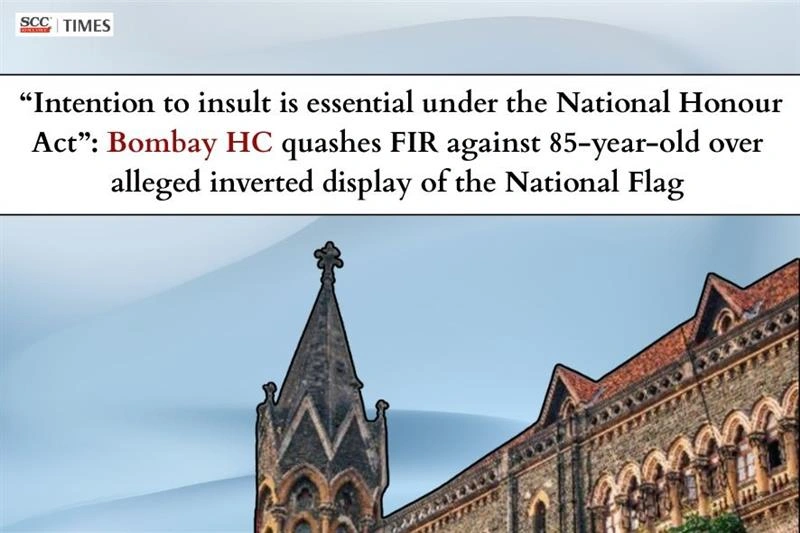
Bombay High Court: While hearing a petition under Section 482, Criminal Procedure Code, 1973, a Single Judge Bench of Ashwin D. Bhobe, J., observed that mere presence at a flag-hoisting ceremony cannot constitute an offence under the Prevention of Insults to National Honour Act, 1971 (National Honour Act). The Court emphasised that mens rea is an essential ingredient of the offence and, finding no material to show intentional inverted display of the National Flag, held that the FIR, chargesheet, and the Magistrate’s order taking cognizance were unsustainable. Accordingly, the Court quashed the proceedings against the applicant.
Background
The matter arose from an FIR registered on Republic Day 2017, when police officers reported that the National Flag hoisted at a residential society was inverted. The FIR alleged that members present during the ceremony had committed an offence under Section 2(4)(l), National Honour Act. The applicant, an elderly person suffering ailments, was present at the ceremony but had not hoisted the flag.
It was contended on behalf of the applicant that the FIR and chargesheet lacked material to show intentional hoisting of the flag in an inverted position. It was further submitted that no independent witnesses supported the allegation and that the terrace where the flag was hoisted was not a “public place” within the meaning of the National Honour Act. It was highlighted that the applicant had tendered an unconditional apology to avoid further distress.
On the other hand, the prosecution relied on the statement of the society’s watchman, who noted the presence of members during the flag hoisting, and argued that the offence was made out.
Analysis and Decision
The Court emphasised that the offence charged is under Section 2(4)(l), National Honour Act, wherein a person who, in any public place, intentionally displays the Indian National Flag with the “saffron” downwards is said to have committed the offence. The Court observed that neither the statement of the watchman nor any material collected by the prosecution on record indicated that the applicant hoisted or displayed the Indian National Flag, or was involved in its display, on 26 January 2017. Similarly, the Court noted that there was no material-on-record to show that any act of the applicant was intended to insult or show disrespect to the honour of the Indian National Flag.
The Court emphasised that to constitute the offence under Section 2(4)(l), National Honour Act, the display of the Indian National Flag in an inverted manner must be intentional, thus, mens rea to cause insult or disrespect, or to bring the Indian National Flag into contempt, would be required. The Court also highlighted that the applicant’s mere presence at the place of hoisting of the Flag, as alleged, would not amount to an offence under Section 2(4)(l), National Honour Act.
The Court observed that, on perusal of the order dated 3 July 2017 (the order), no reasons, even for namesake, had been assigned by the Magistrate, as the said order was non-speaking. Since taking cognizance is a judicial act that requires the application of mind, the absence of reasons rendered the order defective. The Court referred to Lalankumar Singh v. State of Maharashtra, (2023) 236 Comp Cas 741, wherein the Supreme Court held that the Magistrate is required to apply his mind as to whether sufficient ground for proceeding exists in the case or not, thereby making the order liable to be set aside if no reasons are given therein while coming to the conclusion that there is a prima facie case against the accused.
Therefore, the Court emphasised that the order did not disclose that the Magistrate considered the material available on record, hence, it was illegal and warranted interference. The Court stressed that the case fell within the principles laid down in State of Haryana v. Bhajan Lal, 1992 Supp (1) SCC 335, warranting exercise of powers to prevent abuse of process under Section 528, Nagarik Suraksha Sanhita, 2023.
Accordingly, the Court allowed the application with no order as to costs and quashed the FIR, chargesheet, and the order taking cognizance against the applicant.
[V. K. Narayanan v. State of Maharashtra, 2026 SCC OnLine Bom 1438, decided on 23-2-2026]
Advocates who appeared in this case:
For the Applicant: Rajendra Sonwal, Advocate
For the Respondent: Pallavi Dabhokar, APP
Buy Code of Criminal Procedure, 1973 HERE