


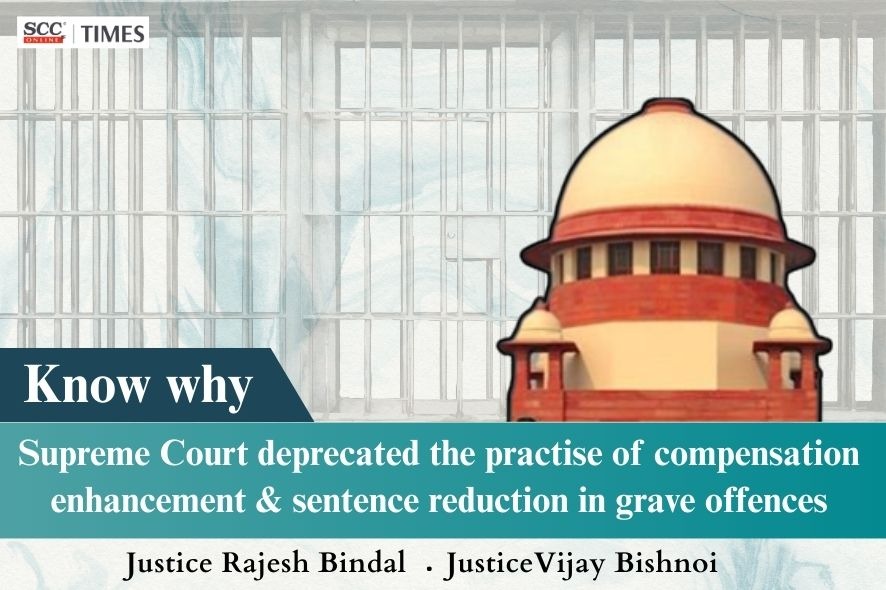
Supreme Court: In an appeal against Madras High Court’s judgment whereby, while upholding the conviction of the accused for offences under Sections 307, 326 and 324, Penal Code, 1860 (IPC), the sentence of 3 years’ rigorous imprisonment imposed by the Trial Court and affirmed in appeal, was reduced to the period already undergone, coupled with enhancement of fine and payment of compensation to the victim’s wife, the Division Bench of Rajesh Bindal and Vijay Bishnoi,* JJ. were called upon to determine whether such reduction of sentence in exercise of revisional jurisdiction was legally sustainable.
While slamming “the practice of enhancing the compensation payable to the victim and reducing the sentence, especially in cases of grave offence,” as it sends wrong message to society, the Court , set aside the High Court’s judgment and restored the sentence imposed by the Trial Court as affirmed by the Appellate Court.
The Court further culled out following basic factors which are to be kept in mind by the courts while dealing with imposition of sentence —
-
Proportionality between crime and punishment,
-
Consideration of the factual matrix and findings of the Trial Court,
-
Impact on society, and
-
Balancing of aggravating and mitigating circumstances.
Factual Matrix
The instant matter originated from FIR registered at Thiruppachethi Police Station on account of prior enmity between the parties. On 6 June 2009 at about 3:00 p.m., the accused, armed with knives, attacked the victim and inflicted stab injuries on vital parts of the body including the chest, rib and abdomen, while the co-accused assaulted him with sticks. The medical evidence disclosed four stab injuries which were life-threatening if not immediately treated.
Upon completion of investigation, a charge-sheet was filed. The Trial Court, relying on the ocular testimony of the injured witness, the complainant, the victim’s wife and the medical evidence, held that the prosecution had proved the case beyond reasonable doubt and convicted the private respondents under Sections 307, 326 and 324 IPC, sentencing them to 3 years’ rigorous imprisonment.
The Appellate Court dismissed the appeal and affirmed both conviction and sentence and held that the injuries were inflicted with the intention and knowledge necessary to attract Section 307 IPC.
During the pendency of the revision before the High Court, the victim died in an unrelated incident. The High Court, noting the lapse of more than ten years, absence of adverse antecedents and the willingness of the accused to pay compensation, reduced the custodial sentence to the period already undergone (about two months) while enhancing the fine.
Moot Point
Whether the High Court was justified in reducing the substantive sentence to the period already undergone in a case involving conviction under Section 307 IPC?
Parties’ Contentions
The appellant contended that the reduction of sentence was wholly disproportionate compared to the gravity of the offence and contrary to the settled principle that punishment must be commensurate with the seriousness of the crime. It was argued that mere lapse of time cannot be treated as a mitigating circumstance and that compensation cannot substitute a custodial sentence.
The State supported appellant’s arguments and submitted that the High Court showed “undue sympathy” without recording cogent reasons and exceeded the limits of revisional jurisdiction.
However, the private respondents justified the impugned order by referring to the passage of time, their conduct, the subsequent death of the victim in another incident and the compensatory payment to the family. They further stressed on the reformative aspect of sentencing.
Court’s Analysis
At the outset, the Court noted that the High Court had reduced the sentence from rigorous imprisonment of 3 years to the period already undergone, i.e., 2 months, in case where the accused had inflicted grievous and life-threatening injuries and did so without assigning any convincing reasons. The Court described such an approach as being “in complete defiance of the law” and a “travesty of the established criminal jurisprudence.”
The Court noted that apart from lapse of time and that the victim had been murdered by some other persons a few years later, the High Court failed to provide any reason for reducing the sentence for such a heinous offence and therefore erred in not applying its judicial mind to accurately decide the sentence.
The Court referred to Hazara Singh v. Raj Kumar, (2013) 9 SCC 516; Ahmed Hussein Vali Mohammed Saiyed v. State of Gujarat, (2009) 7 SCC 254 and Guru Basvaraj v. State of Karnataka, (2012) 8 SCC 734 and reiterated that sentencing must maintain a balance between deterrence, reformation and the rights of the victim, but the controlling principle remains proportionality between the crime and the punishment. It was asserted that undue sympathy resulting in inadequate sentence undermines public confidence in the justice system and erodes the social fabric.
“The objective of punishment is not to seek vengeance for the crime, rather, it is an attempt to reconstruct the damaged social fabric of society in order to pull back its wheel on the track… objective of punishment is to create an effective deterrence so that the same crime/actions are prevented and mitigated in future.”
The Court rejected the approach of treating compensation as a substitute for punishment, especially in cases of grave offence, and held that compensation is restitutory in nature and “cannot be considered as equivalent to or a substitute for punishment.” Further, the Court referred to Shivani Tyagi v. State of U.P., 2024 SCC OnLine SC 842, where the Supreme Court termed that such payment was kind of “Blood Money” to the victim by the offenders. The Court cautioned against the practice of reducing custodial sentence upon payment of money was as it conveys a dangerous message that criminal liability can be “purchased by money.”
Considering the gravity of the situation, the Court culled out certain basic factors, which are to be kept in mind by the courts while dealing with imposition of sentence. The said factors are enunciated as below —
-
“Proportionality: Adherence to the principle of “just deserts” ought to be the primary duty of the courts. There should be proportionality between the crime committed and the punishment awarded, keeping in consideration the gravity of the offence.
-
Consideration to Facts and Circumstances: Due consideration must be given to the facts and circumstances of the case, including the allegations, evidence and the findings of the trial court.
-
Impact on Society: While imposing sentences, the courts shall bear in mind that crimes essentially impair the social fabric of the society (of which the victim(s) is/are an indispensable part) and erodes public trust. The sentence should be adequate to maintain the public trust in law and administration, however, caution should also be taken, and the Court shall not be swayed by the outrage or emotions of the public and must decide the question independently.
-
Aggravating and Mitigating Factors: The courts, while deciding the sentence or modifying the sentence, must weigh the circumstances in which the crime was committed, and while doing so, the court must strike a fair balance between the aggravating and the mitigating factors.”
Applying these principles to the facts of the present case, the Court noted that the Trial Court had already exercised leniency by awarding only 3 years’ imprisonment against a possible maximum of 10 years under Section 307 IPC. The Court asserted that the High Court, while exercising revisional powers, ignored the gravity of the offence and the well-reasoned findings of the courts below.
The Court further added that the undue sympathy shown by the High Court was totally unwarranted, and “such displays of overt sentiments risk undermining the administration of justice, as it is imperative that justice is not merely done but also seen to be done.”
Court’s Decision
The Court set aside the High Court’s judgment and restored the sentence imposed by the Trial Court as affirmed by the Appellate Court. It directed the private respondents to surrender within 4 weeks to serve the remaining part of the sentence after adjusting the period already undergone.
[Parameshwari v. State of T.N., 2026 SCC OnLine SC 209, decided on 17-2-2026]
*Judgment by Justice Vijay Bishnoi
Advocates who appeared in this case :
Mr. A Velan, AOR, Ms. Navpreet Kaur, Adv., Mr. Mritunjay Pathak, Adv., Mr. Prince Singh, Adv., Mr. Nilay Rai, Adv., Ms. Kanika Sharma, Adv., Mr. M. Rashik Hameed Mukilan, Adv., Counsel for the Appellant
Mr. V. Krishnamurthy, Sr. A.A.G., Mr. Sabarish Subramanian, AOR, Mr. M.P. Parthiban, AOR, Ms. Priyaranjani Nagamuthu, Adv., Mr. Bilal Mansoor, Adv., Mr. Shreyas Kaushal, Adv., Mr. S. Geyolin Selvam, Adv., Mr. Alagiri K, Adv., Mr. Shivansh Sharma, Adv., Mr. Abhishek S, Adv., Counsel for the Respondents

Judgment of the Honourable Supreme Court of India in Parameshwari v. State of Tamil Nadu rendered on 17 February 2026 assumes enormous significance on the question of exercise of revisional powers by the Honourable High Court in the sphere of criminal law.
The apex Court clearly rejected the approach of treating compensation as a substitute for punishment, particularly in cases of grave offence, and ruled that compensation is restitutory in nature and “cannot be considered as equivalent to or a substitute for punishment.” The Court also referred to Shivani Tyagi v. State of U.P., 2024, where the Supreme Court termed that such payment was kind of “Blood Money” to the victim by the offenders. The Court warned against the practice of reducing custodial sentence upon payment of money was as it conveys a dangerous message that criminal liability can be “purchased by money.”
The question of law before the Supreme Court was whether the High Court was justified in reducing the substantive sentence to the period already undergone in a case involving conviction under Section 307 IPC? As it is well known, Section 307 of the Indian Penal Code deals with the offence of ‘Attempt to Murder’. It reads: “Whoever does any act with such intention or knowledge, and under such circumstances that, if he by that act caused death, he would be guilty of murder, shall be punished with imprisonment of either description for a term which may extend to ten years, and shall also be liable to fine; and, if hurt is caused to any person by such act, the offender shall be liable either to imprisonment for life, or to such punishment as is hereinbefore mentioned”.
It further reads : “Attempts by Life Convicts: When any person offending under this section is under sentence of imprisonment for life, he may, if hurt is caused, be punished with death”.
Thus, the IPC Section 307 deals with a very serious offence of an attempt to murder. Depending on the nature of culpability of the accused, the punishment varies from imprisonment for 10 years, fine, and even death sentence.
The apex court applied the following four principles to the facts of the present case:
1 Proportionality between crime and punishment,
2 Consideration of the factual matrix and findings of the Trial Court,
3 Impact on society, and
4 Balancing of aggravating and mitigating circumstances.
The Court while referring to Hazara Singh v. Raj Kumar, (2013) 9 SCC 516; Ahmed Hussein Vali Mohammed Saiyed v. State of Gujarat, (2009) 7 SCC 254 and Guru Basvaraj v. State of Karnataka, (2012) 8 SCC 734 emphasised that sentencing must maintain a balance between deterrence, reformation and the rights of the victim. The controlling principle, however, remains proportionality between the crime and the punishment. It was held that undue sympathy resulting in inadequate sentence undermines public confidence in the justice system and erodes the social fabric. The highest court of the land stated:
“The objective of punishment is not to seek vengeance for the crime, rather, it is an attempt to reconstruct the damaged social fabric of society in order to pull back its wheel on the track… objective of punishment is to create an effective deterrence so that the same crime/actions are prevented and mitigated in future.”
The top Court noted that the Trial Court had already exercised leniency by awarding imprisonment of only three years against a possible maximum of ten years under Section 307 IPC. The Court noted that the High Court, while exercising revisional powers, ignored the gravity of the offence and the well-reasoned findings of the courts below. The Court set aside the High Court’s judgment and restored the sentence imposed by the Trial Court as affirmed by the Appellate Court. The Supreme Court ordered the private respondents to surrender within four weeks to serve the remaining part of the sentence after adjusting the period already undergone.
This judgment of the Supreme Court reminds all stakeholders of the crucial need to abide by the cherished principle of awarding exemplary punishment to those who are convicted of committing heinous crimes. The message is loud and clear: In India, criminal liability cannot be “purchased by money.”