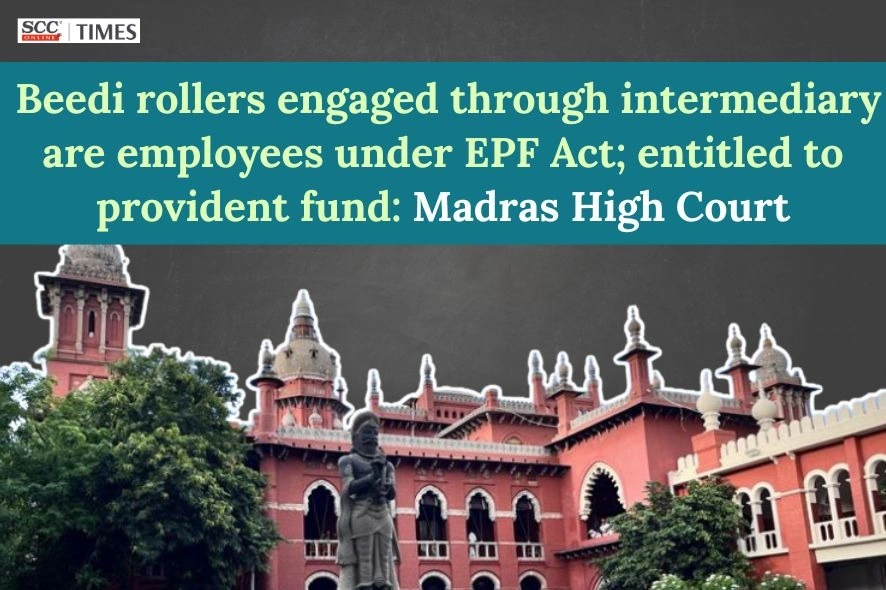
Madras High Court: In writ petitions under Article 226 of the Constitution, a Single Judge Bench of K. Surender, J., held that beedi rollers engaged through an intermediary were employees of the petitioner company under the Employees’ Provident Funds (‘EPF’) and Miscellaneous Provisions Act, 1952 (‘EPF Act’). The Court underscored that the intermediary was merely a benami arrangement, noting that specifications for rolling beedis were given by the company and the products were branded and sold under its name. Observing that the workers’ sustenance was wholly dependent on the company, the Court upheld the orders passed under the EPF Scheme read with Section 7A of the EPF Act, and dismissed the writ petitions as devoid of merits.
Background:
The matter arose from a complaint lodged by the Beedi Employees Union alleging that nearly 800 beedi workers engaged through a trader were denied provident fund benefits. The petitioner company procured unbranded beedis from the trader and sold them under its own brand label.
The Regional Provident Fund Commissioner, after enquiry, held that the beedi rollers supplying beedis through the trader were in fact employees of the petitioner company. The petitioner company challenged this order, contending that there was no nexus between the beedi rollers and the company, and that they were independent workers associated only with the trader.
It was argued that inspections by the Central Excise Department and findings in criminal proceedings showed no evidence of employment relationship with either the trader or the petitioner company. The respondents, however, contended that documentary and oral evidence established that the beedi rollers were employees of the petitioner company, and that the arrangement was devised to circumvent the EPF Act.
Analysis and Decision:
The Court emphasised that under Section 2(f) of the EPF Act, an “employee” includes persons employed directly or indirectly. The Court noted the Regional Provident Fund Commissioner’s findings that the trader was not a registered firm, had no Goods and Services Tax (‘GST’) registration, and carried on business exclusively with the petitioner company. It was further highlighted that the documents revealed that the trader was merely a benami unit of the petitioner company, created to procure beedis from workers and avoid EPF obligations.
The Court observed that specifications for rolling beedis were given by the petitioner company, and the beedis were branded and sold under its name. It was highlighted that the beedi rollers were producing beedis and rendering services to the petitioner company through traders, however, the presence of the traders as an intermediary does not alter the relationship between the beedi workers and the petitioner company. The Court noted that the sustenance of the beedi rollers was wholly dependent on the petitioner company. It was further emphasised that the arrangement adopted by the petitioner company was to project the absence of nexus between the beedi rollers and the petitioner company.
The Court observed that the Regional Provident Fund Commissioner had given adequate and convincing reasons to establish that the beedi rollers were, in fact, employees of the petitioner company. The Court highlighted that the EPF Act is a beneficial piece of legislation intended to safeguard employees’ welfare. Though a dubious method was adopted by the petitioner company in engaging the services of the beedi rollers, on close scrutiny and the reasoning given in the order dated 01-07-2003, the Court held that it cannot be said that the beedi rollers are not employees of the petitioner company or that they are not entitled to provident fund benefits.
The Court observed that though two views were possible, it could not take a different view when the authority’s findings were probable, reasonable, plausible, and convincing. Accordingly, the Court sustained the orders dated 01-07-2003 and 17-08-2004 and dismissed the writ petitions as devoid of merits.
[Seyadu Beedi Company v. EPFO, 2026 SCC OnLine Mad 1510, decided on 13-02-2026]
Advocates who appeared in this case:
For the Petitioner: C. Karthikeyan
For the Respondent: I. Robert Chandra Kumar, Standing Counsel
Buy Constitution of India HERE