Disclaimer: This has been reported after the availability of the order of the Court and not on media reports so as to give an accurate report to our readers.
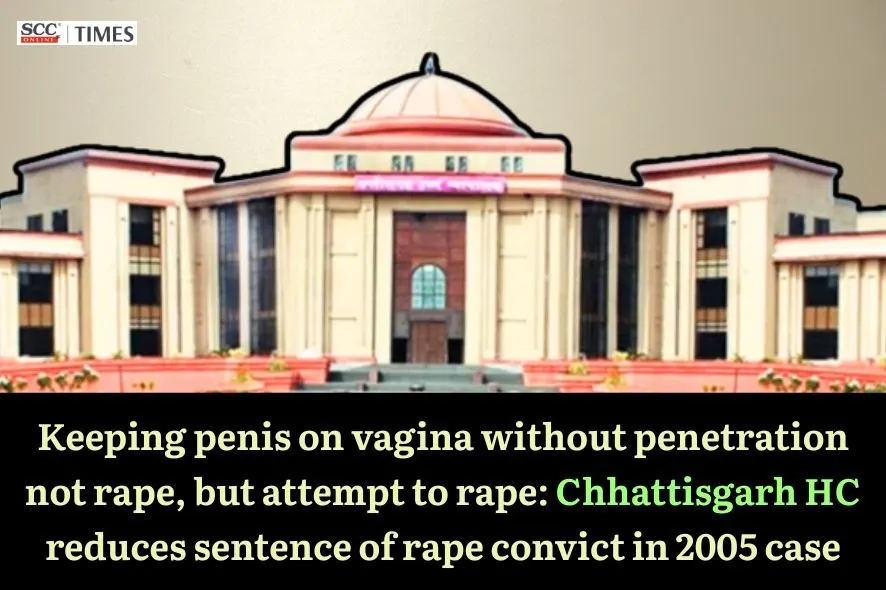
Chhattisgarh High Court: In a criminal appeal filed by a man convicted of rape in 2005, the Single Judge Bench of Narendra Kumar Vyas, J., partially allowed the appeal, holding that the convict did not penetrate the vagina, thus he only committed an attempt to rape and not rape. Accordingly, the Court modified his sentence from Section 376(1) to Section 375 read with Section 511 of the Penal Code, 1860 (“IPC”) and sentenced him to rigorous imprisonment for 3 years and 6 months.
Background
On 21-05-2004, the victim was alone in her house when the accused visited her and forcibly dragged her to his house. At his house, he undressed both of them and committed sexual intercourse against her will. Thereafter, he locked her inside a room after tying her hands and legs and stuffing cloth into her mouth.
The FIR regarding the incident was lodged, and an investigation was conducted. Ultimately, the Trial Court vide its judgment dated 06-04-2005, convicted him under Sections 376(1) and 342 of the IPC and sentenced him to imprisonment for seven years with Rs 200 as fine. Aggrieved, he filed the present appeal.
During her cross-examination before the Trial Court, the victim stated that the convict had kept his private part above her vagina for about 10 minutes and did not penetrate. However, in another statement, she claimed he did penetrate. She also stated that she could not open her mouth as he had tightened both her hands and remained in the closed room for eight hours till her mother discovered her.
The doctor who medically examined the victim stated that the hymen was not ruptured, and no definite opinion could be given regarding the commission of rape. In the cross-examination, she reiterated that there was a possibility of partial penetration. She also stated that there was redness in the vulva and white liquid in it, and the victim was complaining of pain. Furthermore, the convict was found capable of engaging in sexual intercourse.
However, as per the FSL report, no human sperm was found in the victim’s undergarments.
Analysis
At the outset, the Court noted that the victim in one part of her evidence claimed penetration, and on a subsequent line, she stated that the convict kept his private part above her private part for about 10 minutes, but did not penetrate. This version of the victim’s evidence was corroborated with the medical report, wherein the doctor opined that the hymen was not ruptured and only the tip of 1 finger could be introduced into the vagina; therefore, there was a possibility of partial penetration.
The Court further noted that the doctor, in her evidence, stated that the victim complained of pain in her private part, and her vulva had redness and white liquid, which clearly proved beyond a reasonable doubt that the victim was subjected to the commission of the offence of rape by the convict.
The Court relied on State of U.P. v. Babul Nath, (1994) 6 SCC 29, to reiterate that to constitute rape as per Section 375 of the IPC, as stood before the 2013 amendment, medical evidence of penetration was required. This may occur with the hymen remaining intact, and in view of the explanation to Section 375, mere penetration of the penis in the vagina is an offence of rape. Even slight penetration is sufficient for conviction under Section 376 of the IPC. Thus, penetration is sine qua non for an offence of rape, and to constitute penetration, there must be clear and cogent evidence to prove that some part of the virile member of the accused was within the labia of the pudendum of the woman, no matter to what extent, which is sufficient to hold accused guilty under Section 376 of the IPC.
To find an accused guilty of an attempt with intent to commit a rape, the Court stated that it has to be satisfied that the accused, when he laid hold of the prosecutrix, not only desired to gratify his passion upon her person, but also intended to do so at all events, notwithstanding any resistance on her part.
Stating that indecent assault was often magnified into an attempt to rape, the Court held that to conclude that the conduct of the accused was indicative of the determination to gratify his passion at all events and despite all resistance.
Reiterating that the sine qua non for rape is penetration and not ejaculation, the Court held that ejaculation without penetration constitutes an attempt to commit rape and not actual rape.
Upon consideration of the victim’s evidence, the Court stated that it was clear that the commission of actual rape had not been established, as the victim’s own statement created doubts. She affirmed that the appellant had kept his private part above her private part, but did not penetrate, and this statement was corroborated by medical evidence. Furthermore, the doctor stated that there was a possibility of partial penetration.
Thus, the Court held that this evidence was sufficient to prove that an attempt to commit rape was made out, but not rape. In this regard, the Court referred to Madan Lal v. State of Jammu and Kashmir1 wherein the Supreme Court examined the concept of attempt to rape and State of M.P. v. Mahendra, (2022) 12 SCC 442, wherein the Supreme Court analysed the distinction between preparation and attempting to commit the offence of rape.
The Court further stated that the acts of forcibly taking the victim inside the room, closing the doors with the motive of carnal knowledge, were the ‘preparation’ to commit the offence, while the following actions of stripping the victim and himself, rubbing his genitals against hers, and partial penetration were indeed an endeavour to commit sexual intercourse. These acts of the convict were deliberately done with manifest intention to commit the offence aimed at and were reasonably proximate to the consummation of the offence.
Since the acts of the convict exceeded the stage beyond preparation and preceded the actual partial penetration but without ejaculation, the Court held that the convict was guilty of attempting to commit rape as punishable within the ambit and scope of Section 511 read with Section 375 of the IPC as it stood in force at the time of occurrence.
Accordingly, the Court modified the conviction from Section 376 (1) to Section 375 read with 511 of the IPC and sentenced him to rigorous imprisonment for 3 years and 6 months along with a fine of Rs. 200. Regarding the conviction and sentence under Section 342 of IPC, the Court held that the sentence of 6 months was just and proper and thus, it was affirmed. The Court directed that both sentences shall run concurrently.
Furthermore, the Court cancelled the accused’s bail and directed him to surrender before the Trial Court to serve out the remaining sentence.
[Vasudeo Gond v. State of Chhattisgarh, 2026 SCC OnLine Chh 2703, decided on 16-02-2026]
Advocates who appeared in this case :
For the petitioner: Rahil Arun Kochar, Leekesh Kumar
For the respondent: Manish Kashyap, Panel Lawyer
1. 1998 (Cr.L.J.) 667 SC