
Disclaimer: This has been reported after the availability of the order of the Court and not on media reports so as to give an accurate report to our readers.
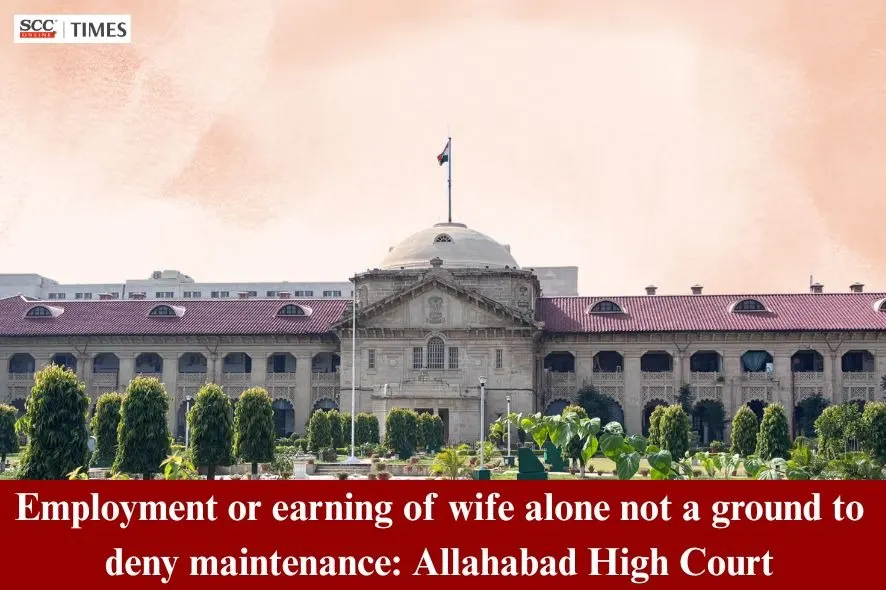
Allahabad High Court: In a criminal revision filed by a husband against the Trial Court’s order directing him to pay maintenance to his wife, the Single Judge Bench of Madan Pal Singh, J., dismissed the revision, reiterating that mere employment or earning of the wife is, by itself, not a ground to deny maintenance. The Court held that the maintenance awarded by the Trial Court appeared to be just, reasonable, and commensurate with the status and earning capacity of the husband.
Background
The wife filed an application under Section 125 of the Criminal Procedure Code, 1973 (“CrPC”), seeking maintenance from her husband. The Trial Court directed the husband to pay Rs 15,000 per month to the wife from the date of the application. Aggrieved, he filed the present criminal revision.
The husband contended that the wife was an educated working woman and financially independent with an annual salary of Rs 11.28 Lakhs. He further stated that the wife had voluntarily left the matrimonial home, was unwilling to discharge her matrimonial obligations, and refused to reside with his old parents. He claimed that he was compelled to leave his employment to take care of his ailing parents and was burdened with financial liabilities, thereby lacking sufficient means to pay the maintenance awarded.
The wife contended that the husband had admitted before the Trial Court that he was employed with J.P. Morgan from April 2018 to 2020, drawing an annual package of Rs. 40 lakhs per annum.
Analysis
Upon perusal of the income documents relied upon by the parties, the Court noted that the husband was previously drawing a substantially high annual remuneration, and he was not able to satisfactorily explain the said material or place any cogent evidence on record to demonstrate a commensurate reduction in his earning capacity.
The Court stated that even if it were to be assumed that the wife had some source of income, the material available on record clearly reflected a substantial disparity in the earning capacity and financial status of the parties. Furthermore, the income attributed to the wife, as reflected from the documents relied upon by the husband, could not be said to be sufficient to enable her to maintain the same standard of living to which she was accustomed during her matrimonial life.
Regarding the husband’s assertions of alleged financial constraints and liabilities, the Court held that these were bald assertions as no convincing or reliable material was placed on record to establish that the husband lacked sufficient means to relieve him of his statutory obligation to maintain his wife.
“The Court is unable to accept the submission that mere employment or earning of the wife is, by itself, a ground to deny maintenance. The object of Section 125 CrPC is not merely to prevent destitution, but to ensure that the wife is able to live with dignity, consistent with the status of the husband.”
In this regard, the Court relied on the settled legal position laid down by the Supreme Court in Shailja v. Khobbanna, (2018) 12 SCC 199, wherein the Court held that mere earning of the wife does not disentitle her from maintenance; the decisive test is whether such income is sufficient to enable her to maintain the same standard of living as enjoyed in the matrimonial home. The said principle was reiterated in Rajnesh v. Neha, (2021) 2 SCC 324.
Based on the aforesaid legal principles and the material available on record, the Court held that the maintenance awarded by the Trial Court appeared to be just, reasonable, and commensurate with the status and earning capacity of the husband. The Court further held that the impugned order did not suffer from any perversity, illegality, or material irregularity warranting interference in the exercise of revisional jurisdiction.
[Ravinder Singh Bisht v. State of U.P., 2026 SCC OnLine All 363, decided on 05-02-2026]
Advocates who appeared in this case :
For the petitioner: Advocates Nitin Sharma, Parmeshwar Yadav
For the respondent: Ravindra Kumar Mishra and Additional Government Advocate