
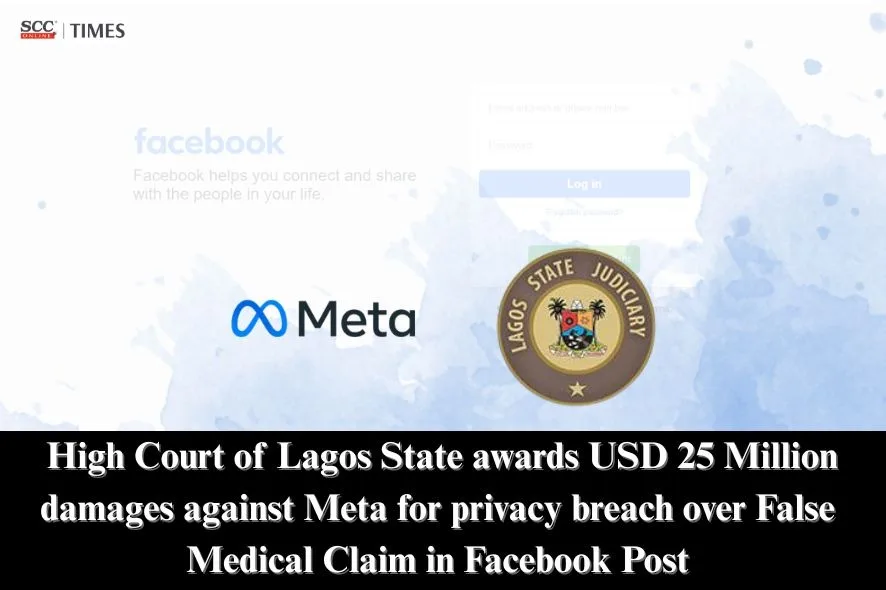
High Court of Lagos State: A suit was filed by the applicant against Meta Platforms seeking declaratory and consequential reliefs for alleged invasion of privacy and breach of data protection rights arising from the continued publication of his name, image and purported voice in a video captioned “Africare Health Centre” on the respondent’s platform (www.facebook.com). Olalekan A. Oresanya, J., awarded general damages in the sum of USD 25,000,000 in favour of the applicant for breach of privacy and data protection rights, thereby resolving the suit in favour of the Applicant.
The applicant prayed for a declaration that the continued publication suggesting that he suffered from prostatitis constituted an invasion of his privacy guaranteed under Section 37 of the Constitution of the Federal Republic of Nigeria, 1999 and violated Section 24(1)(a) and (e) of the Nigeria Data Protection Act, 2023; an order mandating the respondent to forthwith remove/delete the said video; and general damages, on the ground that the false publication exposed him to emotional distress, reputational harm and unlawful processing of inaccurate personal data.
The suit originated by way of an originating motion accompanied by affidavit evidence in which the applicant averred that he discovered a video on the respondent’s platform falsely portraying that he suffered from prostatitis, a claim he denied, asserting that the publication was false, misleading and an intrusion into his private life. The respondent raised a preliminary objection challenging jurisdiction on the basis that it was a foreign company outside Nigeria and that the applicant failed to comply with Section 97 of the Sheriffs and Civil Process Act regarding service outside jurisdiction, and further contended that it acted merely as an intermediary platform and had removed the video upon becoming aware of it. The Court first addressed and dismissed the preliminary objection, holding that fundamental rights enforcement proceedings are sui generis and not strictly governed by the procedural requirement relied upon by the Respondent.
On the merits, the core issue before the Court was whether the continued publication of the Applicant’s name, image and purported voice in connection with a disease amounted to an invasion of privacy and breach of data protection law, and whether the Applicant was entitled to the reliefs sought. The Court observed that the right to privacy under Section 37 of the Constitution protects individuals against unauthorized publication of personal information, and that falsely attributing a serious illness to a person without consent constitutes a violation capable of grounding liability even without proof of actual damage. The Court noted that although the Respondent claimed to be an intermediary, evidence showed that the publication existed on its platform and that a platform hosting and disseminating personal data bears responsibility where it fails to ensure accuracy and fairness in data processing. The Court analysed the provisions of the Nigeria Data Protection Act, 2023 and held that personal data must be accurate, lawful and fairly processed, and that dissemination of false personal medical information amounts to a gross violation of privacy and data protection obligations.
The Court further stated that the defence of innocent dissemination was not sustainable in the circumstances, particularly where the platform continued to host and disseminate harmful personal information, and held that an intermediary hosting provider may be liable where it enables or fails to prevent publication that violates constitutional privacy rights. The Court emphasised that the constitutional right to privacy extends to protection against false medical imputation, reputational harm and misuse of personal data, and that the Respondent, as controller of the platform hosting the impugned content, breached its duty of care and statutory obligations by allowing inaccurate and misleading personal data to be processed and published.
In conclusion, the Court held that the continued publication of the applicant’s name, image and purported voice in a video falsely suggesting that he suffered from prostatitis constituted an invasion of his right to privacy guaranteed under Section 37 of the Constitution of the Federal Republic of Nigeria, 1999 and a violation of Section 24(1)(a) and (e) of the Nigeria Data Protection Act, 2023. The Court also directed the respondent to forthwith remove/delete the said video from its platform, noting that the claim for removal had been overtaken by the respondent’s subsequent deletion of the impugned video, the claim for removal having been overtaken by the respondent’s subsequent deletion of the video.
[Femi Falana v. Meta Platforms, Suit No. LD/17783MFHR/2025, decided on 13-01-2026]