
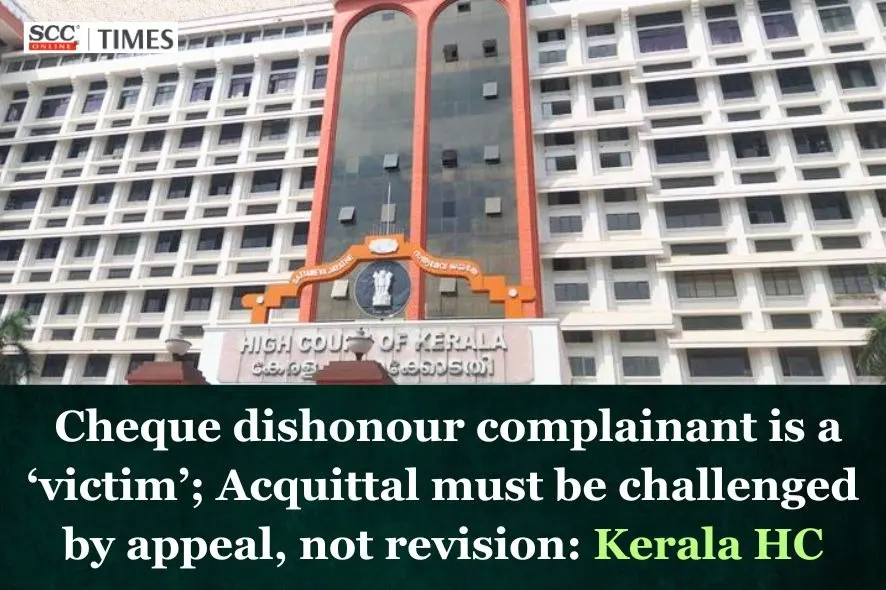
Kerala High Court: In a case revolving around the maintainability of criminal revision petitions against judgments of acquittal rendered in complaint cases under Section 138 of the Negotiable Instruments Act, 1881 (‘NI Act’), a Single Judge Bench of K. Babu, J., while dismissing the revision petitions, held that the cheque dishonour complainant is a ‘victim’ in law and the acquittal must be challenged by preferring an appeal under proviso to Section 372 of the Criminal Procedure Code, 1973 (‘CrPC’) or Section 378(4) CrPC, and not through a revision petition, in view of Section 401(4) CrPC.
Background
The revision petitioner (‘complainant’) filed two complaints under Section 200 CrPC read with Sections 142 and 143 of the NI Act alleging commission of an offence punishable under Section 138 of the NI Act, wherein the accused was convicted by the Trial Court. The accused preferred criminal appeals before the Sessions Court, which resulted in his acquittal. The complainant thereafter filed criminal revision petitions challenging the judgments of acquittal. When the revision relating to one of the acquittals was presented, the Registry raised the defect whether criminal revision petition was the proper remedy.
Issue
Whether the judgment of acquittal in a complaint case alleging offence under Section 138 of the NI Act is appealable at the instance of the complainant?
Analysis and Decision
The Court noted that Section 401(4) CrPC provided that where an appeal lies but is not filed, a party who had the right to appeal cannot seek revision. The Court highlighted that Section 372 CrPC mandated that no appeal shall lie from any judgment or order of a criminal court except as provided by the Code or by any other law in force, and further noted that Section 378 CrPC dealt with appeals in cases of acquittal, and sub-sections (4) stipulated that where acquittal is in a case instituted upon a complaint, it required special leave and prescribed time limits for seeking such leave.
The Court observed that prior to the 2009 amendment, a complainant challenging an acquittal would proceed under Section 378(4) CrPC. However, post-amendment, the definition of ‘victim’ in Section 2(wa) CrPC was introduced, and the proviso to Section 372 CrPC conferred a right of appeal on the victim against any order passed by the Court acquitting the accused or convicting for a lesser offence or imposing inadequate compensation.
The Court noted that Section 142 of the NI Act provided that cognizance of any offence punishable under Section 138 of the NI Act would not be taken except upon a complaint, in writing, made by the payee or the holder in due course of the cheque. The Court clarified that a complainant under Section 138 of the NI Act is a victim as defined in Section 2(wa) CrPC as the expression ‘victim’ includes not only the person who has suffered any loss or injury caused by reason of any act or omission for which the accused person has been charged, but also includes his or her guardian or legal heir.
The Court relied on Celestium Financial v. A. Gnanasekaran, 2025 SCC OnLine SC 1320, wherein it was observed that in an offence under Section 138 of the NI Act, the complainant is indeed the victim owing to the dishonour of a cheque and can proceed to prefer an appeal under the proviso to Section 372 CrPC, provided the conditions enabling such an appeal are met. It should be kept in mind that when an appeal is to be preferred by a complainant, he should also be a ‘victim’ and not just an ‘informant’. It was further clarified that if the complainant is not a victim and the case is instituted upon a complaint, then he must seek special leave to appeal from the High Court, however, if he is also a victim, he can proceed under the proviso to Section 372 CrPC. Thus, it was held that a person who is a complainant under Section 200 CrPC alleging an offence under Section 138 of the NI Act has the right to prefer an appeal as a victim under the proviso to Section 372 CrPC and he need not invoke Section 378(4) CrPC.
The Court observed that a person who files a complaint alleging an offence under Section 138 of the NI Act has the right to prefer an appeal either under Section 378 CrPC or proviso to Section 372 CrPC (corresponding to Section 419 and proviso to Section 413 of the Nagarik Suraksha Sanhita, 2023 (BNSS)). The Court clarified that once an appeal lies, Section 401(4) CrPC operates as a bar to a revision at the instance of the party who could have filed an appeal.
Consequently, the Court rejected the revision petitions as not maintainable while reserving the liberty to the complainant to prefer an appeal. The Court further directed that the period during which the revision petitions remained on the Court’s file would be excluded for reckoning limitation for preferring the appeal.
[Liji v. State of Kerala, 2026 SCC OnLine Ker 2053, decided on 11-2-2026]
Advocates who appeared in this case:
For the Revision Petitioner: Abhiram T.K., Arun George. D, S. Krishna Kumar, Advocates.
For the Respondents: EC Bineesh, PP.
Buy Code of Criminal Procedure, 1973 HERE