
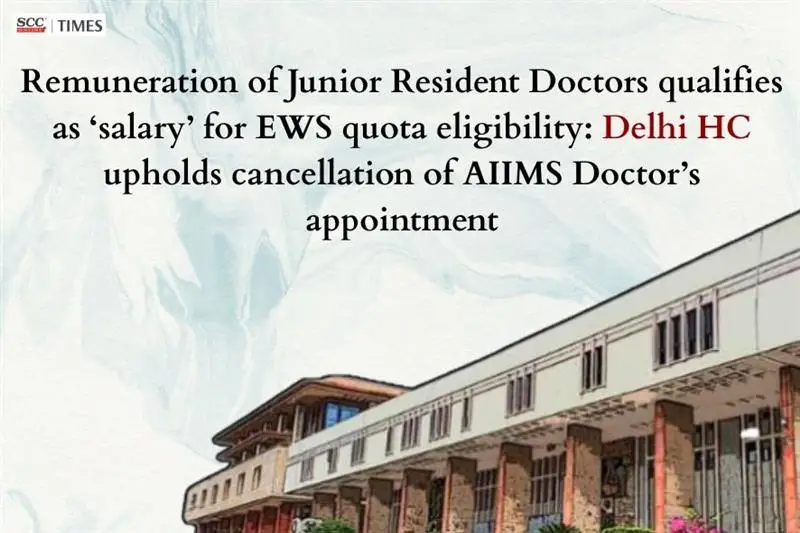
Delhi High Court: While hearing a petition assailing the correctness of the order dated 13-1-2026 (‘impugned order’) whereby the Central Administrative Tribunal (‘Tribunal’) had declared the Economically Weaker Section (‘EWS’) certificate submitted by the petitioner as invalid, the Division Bench of *Anil Kshetarpal, J and Amit Mahajan, J, held that remuneration received by the petitioner as a Junior Resident Doctor qualified as ‘salary’ for the purposes of ascertaining eligibility under the EWS quota. Since the remuneration so received crossed the ceiling for EWS criteria, the Court held the EWS certificate to be invalid and canceled the appointment of the petitioner for the post of Senior Resident.
Background
Respondent 1, AIIMS, had issued a prospectus dated 5-6-2024 inviting applications for engagement to the post of Senior Resident/Senior Demonstrator in various departments. This prospectus had also provided for reservation of posts in favour of candidates belonging to the EWS category. Pursuant to the same, the petitioner had applied for the post of Senior Resident (Ophthalmology) under the EWS category. Along with his application, the petitioner had furnished an EWS certificate issued by the competent authority certifying that his family income for the relevant financial year was within the prescribed threshold.
Upon completion of the selection process, a first merit list was prepared, and the first round of seat allocation had been undertaken by Respondent 1. As per the merit list, Respondent 2 had been placed at Rank 7 in the Unreserved category, whereas the Petitioner had been placed at Rank 19 under the EWS category. Respondent 2 could not secure a seat in the Unreserved category owing to the cut-off applicable to that category, whereas the Petitioner had been offered appointment against the EWS category vacancy.
Aggrieved by the selection and appointment of the petitioner under the EWS category, Respondent 2, through her father, had submitted representations to the Director, Assistant Controller of Examinations, and Registrar of AIIMS, contending that the petitioner was ineligible for consideration under the EWS category as his income for the relevant financial year exceeded the prescribed limit. It was alleged that the EWS certificate furnished by the petitioner was invalid, and a request was made for verification of his documents prior to declaration of the final result.
As no action was taken on the said representations, the father of Respondent 2 had filed an application under the Right to Information Act, 2005, seeking details of payments made to the petitioner and the corresponding income tax deductions for the financial year 2023-2024.
Subsequently, Respondent 1 had furnished Form-16 of the petitioner, reflecting a total taxable income of Rs. 13,59,032 for the financial year 2023-2024. Thereafter, Respondent 2 had sought cancellation of the petitioner’s appointment on the ground that the EWS certificate was false and that he was ineligible under the EWS category.
By the impugned order dated 13-1-2026, the Tribunal, declared the EWS certificate invalid, held that the remuneration received by the petitioner constituted income for determining EWS eligibility in accordance with the Office Memorandum dated 31-1-2019 (‘memo’) issued by the Department of Personnel and Training (‘DoPT’), and directed Respondent 1 to terminate his appointment as Senior Resident (Ophthalmology). The Tribunal had further directed that the post be offered to the next eligible EWS candidate and, failing such availability, be converted to the Unreserved category and offered to Respondent 2 in accordance with the applicable prospectus and merit list.
Analysis, Law and Decision
The Court noted that the memo, as adopted by Respondent 1 and incorporated in the prospectus dated 5-6-2024, prescribes an income ceiling of Rs. 8,00,000 per annum and mandates consideration of the ‘gross annual income from all sources’ of the candidate’s family. The subsequent clarification dated 19-9-2022 specifies that ‘gross annual income’ refers to income taken into account under the Income Tax Act, 1961 (‘Tax Act’). The policy framework thus leaves no scope for exclusion of income otherwise reflected for the relevant financial year.
The Court observed that the petitioner had received Rs. 13,59,032 during FY 2023-2024 while serving as Junior Resident, as reflected in Form-16 and pay slips which exceeds the prescribed income ceiling.
The Court further stated that the contention that the amount constituted a stipend and not income could not be accepted. The true character of a payment is determined by its substance and not nomenclature. The material on record demonstrated that the petitioner received fixed monthly remuneration, subject to tax deduction at source; pay slips were issued; and Form-16 reflected the amount as ‘gross salary’. The Court observed that the engagement was on contractual terms with salary and allowances under the applicable Pay Commission, coupled with service obligations and penalty conditions.
Thus, the Court opined that the issue in the instant case was not of the petitioner’s status as a government servant, but whether the amount received as remuneration constitutes ‘gross annual income’ for EWS eligibility which according to the Court, it did.
Furthermore, the Court observed that reliance on Section 10(16) of the Tax Act and precedents relating to tax exemption of stipends was misplaced. The question before the Tribunal was not taxability, but inclusion of income for determining eligibility under the EWS reservation framework, which operates in a distinct field. Exemption under the Tax Act does not govern eligibility under the EWS policy.
On the question of the jurisdiction of the Tribunal, the Court opined that the Tribunal acted within jurisdiction in examining the petitioner’s eligibility notwithstanding the interim stay on cancellation of the EWS certificate by the issuing authority. The Tribunal was concerned with eligibility in a service matter and was competent to assess whether the petitioner satisfied the prescribed criteria. The Court opined that the Tribunal’s finding that the certificate stood vitiated due to non-disclosure of income exceeding the threshold was based on the material-on-record and could not be termed perverse.
On the aspect of comparative merit, the Court noted that it was undisputed that Respondent 2 ranked higher in merit but failed to secure selection in the Unreserved category due to the cut-off. The petitioner’s appointment under the EWS category directly impacted her non-selection. The Court held that upon concluding that the petitioner was ineligible under the EWS category, the Tribunal’s consequential directions to restore the selection process in accordance with the prospectus and merit list were neither arbitrary nor disproportionate.
Accordingly, the Court held that the petitioner’s gross annual income exceeded the prescribed ceiling for eligibility under EWS category, the Tribunal had acted within its jurisdiction while determining the validity of the EWS certificate and the direction for termination of the petitioner’s appointment and consequential offer of appointment to Respondent 2 was in accordance with the law and was neither disproportionate nor arbitrary. Thus, the impugned order was found to be free from any patent illegality or perversity, and the Court found no ground to interfere with the same.
[Dr. Bahubali N. Shetti v. All India Institute of Medical Sciences, 2026 SCC OnLine Del 517, decided on 7-2-2026]
*Judgment Authored by: Justice Anil Kshetarpal
Advocates who appeared in this case :
For the Appellant: Amit George, Akshay Bhandari, Manu Jain, Rupam Jha, Medhavi Bhatia, Adhishwar Suri, Bhrigu A. Pamidighantam, Vaibhav Gandhi, Kartikay Puneesh, Advocates
For the Respondents: Anand Varma, Ayush Gupta, Shrey Kapoor, Nishit Agrawal, Kanishka Mittal, Deepti Rathi, Advocates