


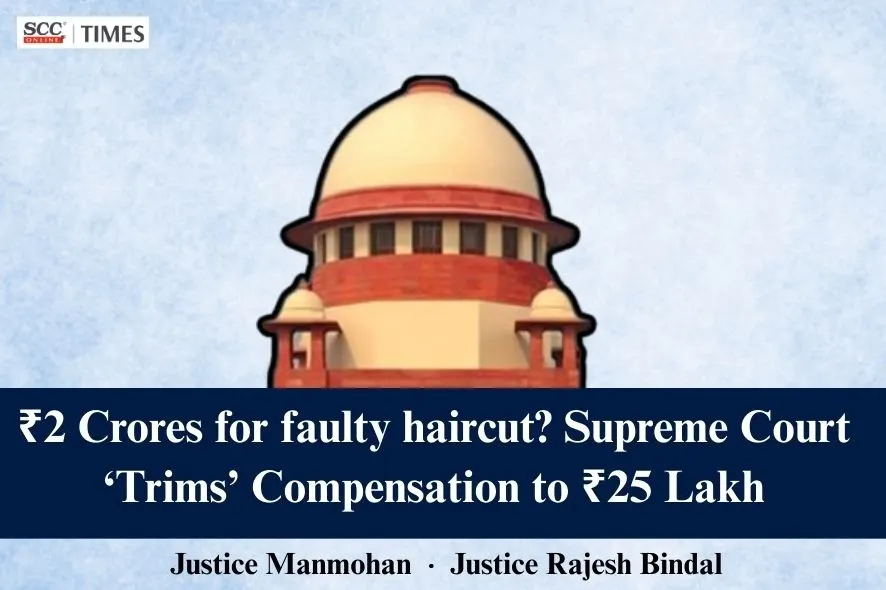
Supreme Court: In an appeal arising out of a consumer dispute in which the complainant alleged deficiency in service on account of an allegedly faulty haircut received at a beauty salon operated in a five-star hotel. While deficiency in service stood concluded against the service provider in earlier proceedings, the controversy before the Court was confined to the legality and justification of the quantum of compensation, particularly whether compensation amounting to ₹2 crores could be sustained in the absence of legally acceptable evidence of loss. A Division Bench of Manmohan and Rajesh Bindal,* JJ., modified the impugned order of the NCDRC to the extent that the compensation payable to the respondent was restricted to ₹25,00,000, being the amount already released pursuant to earlier orders.
The Court held that quantification of compensation in consumer disputes, particularly where claims run into crores, must rest on reliable, proved, and trustworthy evidence, and not on unverified photocopies, conjecture, presumptions or “whims and fancies of the complainant.”
Factual Matrix
On 12-04-2018, the respondent visited the beauty salon situated in the ITC Maurya Hotel, New Delhi, for a haircut. Alleging that her hair was cut much shorter than instructed, resulting in emotional trauma and professional setbacks, she filed a consumer complaint before the National Consumer Disputes Redressal Commission (NCDRC) in July 2018.
By order dated 21-09-2021, the NCDRC held the hotel guilty of deficiency in service and medical negligence and awarded compensation of ₹2,00,00,000. This order was challenged before the Supreme Court.
In the first round of litigation, the Supreme Court, by judgment dated 07-02-2023, upheld the finding of deficiency in service but set aside the compensation, observing that “there was no material placed on record by the respondent to justify her claim”. The matter was remanded to the NCDRC limited to reconsideration of quantum, with liberty to both parties to lead and rebut evidence.
After remand, the respondent enhanced her claim to ₹5.20 crores and filed an affidavit dated 21-02-2023, annexing photocopies of emails, alleged modelling offers, certificates, advertisements, medical prescriptions, and salary slips. The, by order dated 25-04-2023, once again awarded ₹2 crores with 9% interest, relying upon the NCDRC said material.
Aggrieved thereby, ITC Limited approached the Supreme Court in the present appeal.
Moot Points
-
Whether the NCDRC was justified in awarding compensation of ₹2 crores on the basis of photocopied and unproved documents?
-
Whether the principles of natural justice were violated by denial of opportunity to cross-examine the respondent and authors of the documents?
-
Whether the respondent had established any legally cognisable loss warranting such quantum of compensation?
Parties’ Contentions
The appellant contended that despite a clear direction in the earlier judgment that “quantification of compensation has to be based upon material evidence and not on the mere asking”, the respondent failed to adduce admissible evidence. All documents relied upon were photocopies, denied by the appellant, with no originals produced, no authors examined, and no commission sought for their examination.
It was urged that the respondent never entered the witness box, depriving the appellant of the right to cross-examine. The salary slips demonstrated that she remained in the same employment at the same pay both before and after the haircut. It was alleged that modelling and film offers were vague, undated, unsupported by proof of payment, and bore no nexus to the alleged deficiency.
The appellant submitted that damages of such magnitude cannot be awarded on conjectures and surmises, especially when the claim itself kept escalating without foundational pleadings or proof.
On the other hand, the respondent asserted that her professional career and self-confidence were irreparably damaged. She emphasised that consumer forums are meant to be consumer-friendly and not bound by technicalities. It was contended that the appellant failed to summon witnesses to disprove her documents and that denial of compensation would amount to grave injustice after years of litigation.
Court’s Analysis
Upon examination of the material produced after remand, the Court noted that all documents relied upon by the respondent were photocopies. None of the authors of those documents were examined, nor was any commission sought for their examination. Even the respondent herself did not enter the witness box in a manner that would permit cross-examination.
The Court reaffirmed that while the strict provisions of the Evidence Act do not apply to consumer proceedings, compliance with principles of natural justice is mandatory. It noted that all documents relied upon by the respondent were photocopies, categorically denied by the appellant, and yet no steps were taken to prove their authenticity.
“It is well-settled that the provisions of the Indian Evidence Act, 1872 (Bharatiya Sakshya Adhiniyam, 2023) are not strictly applicable for proceedings under the 1986 Act. The Commission is, however, bound to comply with the Principles of Natural Justice, save and except as laid down in sub-section (4) of Section 13 of the 1986 Act.”
The Court observed that “the manner in which the photocopies thereof are sought were produced do not inspire confidence especially where the claim of damages is made for crores of rupees.” It was noted that several documents pre-dated the haircut, others post-dated it by years, and none established a causal link between the haircut and the alleged professional losses.
Reiterating settled law, the Court held that “damages cannot be awarded merely on presumptions or whims and fancies of the complainant.” The Court asserted that the present case was not a case involving a minor or routine consumer grievance where compensation could be assessed by applying a thumb rule. The claim being of an exceptionally high magnitude, it required trustworthy and reliable evidence of actual loss, which was conspicuously absent.
The Court rejected the NCDRC’s reasoning that trauma may have prevented preservation of originals as an insufficient justification. The Court found that even after remand, the respondent “has not been able to make out a case for award of such huge compensation.”
Court’s Decision
The Court partly allowed the appeal, modified the impugned order of the NCDRC to the extent that the compensation payable to the respondent was restricted to ₹25,00,000, being the amount already released to her pursuant to earlier directions of the Supreme Court.
[ITC Limited v. Aashna Roy, 2026 SCC OnLine SC 168, Decided on 06-02-2026]
*Judgment by Justice Rajesh Bindal
Compensation for non pecuniary damages should be rational. Triming by Apex Court is reasonable.