Disclaimer: This has been reported after the availability of the order of the Court and not on media reports, so as to give an accurate report to our readers.
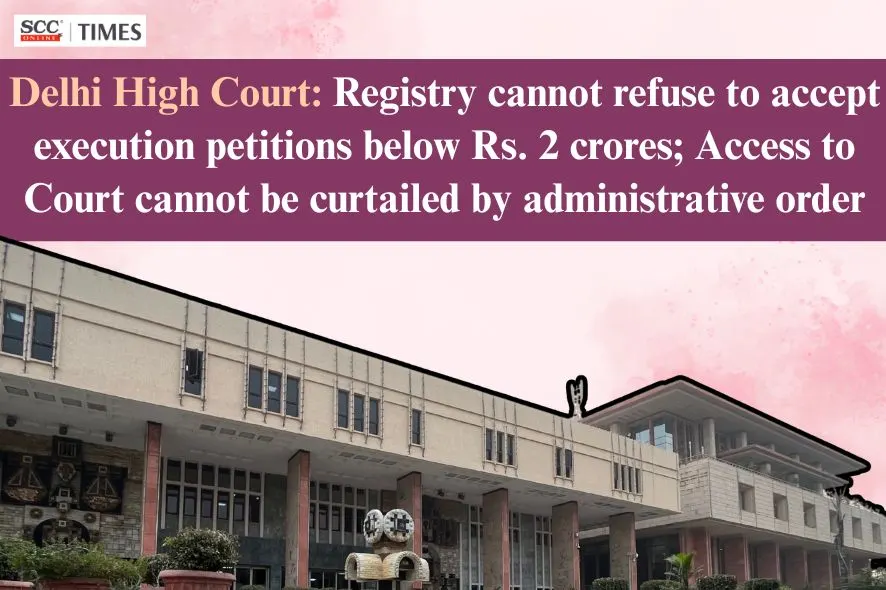
Delhi High Court: In a writ petition challenging an administrative order issued by the Registry declining to accept execution petitions where the amount of the decree was Rs. 2 crores or less, the Division Bench of C. Hari Shankar* and Om Prakash Shukla, JJ., partly allowed the petition, holding that such a threshold bar was impermissible in law. The Court ruled that while objections as to jurisdiction may be raised, the Registry could not refuse to register proceedings; the question of maintainability must be decided by the Court. Accordingly, the impugned administrative order was set aside to that extent.
Background
The petitioner assailed an Administrative Order dated 17-11-2016 issued by the Registrar (Original), directing the Registry not to accept fresh execution petitions in cases where money decrees were for a sum up to Rs. 2 crores. This was done on the ground that, consequent to the enhancement of pecuniary jurisdiction under the Delhi High Court (Amendment) Act, 2015, (“DHC Act”), the jurisdiction for such matters was with the District Courts. The order also contemplated the transfer of pending execution petitions of such valuation. to the respective District Courts
The petitioner contended that under Section 37 of the Civil Procedure Code, 1908 (“CPC”), read with the Explanation thereto, the Court which passed the decree does not cease to have jurisdiction merely because of a subsequent change in pecuniary limits, and that both the High Court and the District Court may possess concurrent jurisdiction to entertain execution.
Per contra, the Delhi High Court submitted that the administrative order merely sought to give effect to the amended pecuniary jurisdiction under the DHC Act.
Issues:
Whether the Registry of the Delhi High Court can refuse to accept or register fresh execution petitions where the decretal amount is Rs. 2 crores or less?
Analysis
The Court gave two-pronged reasons for its holding in the case:
Firstly, the Court examined whether the impugned direction/order was traceable to a statutory authority. It noted that Section 4 of the DHC Act merely enables the transfer of pending proceedings, it does not contemplate or authorise the imposition of a threshold prohibition on the institution of fresh proceedings. Importantly, the provision does not empower the Registry to refuse acceptance of filings. Consequently, the Court held that the impugned administrative order, insofar as it barred acceptance of petitions, was unsustainable in law.
Secondly, the Court stated that, based on first principles, a litigant cannot be prevented from filing a proceeding before the Registry. The Registry may scrutinise filings and raise objections, including on jurisdiction; however, it cannot refuse registration. Where disagreement between the Counsel and the Registry persists, the matter must be placed before the Court for adjudication. The Court reasoned that if a frivolous proceeding has been filed, or the jurisdiction of a court was being forcibly invoked, then the Court could issue deterrent directions, such as awarding costs but, there can never be any threshold bar to a party.
The Court remarked that, “There are cases, fortunately extremely few and far between, in which a litigant is found to be so cantankerous, or incorrigible, that he files, one after another, one frivolous litigation after another.”
Thus, the Court held that there could be no threshold bar to access to a court, and the impugned order was unsustainable to the extent that it directed refusal of filings.
Furthermore, the Court refused to issue any pre-emptive clarificatory directions regarding the jurisdiction of the Court to entertain the matter, holding that the aspect of jurisdiction should be left to the Executing Court.
In this context, the Court distinguished between “filing” and “entertainment” of proceedings. The Court relied on Lakshmi Rattan Engineering Works Ltd. v. CST 1967 SCC OnLine SC 140, which approved the view of the Allahabad High Court in Kundan Lal v. Jagan Nath Sharma 1962 SCC OnLine All 38 , and reiterated that “entertainment” refers to the stage when the Court applies its mind to the matter, and not to the mere act of presentation or admission of the filing. Thus, the Court held that the power to entertain a petition or not lies with the Court which hears it on the judicial side.
Therefore, the Court held that the direction to the Registry not to accept execution petitions below Rs. 2 crores was unsustainable in law. The question of jurisdiction or maintainability of such petitions was to be decided by the competent Court on the judicial side.
“t would be open to the Registry to raise an objection with respect to jurisdiction, as it always is. However, if the litigant insists that the petition does lie, the Registry would be duty bound to list the matter before the Court on the judicial side, for a view to be taken in that regard.”
Accordingly, the Court allowed the petition partly by setting aside the impugned administrative order to the extent it directs the Registry not to accept execution petitions with decretal value of less than Rs. 2 crores.
[Asian Patent Attorneys Association (Indian Group) v. Delhi High Court, 2026 SCC OnLine Del 360, decided on 30-01-2026]
Judgment authored by: Justice C. Hari Shanker
Advocates who appeared in this case:
For the petitioner: Sr. Adv. Swathi Sukumar, Shrawan Chopra, Vibhav Mithal, Achyut Tewari, Krisha Baweja and Ritik Raghuvanshi
For the respondent: Dr Amit George, Adhishwar Suri, Bhrigu A. Pamidighantam, Vaibhav Gandhi, Rupam Jha, Medhavi Bhatia and Kartikey Puneesh