
Disclaimer: This has been reported after the availability of the order of the Court and not on media reports, so as to give an accurate report to our readers.
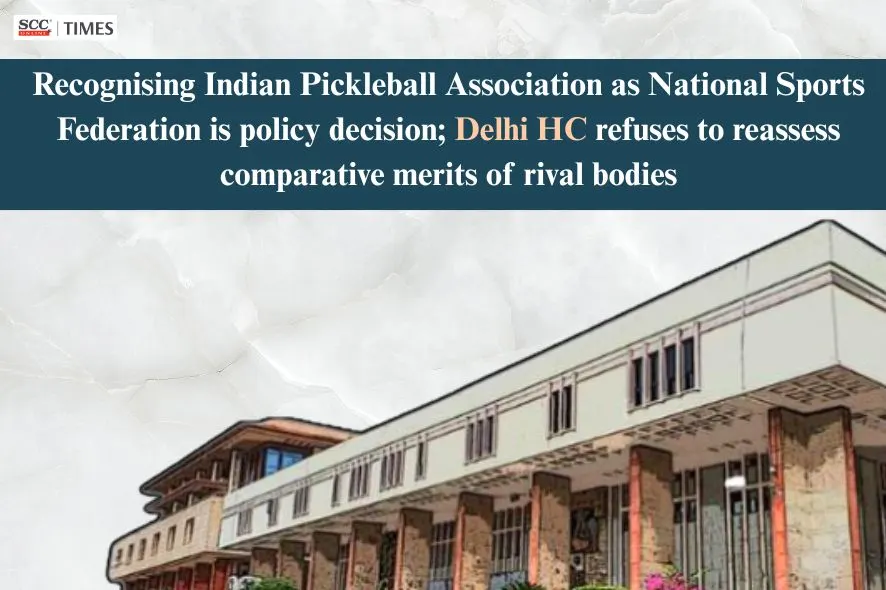
Delhi High Court: In a writ petition filed by the All India Pickleball Association (‘AIPA’) challenging the decision of the Ministry of Youth Affairs and Sports to recognise the Indian Pickleball Association (‘IPA’) as the National Sports Federation (‘NSF’) for pickleball, a Single Judge Bench of Sachin Dutta, J., held that recognition of an NSF is a policy decision within the domain of the executive and that judicial review cannot extend to reassessing the comparative merits of rival associations unless the decision is shown to be arbitrary or mala fide.
Background
The petitioner is an association incorporated in 2008, which claimed long-standing involvement in the promotion of pickleball in India and asserted that it had organised national championships, affiliated State units, and international linkages. It applied to the Ministry on 18-10-2024 seeking recognition as the NSF.
However, by order dated 25-04-2025, the Ministry recognised IPA as the NSF. While doing so, the Ministry relaxed two conditions under the National Sports Development Code of India, 2011 (‘Sports Code’), namely the requirement of three years’ prior existence and the requirement that State units have 50% affiliated district associations. The recognition was made conditional and subject to observation, compliance audits, and annual review.
Aggrieved by this decision, the petitioner contended that IPA was recently incorporated, did not meet mandatory eligibility requirements, and had been granted arbitrary exemptions. It was argued that the Ministry had failed to consider the petitioner’s application and had acted in violation of binding precedents requiring adherence to the Sports Code.
Per contra, the respondents contended that both applications were examined comparatively and that IPA demonstrated better compliance with governance norms, athlete representation, and nationwide presence. They relied upon the Relaxation Clause introduced into the Sports Code in 2021, which empowers the Government to grant exemptions where necessary and expedient for the promotion of sports.
Analysis:
1. Whether the Ministry of Youth Affairs and Sports was empowered under the National Sports Development Code of India, 2011, to relax eligibility conditions and grant recognition to the Indian Pickleball Association as the National Sports Federation for pickleball.
The principal contention of the petitioner was that the recognition granted to the IPA was contrary to the Sports Code and that the Ministry could not have relaxed the eligibility requirements prescribed therein. The Court noted that this argument was premised on an assumption that the provisions of the Sports Code were inflexible and incapable of exemption. The Court rejected this premise at the threshold.
The Court observed that the Sports Code is not a statutory enactment, but a consolidated body of executive instructions framed by the Ministry of Youth Affairs and Sports in exercise of executive power under Article 73 of the Constitution. The Court stated that, given the policy-driven and non-statutory nature, it cannot be construed as immutable or incapable of incorporating exemptions in every circumstance. The Court held that the Code must be interpreted in line with the principles of reasonableness and proportionality to further the objective of sports development.
Addressing the challenge to the Relaxation Clause introduced by notification dated 01-02-2021, the Court held that the validity of such a clause already stood examined by a Coordinate Bench in Rajasthan Equestrian Association v. Union of India 2025 SCC OnLine Del 14 wherein the executive’s authority to provide for exemptions was expressly upheld. Therefore, the Court observed that the Relaxation Clause constitutes a policy mechanism intended to address practical difficulties in implementing the Sports Code and permits flexibility in cases where “necessary and expedient”.
In this context, the Court also referred to the decision of the Supreme Court in Shiv Sagar Tiwari v. Union of India (1997) 1 SCC 444, wherein it was held that the discretionary power vested in the executive is not unfettered and is bound by the principles of accountability, transparency and adherence to the objectives of the Sports Code.
Applying these principles, the Court observed that pickleball is a nascent and evolving sport. The Court recognised that insisting on mechanical application to nascent sports would be “fundamentally flawed and tantamount to treating un-equals as equals.”
2. Whether the Court could reassess the comparative merits and suitability of rival associations for recognition as the National Sports Federation.
Having upheld the legal basis and rationale on which the relaxation in the Sports Code may be granted by the executive, the Court proceeded to consider whether the relaxations granted to IPA were arbitrary. The Court noted the Ministry’s explanation that pickleball is a nascent and emerging sport and that certain structural requirements under the Sports Code, such as long prior existence, extensive district-level penetration, and mature infrastructure, are framed keeping in mind legacy or established sports. The Court accepted the Ministry’s position that pedantic application of the Sports Code on these requirements for emerging disciplines would create incongruous and counter-productive results.
The Court further recorded that the Ministry had granted only two limited exemptions: first, the three-year existence requirement and second, the 50% district-level affiliation requirement. The Court held that these were policy considerations falling within the Ministry’s domain
On the comparative merits of the rival bodies, the Court noted that the Ministry had assessed the compliance status of IPA with several governance requirements under the Sports Code, including age and tenure norms, athlete representation, election procedures, ethics mechanisms, and anti-doping safeguards. The Court held that such comparative evaluation and assessment of suitability is an administrative and executive function and not within the province of judicial scrutiny. The Court expressly observed that it cannot “sit in appeal” over the Ministry’s assessment or undertake a fact-finding exercise regarding the relative credentials of the competing associations.
Another factor emphasized by the Court was that recognition under the Sports Code is not permanent. The Court referred to the provisions relating to annual recognition, periodic review, and withdrawal or suspension of recognition. It held that the scheme itself contemplates continuous monitoring and enables the Ministry to revisit recognition if conditions are not fulfilled. Consequently, the grant of relaxation or recognition at one stage does not create irreversible consequences.
In light of the aforementioned analysis, the Court disposed of the writ petition. It held that the Relaxation Clause to be valid and the exemptions granted to IPA were within the policy domain of the Ministry, exempting judicial scrutiny.
[All India Pickleball Association v. Union of India, 2026 SCC OnLine Del 467, Decided on 02-02-2026]
Advocates who appeared in this case:
For the petitioner: Senior Advocate Mr Dayan Krishnan, Advocate Mr Gautam Narayan, Advocate Mr Hemant Phalpher, Advocate Mr R. A. Iyer, Advocate Ms Disha Joshi and Advocate Mr Sukrit Seth.
For the respondent: Senior Advocate Mr Jayant Mehta, Advocate Ms Arunima Dwivedi, CGSC, Advocate Mr Aakash Pathak, GP, Advocate Ms Pinky Pawar, Advocate Mr Sainyam Bhardwaj