
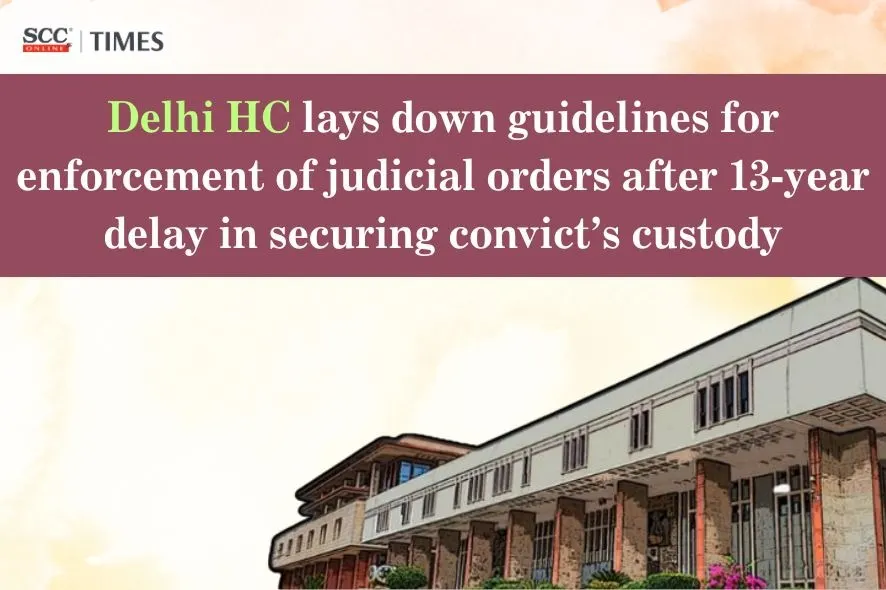
Delhi High Court: While hearing an appeal against the order of conviction dated 24-1-2009 (‘impugned order’), whereby the Trial Court had sentenced the appellant-convict to undergo life imprisonment for offences punishable under Sections 302, 397 and 34 read with Section 120-B of the Penal Code, 1860 (‘IPC’), the Division Bench of Navin Chawla, J and Ravinder Dudeja, J, expressed concern over the inordinate delay of 13 years in securing custody of the convict and laid down guidelines for ensuring enforcement of judicial orders.
Background
By an order dated 31-1-2009, the Trial Court had sentenced the convict to imprisonment for life along with payment of fine. Aggrieved by the conviction and sentence, the convict had preferred a criminal appeal before the Court in 2009.
During the pendency of the appeal, the Court had granted suspension of sentence to the convict for a limited period of two months by order dated 13-12-2010. Pursuant thereto, the convict had furnished the requisite bail bonds, which were accepted by the Trial Court. However, after the expiry of the suspension period, the convict had not surrender to custody.
Subsequently, the Court had dismissed the criminal appeal by judgment dated 19-9-2012, thereby affirming the conviction and sentence imposed by the Trial Court. Despite dismissal of the appeal, the convict remained at liberty for an extended period.
A status report submitted by the Superintendent of Jail had revealed that the convict was arrested only on 13-10-2025 and thereafter committed to prison to serve the remaining sentence. The report did not specify the steps, if any, taken by the authorities over the intervening thirteen years to secure the convict’s custody.
Analysis, Law and Decision
The Court expressed serious concern over the inordinate delay of approximately 13 years in securing the custody of the convict after dismissal of his criminal appeal. The Court observed that the convict had remained at liberty despite the finality of his conviction and sentence, which revealed significant failures in post-conviction supervision and coordination among the Trial Court, jail authorities, and the police machinery. The Court opined that such lapses weakened the enforcement of judicial orders and adversely affected the credibility of the criminal justice system.
In order to prevent recurrence of such situations and to strengthen institutional accountability, the Court issued the following guidelines to be strictly followed by all concerned authorities:
-
Upon passing any order granting interim bail or suspension of sentence, the Registry was required to immediately communicate such order to the concerned Trial Court, the Superintendent of Jail, and the jurisdictional police station.
-
Where suspension of sentence or interim bail was granted for a fixed period, the Trial Court, upon acceptance of the bail bond, was required to clearly fix and record the date of surrender and to list the matter immediately after the expiry of the said period.
-
The Superintendent of Jail was made responsible for informing the Trial Court, which had accepted the bail bond, as to whether the convict had surrendered upon completion of the stipulated period of interim bail or suspension of sentence.
-
In the event the convict failed to surrender on the due date and no order extending the suspension of sentence or interim bail existed, the Trial Court was required to take all appropriate steps permissible in law to secure the arrest of the convict and commit him to prison.
-
In cases where an appeal filed by a convict was dismissed while the convict was on bail, or where an appeal filed by the State or complainant against acquittal was allowed, the Superintendent of Jail was directed to immediately inform the Trial Court regarding the surrender status of the convict, and the Trial Court was required to take necessary action to ensure that the convict was taken into custody to serve the sentence.
Accordingly, the Court dismissed the appeal.
[Sonu @ Sonu Singh @ Gopal v. State NCT Delhi, 2026 SCC OnLine Del 420, decided on 27-1-2026]
Advocates who appeared in this case:
For the Appellant: Harsh Prabhakar, Standing Counsel, Rakhi Dubey, Advocate
For the Respondent: Aman Usman, APP, Manvendra Yadav, Atiq Ur. Rehman, Advocates Insp. Ashwani
Buy Penal Code, 1860 HERE