
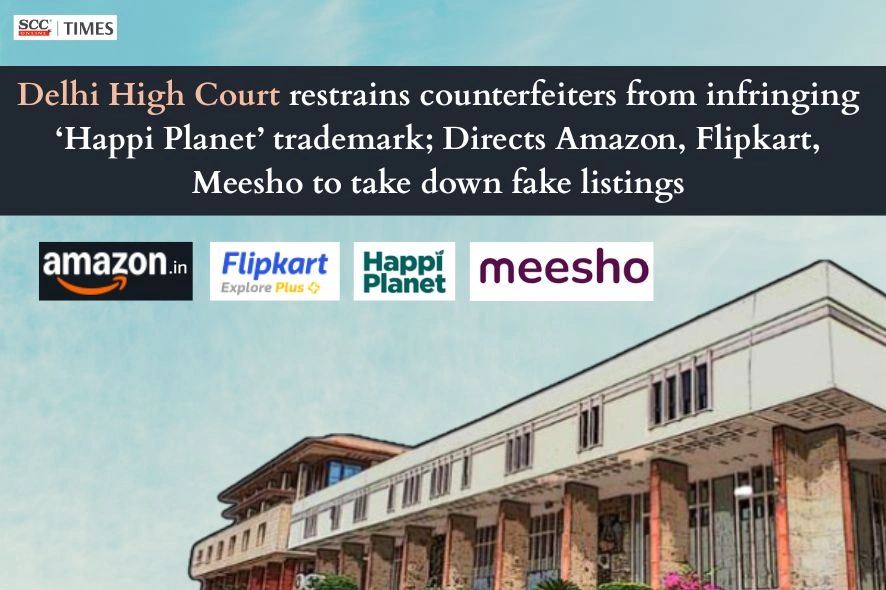
Delhi High Court: An application was filed by Happi Planet Eco Products Pvt. Ltd. (plaintiff) seeking exemption from instituting Pre-Institution Mediation under Section 12A of the Commercial Courts Act, 2015 (“CC Act”), along with seeking an ex parte ad-interim injunction against rampant trademark infringement, counterfeiting, and misuse of the plaintiff’s trade dress on e-commerce platforms. Tushar Rao Gedela, J., restrained defendants 1 to 7 from using in any manner plaintiff’s well-known brand trademarks “Happi Planet” and the distinctive packaging/proprietary trade dress, including inter alia HAPPY PLANET, HIPIPA PLANET et al, and/or plaintiff’s copyright in the artistic work, packaging and trade dress.
The Court, placing reliance upon the Supreme Court decision in Yamini Manohar v. T.K.D. Keerthi, (2024) 5 SCC 815, granted exemption, observing that where urgent interim relief is sought, the requirement of pre-institution mediation cannot operate as a bar.
The plaintiff, Happi Planet Eco Products Private Limited, claims to have conceived and commenced its business in the personal and home care segment under the distinct branding and identity “Happi Planet”. It asserts that it established its market presence through the sale and promotion of products under the said brand, including through its domain name www.happi-planet.com. The plaintiff claims to have launched the first commercial use of the trademark “Happi Planet” on 01.11.2021, followed by incorporation in January 2022. On 11.03.2022, the plaintiff filed an application for registration of the word mark “Happi Planet” in Class 3, claiming use since 01.11.2021. On the strength of the popularity and success of the brand, the plaintiff claims to have received significant venture capital funding from reputed investors.
The plaintiff further claims to have established a distinct market presence by offering eco-friendly home care solutions that are free from harmful toxins and certified “Readily Biodegradable” as per OECD 301 standards. It placed on record its commercial growth, stating that annual revenue figures rose from Rs. 0.46 crores in FY 2022—23 to Rs. 36.37 crores by FY 2025—26. Apart from its own e-commerce website, the plaintiff’s products were stated to be sold through major platforms such as Amazon, Flipkart and Zepto, with offline expansion through retail stores in Delhi, Mumbai and Bangalore. The plaintiff also claimed extensive brand-building through influencer engagement, digital marketing and advertising campaigns, with marketing expenditure reaching approximately Rs. 14.01 crores by FY 2025—26.
A key facet of the plaintiff’s claim was its adoption of a distinctive packaging style with unique colour schemes, visual motifs and an overall distinctive presentation. The plaintiff asserted that this distinctive trademark and trade dress constituted a valuable intellectual property, developed through “considerable effort, creativity and commercial insight.” According to the plaintiff, the packaging and overall get-up of its products had acquired substantial goodwill and consumer association, making it an identifiable brand in the competitive home-care market.
So far as the defendants are concerned, the plaintiff contended that Defendant 1 to 7 were counterfeiters who were not only selling sub-standard products resulting in dilution of the plaintiff’s goodwill and reputation, but were also violating the trademark “Happi Planet” and infringing copyrights in the original artistic work of its packaging and trade dress. The plaint attempted to demonstrate misuse and infringement by Defendant 1 to 7 through the sale of inferior products in “near identical/deceptively similar or identical trade dress and packaging.”
The plaintiff claimed that on conducting a detailed market investigation and online test purchases, it was revealed that several infringing products were being offered for sale on e-commerce platforms by entities whose identities were concealed or fictitiously presented. Such products, according to the plaintiff, bore striking similarity in packaging, trade dress and overall presentation to the plaintiff’s goods. The plaintiff submitted that e-commerce platforms had permitted hundreds of third parties to sell counterfeit and infringing products over their marketplaces, and despite issuance of notices, only limited takedowns were undertaken.
The plaintiff asserted that such large-scale and rampant sale of counterfeit goods had caused and continued to cause irreparable harm, loss and injury to its business, goodwill and intellectual property rights. It was claimed that the defendants were engaging in illicit trade and “riding on the back of the plaintiff’s goodwill and reputation.” The plaintiff also warned that if counterfeit products were not restrained, they could pose serious health risks to consumers, while significantly damaging the plaintiff’s brand reputation, goodwill, and consumer trust painstakingly built over time. Accordingly, the plaintiff prayed that an ex parte ad-interim injunction be passed against Defendant 1 to 7 and that directions be issued for taking down listings against Defendant 8 to 11.
The Court observed that having heard the counsel for the plaintiff and upon perusing the plaint and records, it was of the prima facie opinion that an ex parte ad-interim injunction was warranted. The Court noted that the counsel had handed over the Bench the products manufactured and sold by the plaintiff on one hand, and those being manufactured and offered for sale by Defendant 1 to 7 on the other.
The Court stated that upon comparison, “not only do the infringing products contain the trademark ‘Happi Planet’ of the plaintiff but also are packaged in near identical or deceptively similar packaging and trade dress.” The Court analysed the extent of similarity and remarked that “the artistic work, the trade dress and packaging is so identical that it took a while for this Court to distinguish between the two.”
The Court held that the plaintiff had established a prima facie strong case. Keeping in view the fact that the plaintiff was the owner of registered copyrights in its original artistic works, packaging and trade dress, and had already applied for registration of its trademark “Happi Planet,” the balance of convenience was found to be tilted in favour of the plaintiff. The Court further held that if restraint orders were not passed, the harm to credibility, goodwill, reputation and product standards would not be compensable in monetary terms alone.
Thus, the Court directed:
-
Defendant 1 to 7 were restrained from using in any manner the plaintiff’s well-known trademarks “Happi Planet” and its distinctive packaging/trade dress, including variants such as HAPPY PLANET and HIPIPA PLANET.
-
Defendant 8 to 11 (Amazon, Flipkart, Meesho and Jiomart) were directed to block and suspend infringing listings, delist counterfeiters, and blacklist third parties found infringing upon the plaintiff’s intellectual property.
-
Since the injunction was declared dynamic in nature, the plaintiff was permitted to directly furnish infringing listings to the platforms, which were required to take them down forthwith without further Court intervention.
-
The platforms were also directed to furnish Basic Subscriber Information (BSI) details through compliance affidavits within two weeks.
[Happi Planet Eco Products Pvt. Ltd. v. Ravi Malani, 2026 SCC OnLine Del 351, decided on 28-01-2026]
Advocates who appeared in this case:
Mr. Chander M. Lall, Senior Advocate alongwith Mr. Subhash Bhutoria, Ms. Anuja Negi, Ms. Annanya Mehan and Mr. Tushar Gulati, Advocates for plaintiff Mr. Deepak Singh, Advocate for D-1. Mr. Manas Raghuvanshi, Advocate for D-8.
Mr. Saikrishna Rajagopal, Mr. Vivek Ayyagari and Mr. Abhay Aren, Advocates for Meesho/D-10.
Mr. Jayant Malik and Mr. Nishant Shokeen, Advocates for D-11.
Ms. Nidhi Raman, CGSC alongwith Mr. Om Ram and Mr. Arnav Mittal, Advocates for CCPA(UOI)/D-12.
Mr. Sumit Nagpal, SPC alongwith Mr. Sarthak Rana, G.P. for D-13