
Disclaimer: This has been reported after the availability of the order of the Court and not on media reports so as to give an accurate report to our readers.
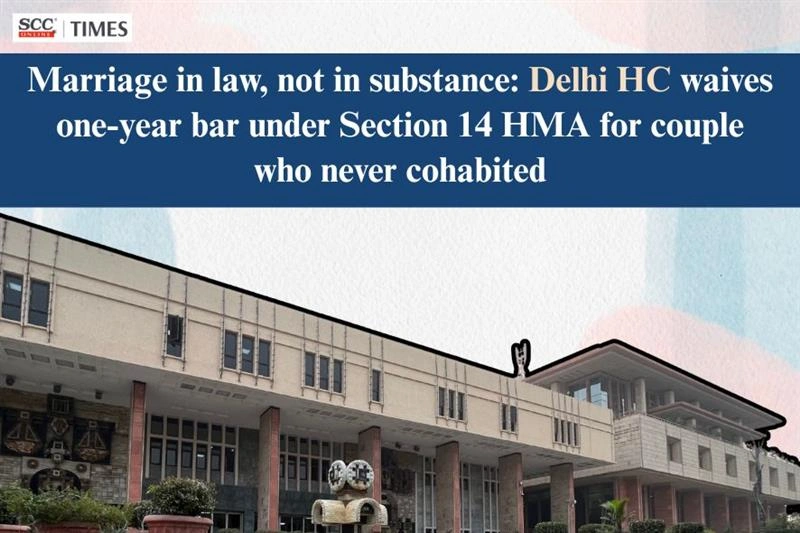
Delhi High Court: In an appeal filed under Section 19 of the Family Courts Act, 1984 read with Section 28 of the Hindu Marriage Act, 1955 (HMA), challenging the Family Court’s order dated 09-12-2025 wherein it held that parties had failed to establish a case of “exceptional hardship” and that they had not made sufficient efforts to preserve the marriage, a Division Bench of Vivek Chaudhary and Renu Bhatnagar, JJ., held that considering the circumstances of present cases insistence on completion of one year would serve no meaningful purpose and would amount to exceptional hardship justifying waiver of one-year bar under HMA. The Court set aside the Family Court’s order and granted leave to the parties to present their joint petition for divorce by mutual consent under Section 13-B(1) HMA.
In the instant matter, the parties were married on 30-03-2025 at Arya Samaj Mandir, Khirki Village, New Delhi. The marriage was subsequently registered on 02-04-2025 before the Office of the District Magistrate, South, New Delhi. It was an admitted position that “the parties never cohabited even for a single day, the marriage was never consummated, and immediately after the marriage, both parties continued to reside separately at their respective parental homes.”
Owing to irreconcilable differences and complete incompatibility discovered immediately after marriage, the parties jointly decided to seek dissolution of marriage by mutual consent. Since the joint petition under Section 13-B(1) of the HMA was presented within seven months of marriage, they filed an application under Section 14 HMA seeking leave to present the petition prior to the expiry of one year.
The Family Court declined to grant leave and held that the parties had failed to establish a case of “exceptional hardship” within the meaning of the proviso to Section 14(1) so as to permit presentation of a petition for divorce by mutual consent before completion of one year of marriage and that they had not made sufficient efforts to preserve the marriage. It further observed that registration of marriage shortly after solemnization diluted their claim of hardship.
The parties submitted that the respondent was residing in Canada while the appellant was residing in India. The appellant was required to take care of her aged parents and was neither willing nor in a position to relocate, while the respondent was also unable to relocate to India. These circumstances were stated to be unavoidable and beyond their control, resulting in their continued separation and leaving “no realistic or practical possibility of resumption of matrimonial life.”
The relevant statutory provisions and precedents relied on —
-
Section 13-B(1) of HMA — divorce by mutual consent after one year of separation.
-
Section 14 of HMA — bar on filing divorce petition within one year, with proviso permitting waiver in cases of “exceptional hardship” or “exceptional depravity.”
-
Shiksha Kumari v. Santosh Kumar (MAT.APP.(F.C.) 111/2025, decided on 17.12.2025), which clarified that the one-year period under Section 13-B(1) can be waived by invoking the proviso to Section 14(1), subject to proof of exceptional hardship.
The Court noted that the admitted facts showed that the parties had never cohabited, the marriage had never been consummated, and they had lived separately since inception. There were no children from the wedlock and no reasonable probability of their living together in future. The Court asserted that these facts “strike at the very foundation of a subsisting matrimonial relationship.”
The Court observed that insisting upon continuation of a marriage which exists only in law and not in substance would amount to compelling the parties to endure a relationship devoid of matrimonial foundation, thereby causing avoidable hardship rather than advancing the object of the statute.
The Court rejected the Family Court’s reasoning that registration of marriage negated the claim of hardship. The Court held that “registration of marriage is merely a statutory mandate, and by itself, cannot be determinative of matrimonial harmony, intention to cohabit, or the viability of the marital relationship.”
The Court further found the finding that insufficient efforts were made to save the marriage as unsustainable, as “where the marriage has never been acted upon by the parties through cohabitation, the question of saving such a marriage does not meaningfully arise.”
Considering that the parties resided in different countries, had never lived together, and there was no possibility of reconciliation, coupled with the appellant’s obligation to care for her aged parents, the Court held that insisting on completion of the statutory period would only prolong a marriage that existed merely in law and not in substance, thereby causing “exceptional hardship” within the meaning of Section 14(1) HMA.
The Court allowed the appeal and set aside the Family Court’s order dated 09-12-2025. The Court allowed the application under Section 14 HMA and granted leave to the parties to present their joint petition for divorce by mutual consent under Section 13-B(1) HMA forthwith, without waiting for expiry of one year from the date of marriage. The Court remanded the matter to the Family Court to proceed with the petition under Section 13-B HMA expeditiously.
[Nupur Garg v. Dwarkesh Ahuja, 2026 SCC OnLine Del 291, Decided on 20-01-2026]
Advocates who appeared in this case:
Mr. Abhishek Wadhwa, Mr. Somyaa Gurung and Mr. Saurabh Yadav, Counsel for the Appellant
Mr. Dhiraj Bhiduri, Counsel for the Respondent